Quick answer
Use a tabletop art center as a dedicated learning station: guide your child through color sorting, shape tracing, and free drawing, while using the chalkboard and dry-erase surfaces to reinforce recognition.
Why a tabletop art center works for early learning
A tabletop art center gives toddlers a dedicated, age-appropriate space to explore colors and shapes without the mess spreading across the whole room. Because it sits on a table, it's easy to supervise and lets you sit beside your child, making it natural to talk about what they're creating.
The variety of surfaces—paper roll, chalkboard, and magnetic dry-erase board—invites different kinds of play. That variety keeps young children engaged longer than a single coloring page, and it gives you multiple ways to introduce the same color or shape concept.
Trade-off: structured activities vs. free play
While structured color and shape lessons are useful, toddlers learn best when they also have time for open-ended exploration. If you only use the art center for formal drills, your child may lose interest. Balance short, guided activities with plenty of free drawing time.
The PAW Patrol Wooden Tabletop Art Center is designed for both: the paper roll invites free drawing, while the chalkboard and dry-erase surfaces are perfect for guided tracing and matching games.
Step-by-step: color and shape activities
- Start with color sorting on the dry-erase board: Draw colored circles or squares on the dry-erase surface and ask your child to place a magnetic item (like the compass base) on each one as you call out the color. Checkpoint: If your child struggles, reduce to two colors before adding more.
- Trace shapes on the chalkboard: Draw a large shape (circle, square, triangle) on the chalkboard and have your child trace over it with chalk, naming the shape as they go. Checkpoint: Keep shapes large and simple; avoid perfection—tracing is about recognition, not precision.
- Use the paper roll for color-and-shape drawing prompts: Tear off a sheet and ask your child to draw a red circle, then a blue square, giving verbal prompts and praising each attempt. Checkpoint: If your child mixes up colors, gently repeat the name and point to the crayon or marker they used.
- Create a matching game with the activity sheets: Use the included activity sheets to have your child match shapes or colors by pointing or drawing lines, turning it into a game. Checkpoint: Celebrate correct answers with high-fives, but never scold mistakes—encourage trying again.
- End with free drawing time: Let your child draw whatever they like on the paper roll or dry-erase board, and ask open-ended questions like 'What color is that?' or 'What shape did you make?' Checkpoint: This reinforces learning in a low-pressure way and builds confidence.
Product spotlight
-
PAW Patrol Wooden Tabletop Art Center: This compact tabletop easel includes a paper roll, a chalkboard, a magnetic dry-erase surface, and activity sheets. The multiple surfaces let you switch between color sorting, shape tracing, and free drawing, keeping lessons fresh and engaging for toddlers.
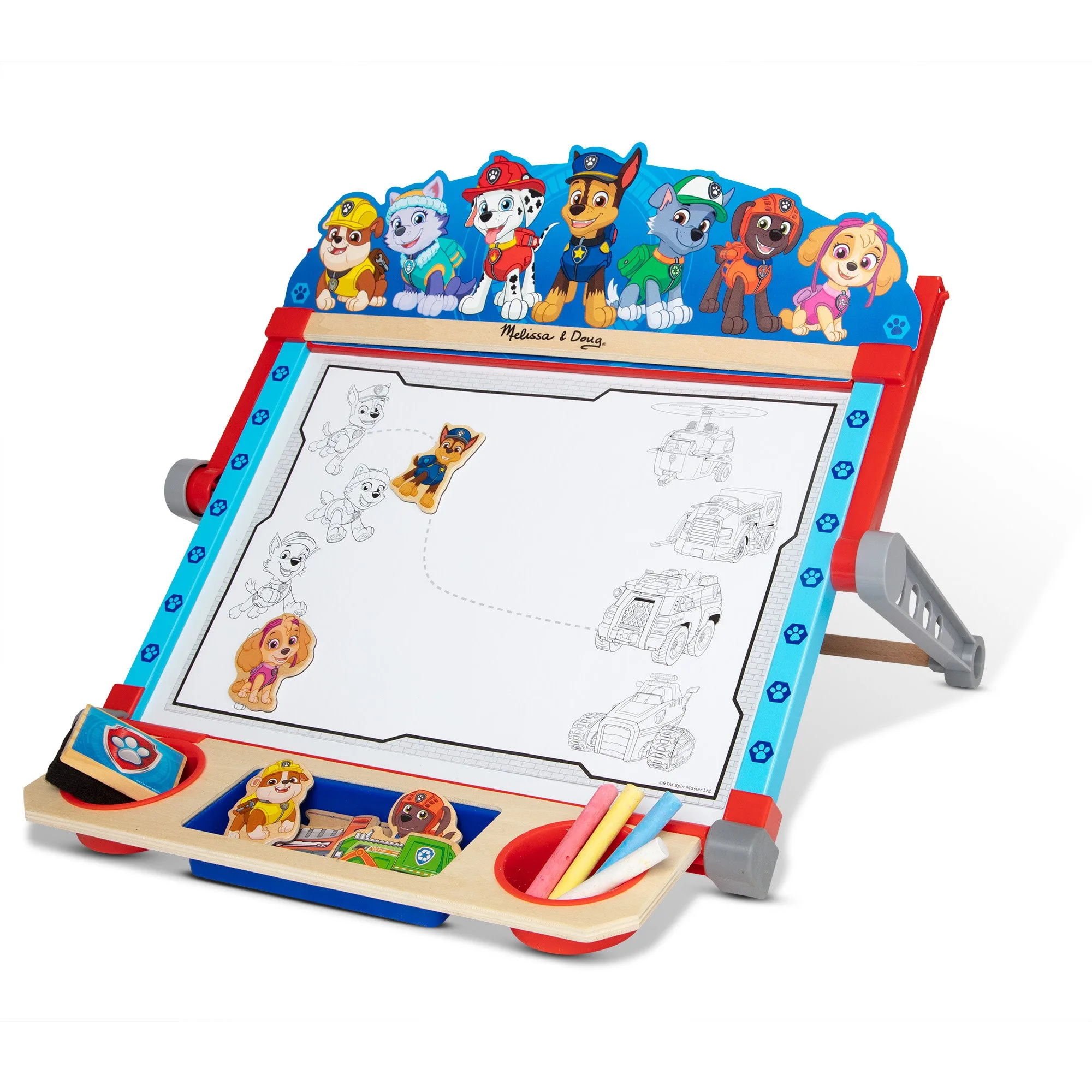
PAW Patrol Wooden Tabletop Art Center