Quick answer
A triangular optical prism splits white light into a rainbow spectrum through refraction. You can easily set up experiments at home to explore this phenomenon.
Why Use a Triangular Prism?
A triangular prism is ideal for light experiments because its precise angles create consistent refraction. This makes it easy to observe how light bends and disperses into colors.
Step-by-Step Guide
- Step 1: Set Up Your Workspace: Place the prism on a flat, stable surface in a dark room. Position it so a beam of light (from a flashlight or window) hits one face at an angle. Common mistake: Using too much ambient light washes out the spectrum. Darken the room for best results.
- Step 2: Adjust the Light Source: Shine a narrow beam of white light directly at one face of the prism. Move the light source until you see the beam enter the prism and bend inside. Checkpoint: If the light passes straight through without bending, adjust the angle of incidence.
- Step 3: Observe the Spectrum: Look at the opposite face of the prism. You should see a rainbow of colors (red, orange, yellow, green, blue, indigo, violet) exiting the prism. Common mistake: Expecting a perfect rainbow every time. The spectrum may appear faint if the light source is weak or the room isn't dark enough.
- Step 4: Experiment with Angles: Rotate the prism slightly to change the angle of the light beam. Notice how the spectrum shifts or becomes more spread out. Checkpoint: Keep the prism stable to avoid blurring the colors.
- Step 5: Use a White Screen: Hold a piece of white paper or cardboard a few inches from the prism's exit face. The spectrum will project clearly onto the surface. Common mistake: Using a dark surface absorbs the colors. A white screen reflects them visibly.
Product Facts
-
Triangular Optical Prism Laser Reflection: The Triangular Optical Prism for Laser Reflection has a precise triangular shape designed to showcase laser reflection and light refraction. This shape ensures consistent results when you experiment with splitting light into a spectrum.
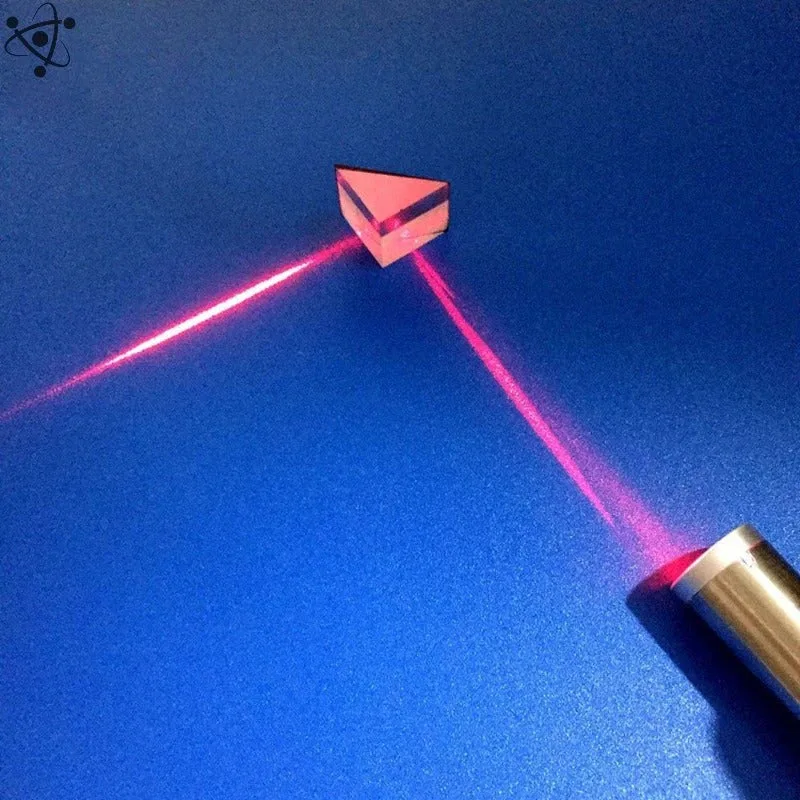
Triangular Optical Prism Laser Reflection