Quick answer
Treat wet weather as a gear and handling problem, not a reason to skip training. Use a waterproof lead with a secure snap hook, shorten your long-line work, keep the line clear of legs and mud, and rinse and dry the lead before storage.
Why wet weather changes how you handle the lead
Rain makes leather heavier and slower to dry, while wet grass and mud reduce grip and hide the line against the ground. A waterproof lead removes the drying problem, but it does not remove the handling problem: a wet line slides faster through your hand and collects grit that can abrade the coating over time.
Visibility is the other change. In low cloud, drizzle or early dusk, a dark lead disappears against wet pavement and field edges. That is the practical case for high-visibility colour, not a style preference.
When a long line is the wrong tool
A long training line gives a dog room to make choices, but in wet weather the risks multiply: tangles around wet legs, line burn when a dog bolts, and mud-heavy line dragging through puddles. If you are training near traffic, livestock or slippery surfaces, use a shorter handling length or a double-ended setup instead of a full long line.
If your lead’s available options do not include a length you need, choose a different handling method rather than improvising with knots that weaken the line.
Wet-weather routine for a waterproof training lead
- Check the snap hook and coating before you leave: Open and close the snap hook a few times and run your thumb along the lead edge. If the hook feels stiff or the coating is cracked, use a different lead. Common mistake: assuming a waterproof lead is indestructible and skipping the check. A five-second hardware check prevents a failure two fields from home.
- Set the lead length before the dog is excited: Choose your position while the dog is calm, then lock in the length you need for the first few minutes. Shorten the line before you enter muddy or crowded ground rather than fumbling with wet clips mid-walk. Adjust length at gates and stiles, not in the middle of a recall.
- Keep the long line off the ground where possible: Loop the slack over your wrist or carry it in loose folds so the line does not drag through puddles and pick up grit. Never wrap a wet line tightly around your hand. Common mistake: letting the line trail behind you where a dog can step over it. Loose folds, not tight wraps, keep a wet line manageable.
- Make yourself and the lead visible: In rain or low light, choose a high-visibility lead colour and wear something bright yourself. Check that the lead is visible against the ground you are walking on, not just against your coat. Visibility is about contrast with the environment, not just brightness.
- Rinse and dry the lead before storage: After a wet walk, rinse the lead in clean water to remove mud and grit, wipe it down, and hang it to dry fully before coiling it. Common mistake: storing a wet lead in a bag, which traps moisture and dirt against the coating. Rinse, dry, then store. Never coil a wet lead into a closed bag.
Product facts
-
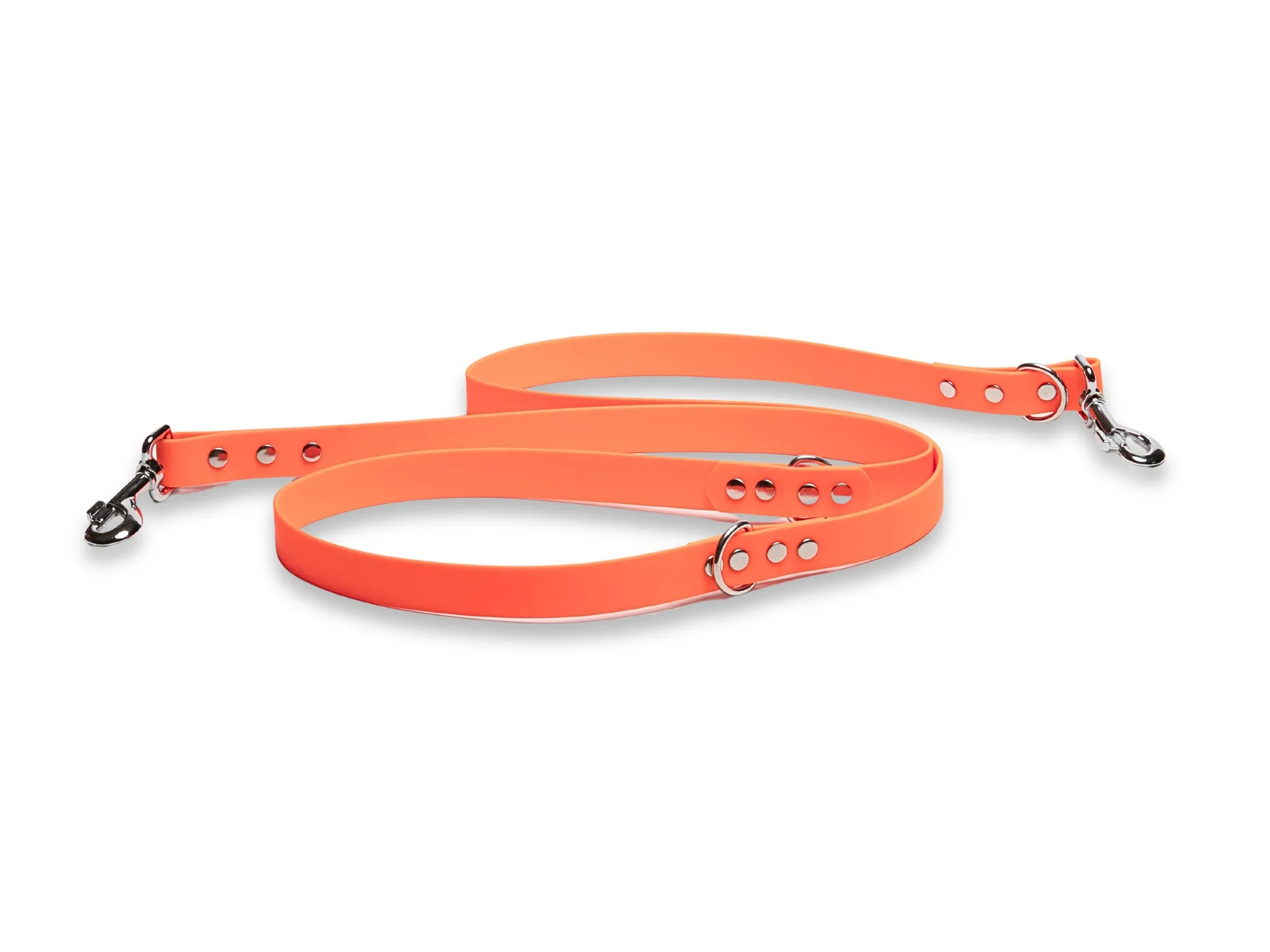
Neon Orange Waterproof / Biothane Dog Training Lead: Made in Yorkshire from PVC/TPU-coated Biothane with a double-ended, six-position design. The multi-position design lets you switch between short and long handling without carrying several leads in wet weather.
Neon Orange Waterproof / Biothane Dog Training Lead