Quick answer
Start simple: sit with your baby, place the largest ring on the base, and let them explore. Gradually add rings as they show interest, always following their lead and stopping when they lose focus.
Why a curved base changes the challenge
A flat base lets a baby drop rings straight down, which is satisfying but quickly mastered. A curved base, like the one on the Saro / Kalencom Wooden Stacking Toy, adds a gentle wobble that keeps the task interesting and demands more precise hand control. That extra challenge is what stretches hand-eye coordination and problem-solving, so resist the urge to steady the toy for them.
Age matters: when to introduce stacking
Most babies aren't ready for true stacking until around 12 to 18 months, when they can sit steadily and grasp with a pincer grip. The Saro / Kalencom toy is labeled for 18 months and up, which reflects the small pieces and the coordination needed. Before that, offer the pieces for free exploration—holding, mouthing, and banging—rather than expecting a tower.
Step-by-step play guide
- Set up a stable play space: Sit on the floor with your baby, place the base on a non-slip surface, and lay the rings within easy reach. Common mistake: putting the toy on a high table where your baby has to reach up—this makes stacking harder and increases frustration. Check that the base doesn't slide when pushed.
- Start with one ring: Hand your baby the largest ring and guide it onto the base if needed. Let them repeat this single step until they can do it independently. Common mistake: adding all the rings at once, which overwhelms them. Mastery of one ring builds confidence for the next.
- Add rings one at a time: Introduce the next ring only after your baby consistently places the first. Show them how to hold the ring flat and lower it slowly. Common mistake: rushing to the smallest rings before they've practiced with larger ones. Each new ring should be a small, achievable step.
- Name colors and sizes as you play: Say the color and size of each ring as your baby handles it—'big red ring,' 'small blue ring.' This builds vocabulary and color recognition alongside motor skills. Common mistake: quizzing them ('What color is this?') before they know the words. Narrate, don't test.
- Let them knock it down: After stacking, encourage your baby to knock the tower over. This teaches cause and effect and makes the game fun. Common mistake: stopping them because you want the tower to stay up—the crash is part of the learning. The knock-down is as valuable as the build-up.
- End on a high note: Stop while your baby is still engaged—after a successful stack or a happy knock-down. Common mistake: continuing until they fuss, which can make them resist the toy next time. Short, frequent sessions beat long, forced ones.
Product facts
-
Saro / Kalencom - Wooden Stacking Toy: The base is curved, so the challenge and fun will be greater. A curved base keeps the stacking task engaging and helps develop balance and precision as your baby learns to place pieces.
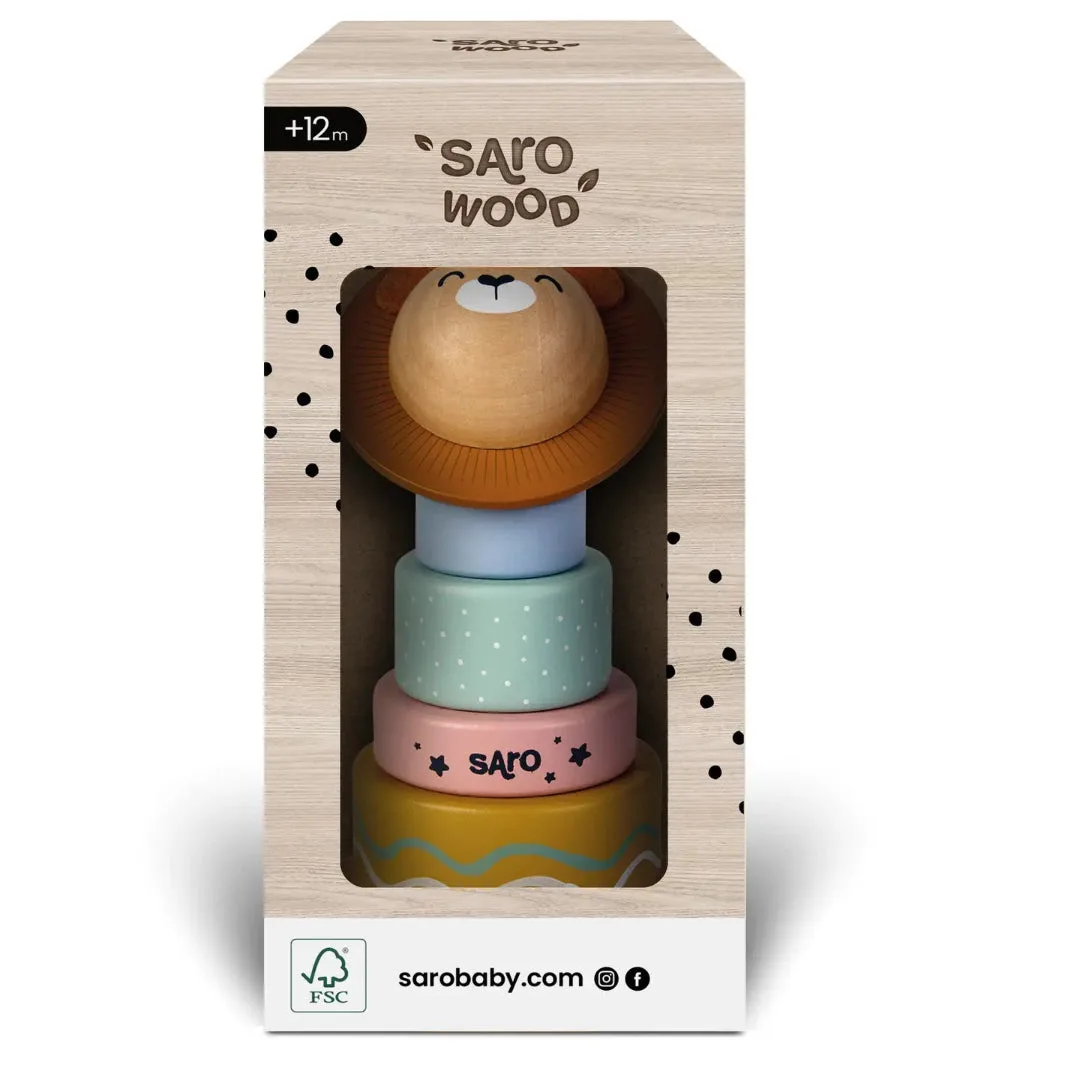
Saro / Kalencom - Wooden Stacking Toy