Quick answer
Treat the Imperfect Monstera Kimono as a print-led layer: build a quiet base outfit around it, check where any blemish sits before you drape it, and wash it gently so the handcrafted fabric and print stay intact.
Why the print changes your styling choices
A large monstera print already does the visual work, so the rest of your outfit should support it rather than compete. Solid neutrals—cream, charcoal, denim blue—let the leaf shapes read clearly, while a second bold pattern can make the print look busy and muddy.
The Imperfect Monstera Kimono is one size fits all, up to 3X, and drapes uniquely on each person. That means the print lands differently on every wearer: a leaf may fall across a shoulder on one person and near the hem on another. Before you plan an outfit, put the kimono on and note where the largest motifs and any small blemishes sit.
The trade-off: character versus predictability
Imperfections on this kimono may include blemishes that look like a small faded or black spot. That is the honest trade-off of a handcrafted, print-led piece: you get a one-of-a-kind garment, but you cannot expect a flawless, uniform print. Decide in advance whether you will style around a blemish or make it part of the look—both are valid, but they lead to different outfits.
If a spot sits near the hem or sleeve edge, a front tuck or a rolled sleeve can move it out of the visual center. If it sits mid-panel, choose a base layer in a similar tone so the eye reads the print first.
How to style the Imperfect Monstera Kimono in five steps
- Start with a solid base layer: Choose a plain top and bottoms in a neutral tone that echoes one color in the print. A fitted tank with wide-leg trousers or a simple slip dress keeps the silhouette calm so the monstera leaves stand out. Lay the base outfit flat first; if it already has a pattern, swap it for a solid before adding the kimono.
- Map the print and any blemishes: Put the kimono on over the base layer and look in a full-length mirror. Note where the largest leaves fall and where any small faded or black spot sits. Decide whether to leave the spot visible or position it toward the back or under a fold. If a blemish lands at eye level on the front panel, try rotating the kimono slightly or adjusting the front overlap before changing the whole outfit.
- Choose your drape and closure: Wear it open over a fitted base for an easy everyday layer, or bring the front panels closer and secure with a simple belt or tie for a more defined shape. Because the kimono drapes uniquely on each person, test both versions rather than assuming one works. Check that the front panels stay put when you walk and sit; if they slip, a light belt solves it without hiding the print.
- Pick one focal accessory: Let the kimono be the statement and add a single complementary piece—a plain straw hat, a simple pendant, or a neutral bag. Avoid stacking multiple bold accessories, which competes with the large leaf motifs. Remove one accessory if the outfit feels busy; the print should remain the first thing people notice.
- Care for the print and fabric gently: Wash the kimono separately in cool water with a mild detergent, turn it inside out, and air-dry it away from direct sun. Avoid harsh bleach or high heat, which can fade the print and stress the handcrafted fabric. Before the first wash, check the care label and test any spot treatment on an inside seam.
Product facts
-
Imperfect Monstera Kimono: One size fits all, up to 3X, with a drape that falls uniquely on each person. You can plan the same outfit formula for different body shapes, but you should check print placement on your own frame before committing to a look.
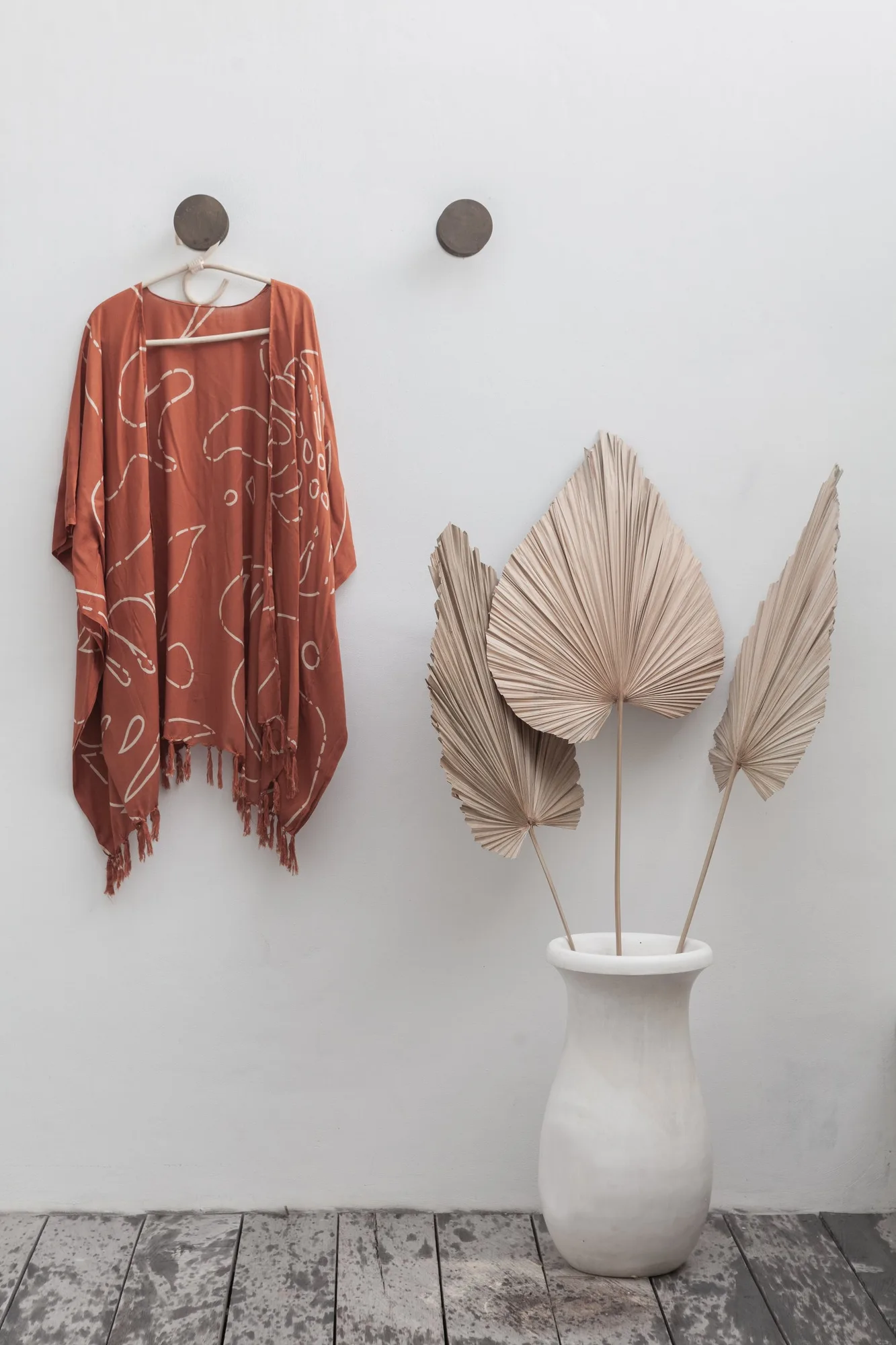
Imperfect Monstera Kimono
-
Imperfect Monstera Kimono: Imperfections may include small faded or black spots. Knowing where the spots sit lets you decide whether to conceal them with a tuck or feature them as part of the print.