Start with the board, not your engine
Imperial Steam is a game about moving goods and people across a growing railway network. Before you spend your first turn hiring workers or building factories, take a minute to read the board. The routes you can build, the cities that demand goods, and the public contracts available all shape what your early moves should be.
The catalog describes the game as a highly strategic yet accessible economic and logistics game. That accessibility comes from having a clear goal: when the connection to Trieste is made, your net worth is all that matters. Keep that endpoint in mind as you scan the board, because every early decision should move you toward it.
Three things to check before your first move
Use these checkpoints to turn a quick board scan into a plan. Each one is grounded in the game's core loop: hire workers, build tracks, produce and deliver goods, and fulfill contracts.
- Where are the high-demand cities?: The rulebook states that delivering goods to cities with high demand is a key way to earn. Identify those cities early so your railway expansion points toward them rather than away.
- Which public contracts are available?: Public contracts are profitable, but they require you to earmark goods. Check what contracts are on offer before you commit goods to regular deliveries, so you do not accidentally short yourself on a contract you wanted.
- How many workers will your plan require?: You need workers for factories and more workers to build railroad tracks. A route-heavy plan demands more track-building workers; a production-heavy plan demands more factory workers. Count the workers your intended opening needs before you hire.
Opening moves: build a foundation you can expand
Your first few turns should establish a base that supports both production and delivery. A common pitfall is building track that does not connect to a city you can actually supply, or hiring workers without a clear task for them. Instead, work backward from the high-demand cities you identified.
The game gives you two unique game end conditions with their own scoring steps, so your opening should not overcommit to one path before you see how the board develops. Keep your options open: a flexible opening that can pivot toward contracts or regular deliveries will serve you better than a rigid one.
A simple sequence for planning your route
This sequence is not a mandatory turn order; it is a way to organize your thinking before you place track or commit goods.
- Pick a target city with high demand: Choose one city that your factories can supply. This becomes your first delivery goal.
- Trace the track you need: Identify the shortest path from your starting position to that city. Note how many track-building workers that path requires.
- Check for contract overlap: See if any public contracts align with the goods you plan to produce. If so, earmark goods for those contracts as you produce them.
- Hire workers to match: Hire enough workers for both factory production and track building. The catalog notes you need workers for both, so balance your hiring.
- Upgrade locomotives when it pays off: Upgrading locomotives lets you carry more goods and passengers. Consider this once your basic route is established and you are consistently delivering.
What the catalog confirms about Imperial Steam
-
Imperial Steam: Imperial Steam is a highly strategic yet accessible economic and logistics game for 2 players, designed by Alexander Huemer (Lignum). The two-player focus means route planning is more direct: you and your opponent are competing for the same cities and contracts, so reading the board early is even more important.
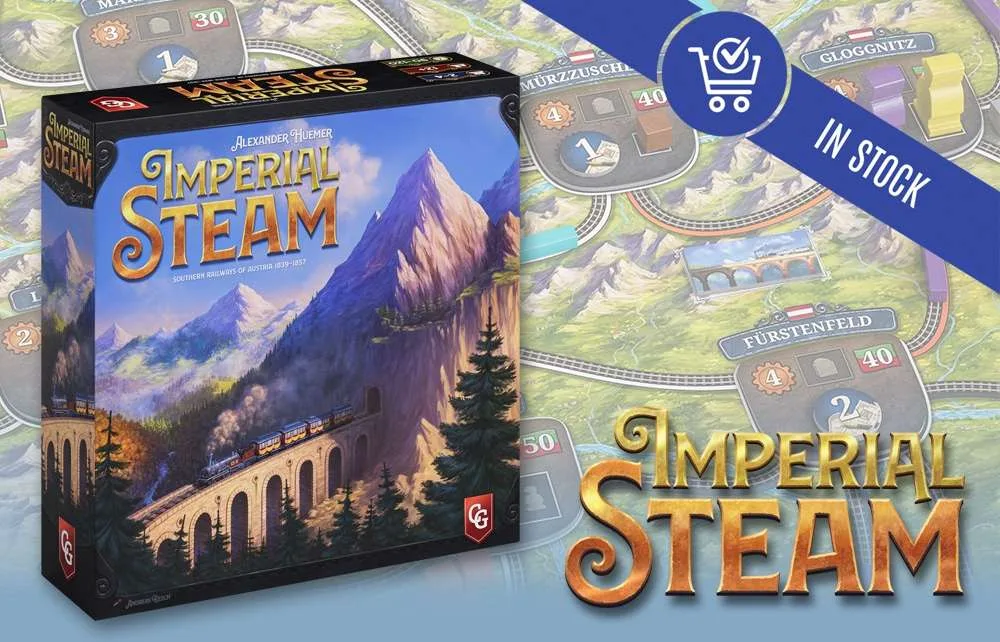
Imperial Steam
-
Imperial Steam: Key features include planning, building, and expanding your railway network; hiring and training workers; building factories; producing and delivering goods; and upgrading locomotives to carry more goods and passengers. These are the levers you will use throughout the game. Your strategy guide should account for all of them, not just track building.
-
Imperial Steam: The game has two unique game end conditions with their own scoring steps. Because scoring can end in different ways, a flexible strategy that can adapt to the board is safer than a single-minded rush toward one condition.
What the catalog does not tell you
The supplied information does not include specific setup instructions, turn order, or detailed rules for how contracts are fulfilled or how locomotives are upgraded. It also does not specify recommended player counts beyond the two-player experience mentioned. Use the rulebook for exact procedures and do not assume any sequence beyond what is printed there.
What the catalog does confirm is the overall goal: when the connection to Trieste is made, your net worth is all that matters. Let that guide your strategy, and treat every early move as a step toward building the most valuable network you can.