Quick answer
For most welding on the HTP Independence 210 AC/DC Dual Voltage, an air-cooled torch is simpler and less expensive. Choose the water-cooled configuration only if you regularly weld at high amperage for long stretches and want the smaller, lighter torch a cooler allows.
What changes when you add water cooling
Water cooling adds a cooler, hoses, and a water-cooled torch to the setup. That extra equipment lets you use a physically smaller torch at the same amperage, which can improve access and comfort on long welds. The trade-off is more setup steps, more maintenance, and higher upfront cost. The Independence 210 is sold in a water-cooled configuration, but the catalog does not list a separate air-cooled version, so if you want air cooling you will need to source a compatible air-cooled torch separately.
When air cooling is the smarter trade-off
Air-cooled torches are self-contained and need no coolant, pump, or extra hoses. That makes them easier to move around the shop and less prone to leaks or maintenance downtime. The downside is that air-cooled torches are typically larger and heavier at a given amperage, and they can become uncomfortable during long, high-amperage welds. If your work is mostly short beads, thinner material, or intermittent, air cooling keeps the setup simple and the cost lower.
The cost and complexity trade-off
The Independence 210 water-cooled package is listed at $2,737.26 (compared to a $3,699.00 catalog comparison price). That price includes the water-cooled torch and associated components, but you should confirm exactly what is included—cooler, hoses, and torch—before ordering. An air-cooled setup may reduce the initial outlay, but you will need to add a compatible torch and possibly a different cable. Neither approach is universally cheaper once you account for the torch you actually need; the decision hinges on how often you weld at high amperage.
Key trade-offs at a glance
- Cooling method: Water-cooled uses a cooler and hoses to carry heat away; air-cooled relies on ambient air and a larger torch body. Water cooling adds equipment but allows a smaller torch.
- Amperage and duty: For sustained high-amperage welding, water cooling is the more comfortable choice; for low-amperage or intermittent work, air cooling is sufficient. Match the cooling method to your typical amperage and weld duration.
- Setup and maintenance: Water cooling requires coolant, a pump, and hose management; air cooling has no coolant to check or change. If you prefer minimal maintenance, air cooling is simpler.
Product facts
-
HTP® Independence 210 AC/DC Dual Voltage Water-Cooled: HTP Independence 210 AC/DC Dual Voltage Water-Cooled; catalog price $2,737.26 (comparison price $3,699.00). This is the only listed configuration, so water cooling is the default path unless you source an air-cooled torch separately.
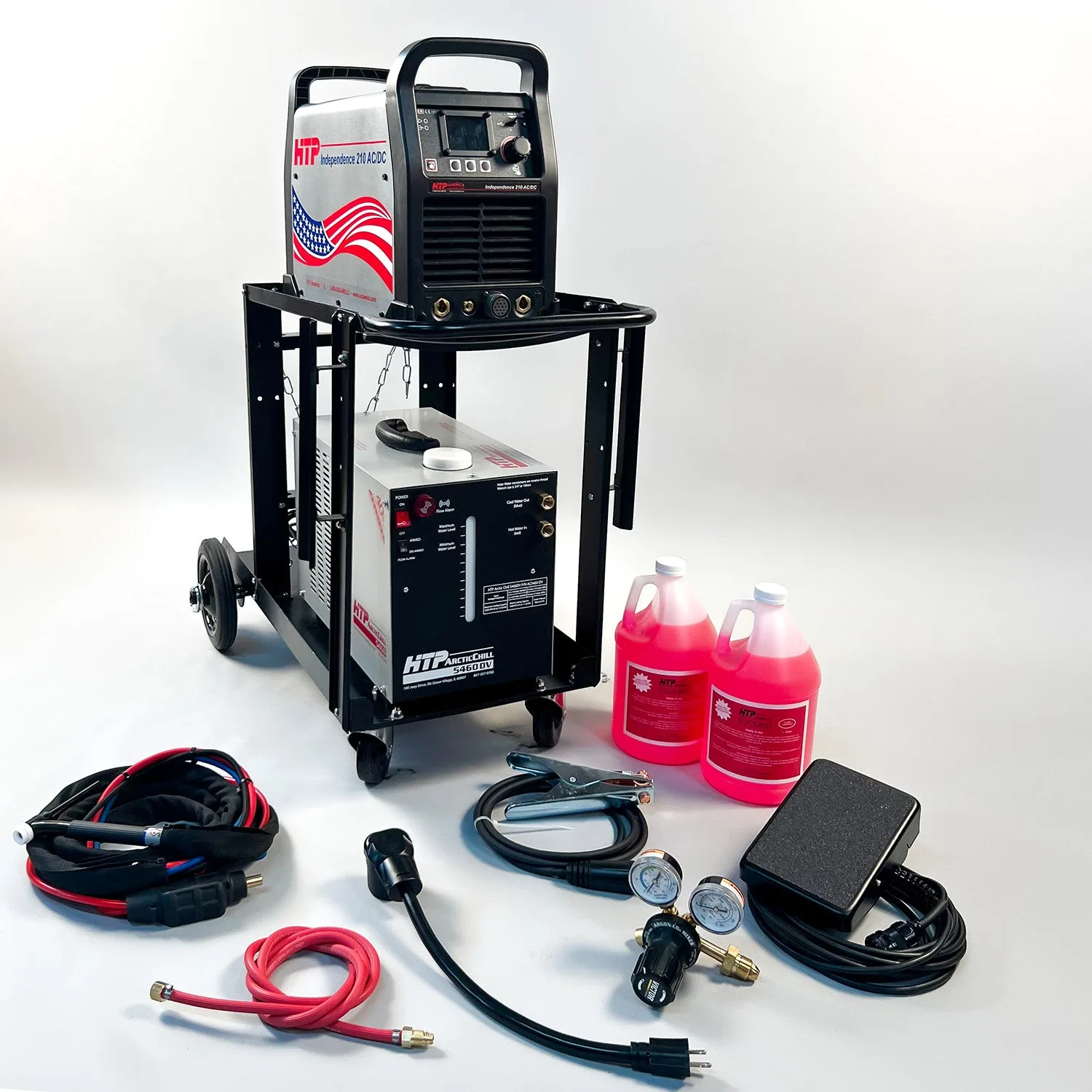
HTP® Independence 210 AC/DC Dual Voltage Water-Cooled
Who should choose which
Choose water-cooled if
- You frequently weld at high amperage for extended periods
- You want a smaller, lighter torch for better access and comfort
Choose air-cooled if
- You do mostly low-amperage or intermittent welding
- You want the simplest, lowest-maintenance setup