Quick answer
Buy the Introductory Play Therapy Package if you are a new therapist who needs a ready-made, multi-topic starter set and would rather not assemble one item by item. Skip it if your caseload is narrow, your sessions are mostly non-verbal or sand-tray based, or you already own a structured card-game kit.
Why a bundled starter kit changes the first-month decision
When you are equipping a first play therapy space, the hidden cost is not any single item. It is the time spent comparing card games, sentence prompts, and activity sets across different clinical goals, then discovering gaps after your first few sessions.
A bundle solves that by locking in one purchase and one consistent topic range. The trade-off is control: you accept the bundle's mix instead of choosing each item to match your exact caseload. That is fine when you are still learning which materials you reach for most, and less fine when you already know your sessions lean heavily on one modality.
The real value is breadth, not depth
The Introductory Play Therapy Package is built around a social and emotional card game covering five specific disorders, plus sentence-prompt cards such as Blurt It Out! That means the kit gives you several distinct conversation entry points rather than one deep resource.
For a new therapist, breadth is usually the right first bet: you can test which prompts children respond to before investing in a specialized set. If you already run a focused anxiety or ADHD group, however, a single targeted deck may serve you better than a mixed package.
When building your own beginner supplies makes more sense
Assembling your own play therapy starter set is the better path when you have a clear modality preference, when storage is tight, or when your setting already supplies shared materials. It also lets you stagger spending across several months instead of committing at once.
The catch is that piecemeal buying tends to drift: you buy what is easy to find rather than what covers the gaps. If you choose this route, write down the clinical goals you need to cover first and buy against that list.
Decision rules for choosing this starter kit
- Rule 1: Match the kit to your caseload mix: Choose the package if your caseload spans several emotional and behavioral presentations and you want materials that open conversations across them. If most of your referrals fall under one category, buy a focused resource instead. List your three most common referral reasons before buying; if they match the kit's topics, it is a sound fit.
- Rule 2: Check whether you already own a structured card game: The package's core is a multi-deck social and emotional card game. If you already own a comparable card-based tool, the overlap reduces the value of the bundle, and you are better off filling other gaps.
- Rule 3: Decide whether you need verbal or non-verbal materials: This kit leans on discussion, sentence prompts, and card play. If your sessions rely mainly on sand trays, dolls, or non-verbal play, put your budget there first and treat this package as a later addition.
- Rule 4: Compare the bundle against buying the items separately: The catalog notes that buying the included items separately would cost substantially more than the package price. Do the same comparison with any items you already own: subtract what you would not need before deciding the bundle is cheaper for you. A bundle is only a saving if you would actually use most of what is inside.
- Rule 5: Plan storage and session flow before checkout: Multiple decks and card sets need a place to live and a way to be sorted quickly between sessions. Decide where the kit will be stored and how you will pull only the deck you need for a given child.
Product facts
-
Introductory Play Therapy Package: The package includes The Social and Emotional Competence Card Game, with five decks covering Anxiety, Depression, ADHD, Asperger's, and Bipolar Disorder, plus Blurt It Out! sentence cards. You get several distinct discussion entry points in one purchase, which helps a new therapist learn which topics and formats children engage with before buying specialized sets.
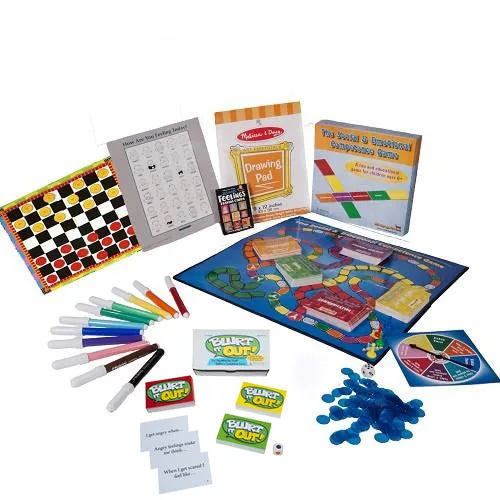
Introductory Play Therapy Package
Who this starter kit fits
Best for
- New therapists equipping a first play therapy space who want one purchase covering several emotional and behavioral topics
- Practitioners who use discussion-based and card-based activities with children old enough to read or respond to prompts
- Clinicians building a shared resource pool for a small practice or training setting
Not for
- Therapists whose sessions are primarily sand-tray, doll, or non-verbal play and who need those materials first
- Practitioners who already own a comparable multi-deck social and emotional card game
- Specialists running a single-disorder group who need depth in one topic rather than breadth