Quick answer
A jigsaw duel is a competitive jigsaw puzzle game built for two players: each side races to finish a 70-piece jigsaw, then grabs the one final piece that fits both puzzles. A standard puzzle is a shared or solo build, often 1000 pieces, with no race mechanic. Choose a duel for head-to-head energy; choose standard for a longer, calmer build.
What a jigsaw duel actually changes
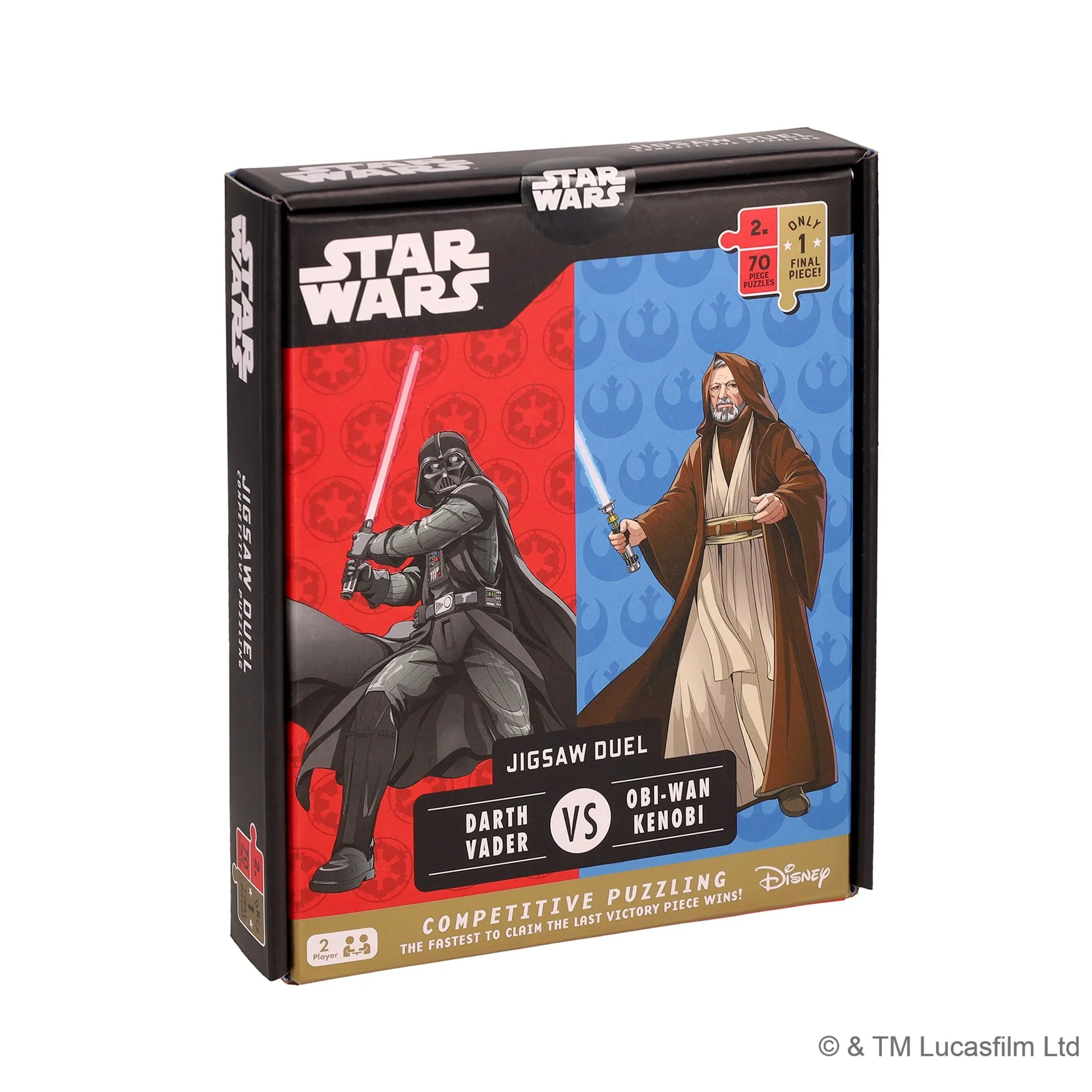
A jigsaw duel keeps the puzzle format but adds a win condition. In Star Wars Obi-Wan Kenobi vs. Darth Vader Jigsaw Duel, each player completes a 70-piece jigsaw, then the first to grab the final double-sided piece wins. That final piece fits both puzzles, so the race stays close until the last second.
This is the key difference from a standard puzzle. A standard puzzle has no opponent and no shared final piece, so the goal is completion, not victory. If your group likes rules and a clear winner, the duel format delivers that without needing a separate board game.
Setup, table space, and play time
A jigsaw duel needs two separate build areas so each player can sort and assemble without mixing pieces. That means more table width than a single standard puzzle of similar piece count. The trade-off is a shorter session: 70 pieces per side is a quick race, while a 1000-piece standard puzzle is a longer sit-down build.
If your table is small, a duel can still work if you build on two trays or puzzle mats. If you want one shared surface and a slower pace, a standard puzzle is the easier fit.
Replay value and who it suits
A duel has a fixed puzzle image and a fixed final-piece gimmick, so replay depends on wanting the race again rather than discovering a new image. A standard puzzle also has a fixed image, but its length and solo appeal make it easier to return to over multiple evenings.
For two people who want a competitive jigsaw puzzle game, the duel is the more direct match. For one person or a group who wants a long build, standard puzzles are the better default.
Where trivia and theme fit in
Some standard puzzles add a knowledge layer. Star Wars Millennium Falcon Jigsaw Puzzle and Trivia connects 1000 pieces into the ship on one side or a detailed schematic on the other, and includes 25 trivia questions about the Falcon. That gives a standard build a second activity without turning it into a race.
If you want a themed game night rather than a puzzle race, Star Wars Stay On Target is a separate game where you complete attack runs for points and can call on Obi-Wan for help. It is not a jigsaw, so compare it as an alternative activity, not a duel substitute.
Trade-offs: duel vs. standard
- Player count and competition: A jigsaw duel is built for two players racing to finish and grab the final piece. A standard puzzle is typically solo or shared with no winner. Pick the duel if you want a two player jigsaw puzzle with a clear result.
- Session length and table space: The duel uses two 70-piece builds, so it needs two sorting areas but finishes faster. A 1000-piece standard puzzle needs one larger area and more time. Short on table space? Use trays for the duel; short on time? The duel is quicker.
- Replay and variety: The duel repeats the same race with the same final-piece twist. A standard puzzle with two image sides and trivia offers a different kind of variety per session. Want a repeatable race? Duel. Want a longer, varied build? Standard.
Product facts
- Star Wars™ Obi-Wan Kenobi™ vs. Darth Vader™ Jigsaw Duel: Each side has a 70-piece jigsaw to complete, but there is only one final piece that fits both puzzles. The first person to finish their jigsaw and then grab the final, double-sided piece wins. This is the core duel mechanic: two simultaneous builds and a single shared winning piece, so the race stays competitive to the end.
- Star Wars Millennium Falcon Jigsaw Puzzle and Trivia: Connect 1000 pieces to complete the Millennium Falcon in two ways: the ship on one side, a detailed schematic on the other. Includes 25 trivia questions about the Falcon. A standard puzzle with a reversible image and trivia adds variety and a longer build, but no head-to-head race.
- Star Wars™ Stay On Target: As Rebel Leader, you organize your crew and make attack runs for points, use defenses to deflect Imperial attacks, and can call on Obi-Wan for help. Four points lets you take aim at the Death Star exhaust port. This is a competitive game with points and defense, not a jigsaw, so it suits groups who want a winner without assembling pieces.
Which should you buy?
Best for
- Two players who want a head-to-head puzzle race with a clear winner
- Fans of Star Wars who want a themed competitive jigsaw puzzle game
- Short sessions where a 70-piece build per side fits the time available
Not for
- Solo puzzlers who prefer a quiet, long build
- Groups of three or more who want everyone building at once
- Players who want a 1000-piece challenge rather than a quick race