Quick answer
Choose the Jumping Gymnast for a younger baby working on pressing, grasping, and cause-and-effect, and choose the Riding Acrobat for an older toddler ready to practice balance and coordination on a string. If you want one toy that grows with a child from sitting play into active balance play, the Riding Acrobat covers more of that later stage.
The core difference: press-and-release versus balance-and-tension
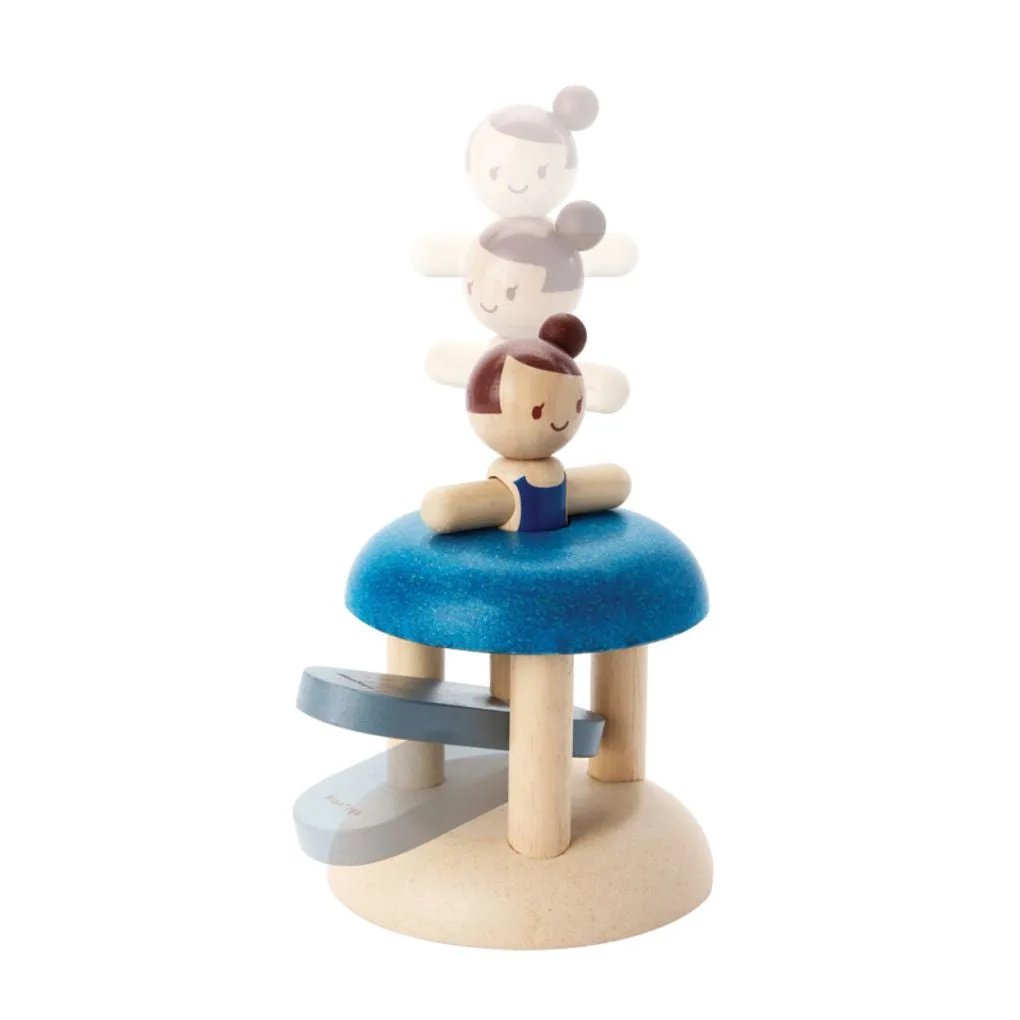
These two wooden acrobat toys look similar on a shelf, but they ask for different actions. The Jumping Gymnast is a push-and-watch toy: a baby presses the base with the right amount of pressure and the figure springs up. The Riding Acrobat is a string toy: a child balances the figure on a wire between two points and raises or lowers the string to move it along.
That difference matters because pressing builds grasp and release control, while balancing on a string builds hand-eye coordination and a feel for gravity and tension. One is about repeating a satisfying action; the other is about steering a moving object without dropping it.
Where the trade-offs show up in daily play
The Jumping Gymnast needs very little setup and works well in a high chair, on a lap, or on a floor mat. Its trade-off is that the challenge is mostly in the press itself, so a child who has mastered the motion may move on quickly.
The Riding Acrobat needs two anchor points and a string held at the right height, so it takes an adult to set up and often an adult to hold one end. In exchange, it offers a longer arc of difficulty: a toddler can start with small lifts and gradually try longer runs and steadier tension.
What the catalog does and does not tell you
Both listings describe skill-building and sustainable wooden construction, but neither supplies a recommended age range, dimensions, or a maximum string length. That means you should judge fit by the action each toy requires rather than by a number on the box. If precise sizing or age grading matters for a gift, check the product page or contact the store before ordering.
Trade-offs to weigh before you choose
- Skill focus: The Jumping Gymnast targets fine motor grasp and release through pressing; the Riding Acrobat targets balance, hand-eye coordination, and an early feel for gravity and tension. Match the toy to the skill you want to practice now, not the one you want later.
- Setup and adult involvement: The Jumping Gymnast works on its own with no string or anchor points. The Riding Acrobat needs a string stretched between two points and usually an adult to hold or adjust one end. If you want independent play, the Jumping Gymnast asks less of you.
- Play lifespan: The Jumping Gymnast is satisfying early but can be mastered quickly. The Riding Acrobat offers more room to increase difficulty by raising the string or lengthening the run. For a child who bores easily, the string toy has more headroom.
Product facts at a glance
-
Jumping Gymnast: Teaches cause and effect as babies press the base with the right amount of pressure and watch the figure spring up. This makes it a low-setup first toy for babies learning that their actions produce a result.
Jumping Gymnast
-
Riding Acrobat: Children balance the acrobat on a string and raise or lower it to move from point to point. This turns mealtime or floor play into a coordination challenge that grows as the child gains control.
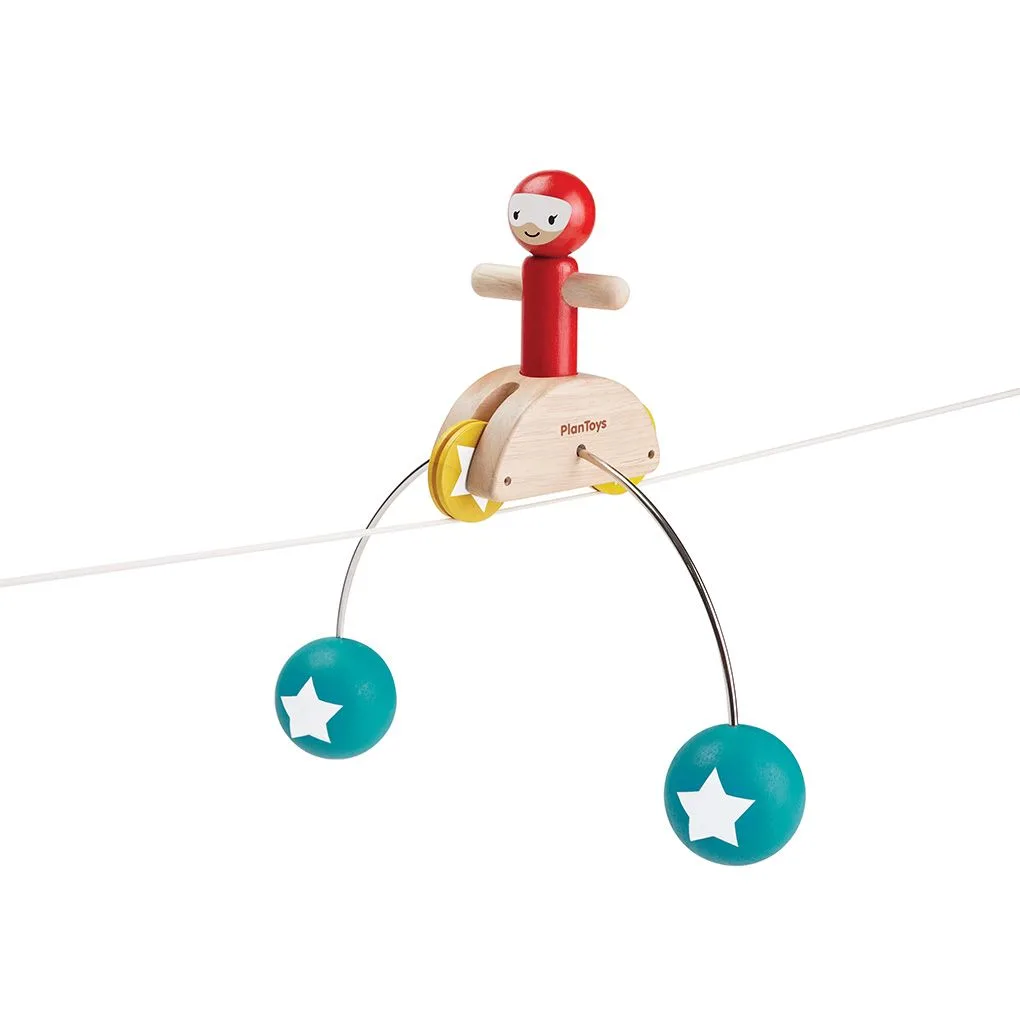
Riding Acrobat
Which one fits your child?
Best for
- Babies and young toddlers practicing pressing, grasping, and cause-and-effect
- Caregivers who want a compact toy with no setup or adult holding required
Not for
- Older toddlers who have already mastered press-and-release play and want a bigger challenge
- Families looking for a toy a child can set up and use entirely alone