Quick Answer
To host a junk food trivia game night, open the Junk Food & Food Food Trivia set, read each question from its misleading category aloud, and let teams lock in answers before revealing the real one. Keep the pace brisk and lean into the silly categories rather than treating it like a serious quiz.
Why the Misleading Categories Matter
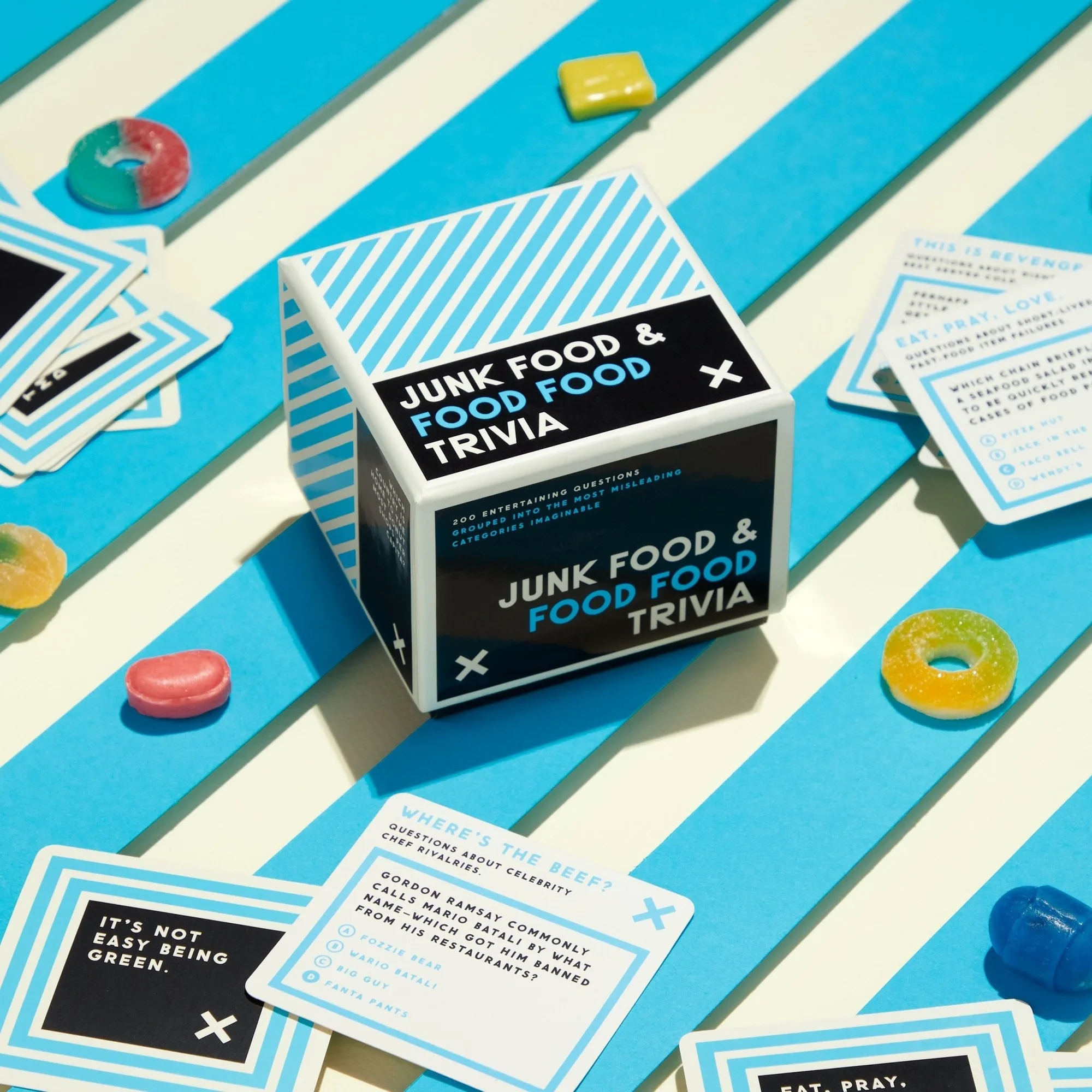
The set includes 200 unique trivia questions, and many are grouped under categories that sound like one thing but are actually about another—for example, 'Hunger Games' is about eating competitions. That structure is the whole point: it rewards players who think sideways, not just those who know food facts. If you read the category name and then immediately give a straight clue, you deflate the joke. Instead, read the category, pause, and let teams argue before you ask the question.
When to Skip the Team Format
Teams work well for four or more players, but with just two or three people, individual play keeps the pace faster and avoids one person dominating the answers. For a solo round, read each question and give yourself a few seconds to guess before checking the card. The set does not include a timer or scorepad, so plan to use a phone timer and a notepad app if you want structured scoring.
How to Run a Junk Food Trivia Game Night
- Set up teams and a scorekeeper: Divide players into teams of two to four and assign one person to keep score on a phone or paper. Common mistake: letting the scorekeeper also play, which slows down scoring and causes disputes. Have the scorekeeper sit out the first round or use a simple tally app. Decide before the first question whether the scorekeeper plays or just keeps score.
- Read the category, then pause: Announce the misleading category name (for example, 'Hunger Games') and wait five seconds before reading the question. That pause lets teams predict what the category really means. Common mistake: rushing straight into the question, which removes the fun of the misdirection. The pause is part of the game—use a visible countdown so everyone knows when the question starts.
- Ask the question and take answers in order: Read the question once, clearly. Go around the room and have each team say their answer aloud before you reveal the correct one. Common mistake: letting teams shout over each other, which makes it hard to score fairly. Write down each team's answer as they say it. If a team hesitates, give them ten seconds and then move on—don't let one question stall the night.
- Reveal the answer and score immediately: After all teams have answered, read the correct answer and award one point per correct team. Common mistake: saving up answers to score at the end, which leads to arguments. Score each question right away so everyone stays engaged. Keep a running total visible so teams know where they stand.
- Run three rounds with a short break: Plan for three rounds of about 20 questions each, with a five-minute break between rounds for snacks or drinks. Common mistake: playing all 200 questions in one sitting, which exhausts players and kills the energy. Stop while people are still having fun. Three rounds of 20 questions fits a two-hour game night comfortably.
- Announce the winner and offer a silly prize: After the final round, add up the scores and declare a winner. A small prize—like the title of 'Junk Food Champion' or a snack—keeps the mood light. Common mistake: dragging out the ending with tie-breakers unless scores are actually tied. If you have a tie, ask one sudden-death question from the set rather than replaying a whole round.
What You Get in the Set
-
Junk Food & Food Food Trivia: Includes 200 unique trivia questions with misleading category names like 'Hunger Games.' That volume gives you roughly two to three hours of quiz material if you use about 50 to 70 questions per game night, so you can host several parties without repeating questions.
Junk Food & Food Food Trivia