Quick answer
For a toddler's first pretend kitchen, choose a sturdy wooden model with realistic but open-ended features like a working oven, sink, and accessories that invite storytelling rather than preset scripts.
Why wood matters for a toddler kitchen
Wooden play kitchens last longer than plastic ones and feel more like real furniture. They also tend to have a heavier, stable base that won't tip when a child leans on the counter. The trade-off is that wood can be heavier to move and sometimes costs more upfront, but the durability often saves money over time.
What to look for in features
The best kitchens balance realism with room for imagination. Look for a working oven with compartments, a sink with a tap, and burners that suggest cooking without requiring specific actions. Accessories like a kettle, pot, and utensils add immediate play value, but avoid sets with too many small parts that can frustrate a toddler.
Size and placement considerations
Measure your play area before buying. A full kitchen like the Kid's Kitchen needs about 3 feet of floor space and a low table nearby for serving. Also check that the counter height matches your child's standing reach—typically 18 to 22 inches for ages 2 to 4.
Your decision rules for choosing a wooden play kitchen
- Safety first: Check for rounded edges, non-toxic paint, and a stable base. Avoid kitchens with small detachable parts that could be a choking hazard for children under 3.
- Open-ended vs. scripted play: Choose a kitchen with realistic but non-prescriptive features (like a sink that looks real but doesn't run water). This lets your child invent their own cooking scenarios instead of following a fixed routine. Open-ended design encourages longer, more creative play sessions.
- Accessory completeness: Look for a set that includes at least a pot, a spatula, a spoon, and a few play food items. Too few accessories can limit play, while too many can overwhelm a toddler. The Kid's Kitchen includes a kettle, pot with lid, tea cups, spatula, spoon, and kitchen towel—a balanced starter set.
- Assembly and maintenance: Wooden kitchens require assembly. Check that the instructions are clear and that all hardware is included. Once built, wipe clean with a damp cloth—avoid soaking the wood. Expect 30–60 minutes of assembly time with basic tools.
Product spotlight
-
Kid's Kitchen: Two burners, an oven with two compartments, a sink with a tap and a shelf of accessories make this a complete first kitchen for serious little cooks. Your child can plan a menu, cook for the family, and clean up—all in their own words—which builds language and social skills through open-ended play.
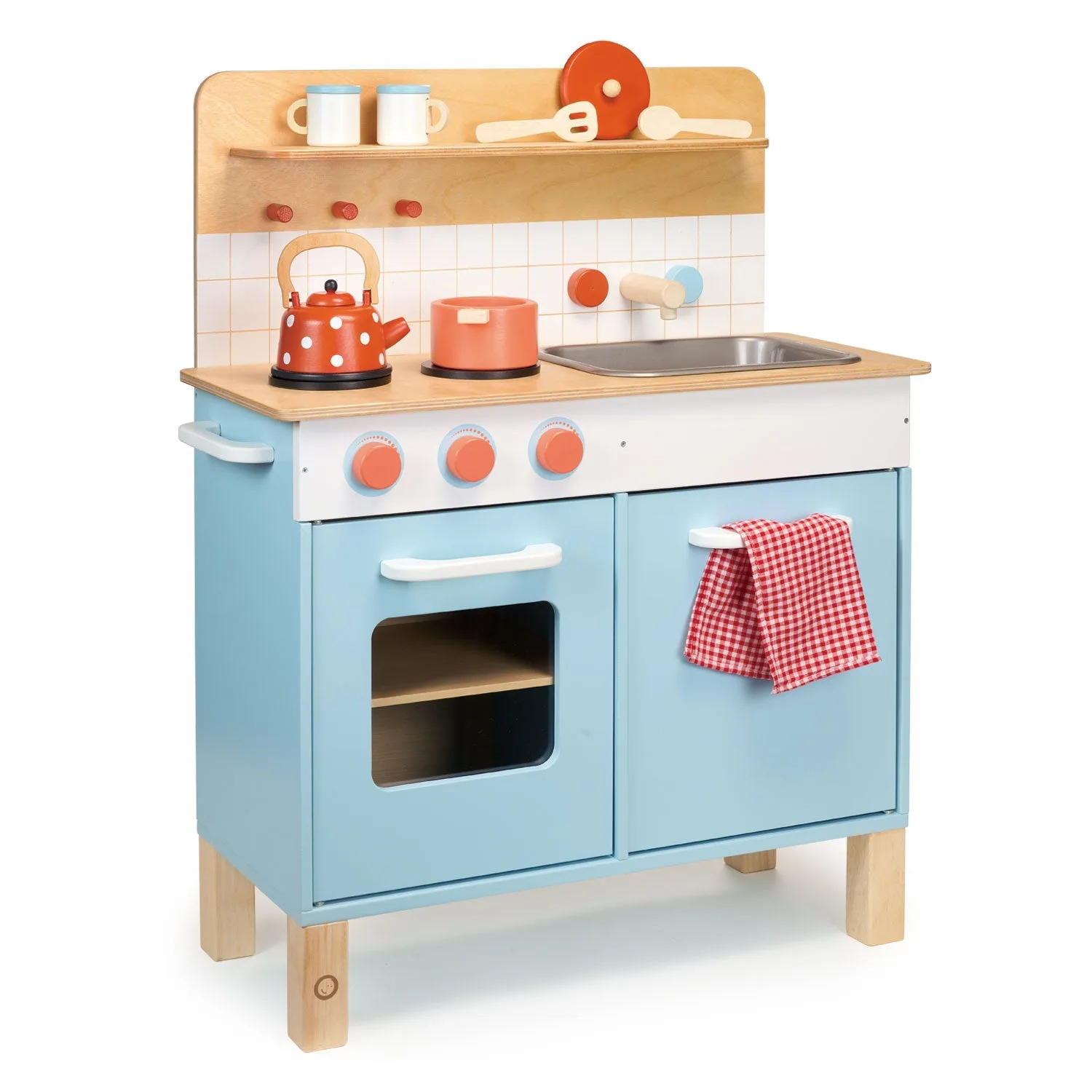
Kid's Kitchen
Who this kitchen is for
Best for
- Toddlers ages 2 to 4 who are just starting pretend play and need a sturdy, safe kitchen with realistic features
- Parents who want a long-lasting wooden toy that can be passed down or resold
Not for
- Families with very limited floor space (under 2 feet wide)
- Children who already have a large collection of play food and accessories and need a more compact add-on station