Quick answer
Use lag bolts (also called lag screws) when fastening wood to wood or wood to metal, because their coarse threads grip into the material. Use hex bolts when joining metal parts with a nut, because they rely on a nut for clamping force. The head style and thread pattern are the main differences that decide the application.
Lag Bolts: Self-Tapping Wood Fasteners
Lag bolts have a sharp, coarse thread that cuts into wood or soft materials as you drive them. They typically have a hex head so you can turn them with a wrench, and they are installed without a nut—the threads hold directly in the substrate. This makes them ideal for deck framing, timber construction, and heavy-duty wood assemblies where you need a removable but strong connection.
A #1 x 2" lag bolt with a hot-dip galvanized finish, like the one from Mutual Screw & Supply, resists corrosion well in outdoor or damp environments. The hex head allows high torque application, which is important for structural and machinery fastening where the bolt must not loosen under vibration.
Hex Bolts: Machine Fasteners for Metal
Hex bolts have a uniform, machine-cut thread that requires a nut to create clamping force. They are designed for use in tapped holes or through-holes with a nut on the opposite side. Hex bolts come in many grades and materials, from standard steel to high-strength alloy, and are common in equipment assembly, automotive, and structural steel connections.
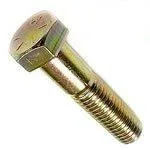
For example, a 1/2-13 x 1-1/4" hex head cap screw made from Grade L9 Alloy Steel with yellow zinc finish is built for machinery and general industrial fastening. The fully threaded design and hex head let you achieve precise torque values, and the yellow zinc provides moderate corrosion resistance. Because these bolts need a nut, they are not suitable for direct insertion into wood.
Thread Design and Head Style Differences
The most visible difference is thread pitch. Lag bolts use a coarse, widely spaced thread that bites into wood fibers. Hex bolts use a finer, machine thread that matches standard nut threads. Head styles also differ: both can have hex heads, but lag bolts often have a sharper under-head angle to pull into wood, while hex bolts have a flat bearing surface for use with washers and nuts.
Material and finish choices also vary. Lag bolts are often galvanized or coated for outdoor use, while hex bolts are available in stainless steel for corrosion resistance or high-strength alloy for load-bearing applications. The M20-2.5 x 60mm socket cap screw in 316 stainless steel is a hex bolt variant with a flat head and hex socket drive, suited for precision assemblies where a flush surface is needed.
Lag Bolts vs Hex Bolts: Tradeoffs
- Installation speed: Lag bolts install directly into wood without a nut, saving parts and time. Hex bolts require drilling a through-hole and adding a nut, which takes longer but allows disassembly. Choose lag bolts for quick wood fastening; hex bolts for reusable metal connections.
- Corrosion resistance: Hot-dip galvanized lag bolts resist rust in wet environments. Yellow zinc hex bolts offer moderate protection but may corrode outdoors over time. For marine or chemical exposure, consider stainless steel hex bolts. Galvanized lag bolts excel outdoors; yellow zinc hex bolts suit dry indoor use.
- Load capacity: Hex bolts with Grade L9 alloy steel can handle higher tensile loads than standard steel lag bolts. However, lag bolts in dense wood can achieve strong pull-out resistance. Use hex bolts for high-tension metal joints; lag bolts for shear loads in wood.
Product Facts at a Glance
- #1 X 2" Lag Bolts | Hex Head | Steel Hot-Dip Galvanized (50 / Pkg.): #1 X 2" Lag Bolts with hex head, hot-dip galvanized finish, made from steel. Designed for structural and machinery fastening. The hot-dip galvanized finish provides excellent corrosion resistance for outdoor wood projects like decks and fences. The hex head allows high torque driving without stripping.
- 1/2-13 X 1-1/4" Hex Head Cap Screws | USA Made | Grade L9 Alloy Steel Yellow Zinc | Fully Threaded (50 / Pkg.): 1/2-13 X 1-1/4" Hex Head Cap Screws, USA Made, Grade L9 Alloy Steel, Yellow Zinc CR+3 finish, fully threaded. For machinery and equipment assembly. Grade L9 alloy steel offers high tensile strength for metal-to-metal joints. The yellow zinc finish resists mild corrosion, making it suitable for indoor industrial applications where a nut can be used.
Which Fastener Fits Your Project?
Best for
- Wood-to-wood or wood-to-metal framing where you need a self-tapping fastener (choose lag bolts)
- Metal-to-metal assemblies where you can access both sides to install a nut (choose hex bolts)
Not for
- Direct insertion into metal without a pre-tapped hole (lag bolts are not designed for metal threads)
- Blind fastening where you cannot reach the nut side (hex bolts require nut access)