Quick answer
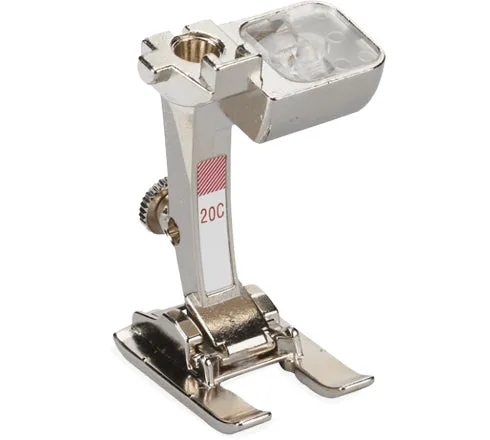
Choose the BERNINA #71 Lap-Seam Foot when you need a precise 6 mm lap seam in medium to heavy-weight fabric, especially for reversible garments. Choose the BERNINA #20D Open Embroidery Foot when the job is embroidery, appliqué, or decorative stitching and you need to see exactly where each stitch lands.
The core trade-off: seam structure vs stitch visibility
These two feet are not interchangeable upgrades. The #71 is built to fold and guide fabric into a lap seam, a construction where one raw edge overlaps another and both sides finish cleanly. That makes it a garment-construction tool. The #20D is built around an open toe and clear sole so you can watch dense stitching, appliqué edges, and decorative motifs. That makes it a surface-embellishment tool.
The practical consequence: the #71 hides the needle area behind its guiding geometry, while the #20D deliberately opens it up. If you buy one expecting the other's behavior, you will be frustrated. Match the foot to the task, not to the machine.
Where the #71 Lap-Seam Foot earns its place
The #71 is specified for lap seams 6 mm wide, for medium to heavy-weight materials, and for both 5.5 mm and 9 mm BERNINA machines. It is also noted as ideal for reversible clothing, which makes sense: a lap seam leaves a clean finish on both sides, so a garment can be worn inside out. If your project is a jacket, bag, or reversible top in canvas, denim, or coating, this foot does a job a standard foot cannot do repeatably.
The limitation is equally clear. It is not an embroidery foot, and its catalog facts do not claim decorative stitch visibility. Do not expect it to help with appliqué or free-motion work.
Where the #20D Open Embroidery Foot earns its place
The #20D combines an open toe with a clear sole, and its wide groove underneath is designed to accommodate dense embroidery and satin stitches. The catalog lists appliqué among its uses. That combination matters when stitch placement is the whole point: you can see the needle, the edge of the appliqué, and the build-up of satin stitching without the foot blocking your view.
The trade-off is that this is a specialty foot for surface work, not a seam-construction foot. Its supplied facts do not describe lap-seam guidance or heavy-weight seam folding, so do not press it into that role.
When a standard foot is the better answer
If you are sewing a basic straight seam, a flat-felled seam by hand-folded method, or general construction in light fabric, neither specialty foot is the first reach. A standard presser foot covers those jobs. The #71 becomes worthwhile when you specifically want a 6 mm lap seam in medium to heavy fabric. The #20D becomes worthwhile when visibility during dense decorative stitching is the bottleneck. Buying either before you have that specific need adds cost without adding capability.
Trade-offs to weigh before you choose
- Seam finish vs surface decoration: Pick the #71 if the goal is a clean, reversible lap seam. Pick the #20D if the goal is visible, controlled decorative stitching. These are different outcomes, not different quality levels. Write down the finished result you need before comparing prices.
- Fabric weight and seam width: The #71 is tied to 6 mm lap seams and medium to heavy-weight materials. If your fabric is light or your seam width differs, this foot is not the match. The #20D's supplied facts focus on dense stitching, not fabric weight. Measure your intended seam width and check fabric weight first.
- Machine compatibility: The #71 is listed for both 5.5 mm and 9 mm BERNINA machines. The #20D record does not state a machine-width restriction, so confirm compatibility with your manual before ordering. When a specification is absent, treat it as unknown rather than universal.
- Visibility during sewing: The #20D's open toe and clear sole are the reason to choose it. The #71's guiding geometry is the reason to choose it. You are trading one kind of control for another. If you cannot see the needle, you have the wrong foot for the task.
Product facts at a glance
-
#71 BERNINA Lap-Seam Foot: Specified for 6 mm lap seams in medium to heavy-weight materials, for 5.5 mm and 9 mm machines. Check your machine's stitch width and your fabric weight before buying; this foot is aimed at a specific seam width, not general seam sewing.
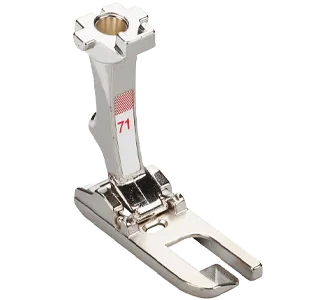
#71 BERNINA Lap-Seam Foot
-
#20D BERNINA Open Embroidery Foot: Open toe with a clear sole and a wide groove underneath for dense embroidery and satin stitches. The open design is what lets you see stitch placement during appliqué and decorative work, which a closed standard foot obscures.
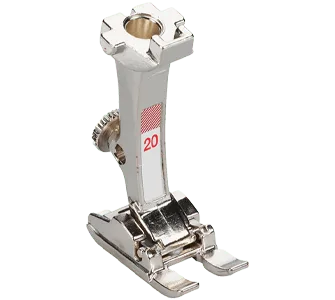
#20D BERNINA Open Embroidery Foot
Which foot fits your project?
Best for
- Sewists making reversible garments or bags in medium to heavy-weight fabric who need a 6 mm lap seam
- Owners of 5.5 mm or 9 mm BERNINA machines doing structured construction
- Embroiderers and appliqué sewers who need to see dense satin stitching and stitch placement
- Decorative stitchers working with an open toe and clear sole for visibility
Not for
- Anyone sewing basic straight seams or light-weight construction, where a standard foot is sufficient
- Sewists expecting the #71 to handle embroidery or appliqué visibility
- Sewers expecting the #20D to guide lap seams or heavy seam folding
- Buyers who have not confirmed machine width compatibility for the #71