Quick answer
Choose the LARGE PURPLE SLICKER BRUSH if you groom medium to large dogs or big cats with thick, long, or double coats and want broad coverage in fewer strokes. Skip it for small pets, short smooth coats, or detail work around the face and paws.
Why coat type matters more than breed name
A slicker brush works by lifting loose fur and separating tangles with fine wire pins. On a thick or long coat, that action needs enough pin coverage to reach through the topcoat without scraping the skin. On a short, smooth coat, the same brush can feel harsh and remove very little. Match the brush to coat density and length first, then to pet size.
When a large brush head helps — and when it gets in the way
A large head covers more surface per stroke, which shortens grooming time on backs, flanks, and hindquarters. The trade-off is reduced control in tight areas. If your pet is under about 15 pounds or has a narrow muzzle, ears, or paws that need precision, a smaller slicker or a comb is the better second tool. The large brush is a body brush, not a finishing tool.
Coat types that benefit most
Thick double coats, long silky coats, and dense curly or woolly coats on medium to large pets are the best match. These coats hold loose fur and form tangles that a broad slicker can lift efficiently. Short single coats, hairless breeds, and freshly clipped coats gain little from a large slicker and may be irritated by it.
Decision rules for the large purple slicker brush
- Pet size: Choose the large brush if your pet is a medium or large breed, roughly over 25 pounds, or a large cat. For small pets under 15 pounds, pick a smaller slicker instead. Weigh your pet before buying if you are between sizes.
- Coat length and density: Use it on thick, long, double, or woolly coats that tangle and shed. Do not choose it for short smooth coats, hairless skin, or very thin coats that show skin easily. Run your fingers through the coat: if you meet resistance or find tangles, a large slicker is likely useful.
- Grooming area: Use the large brush on the back, flanks, chest, and hindquarters. Switch to a smaller slicker or a comb for the face, ears, paws, and sanitary areas. Keep a detail tool within reach before you start.
- Mat severity: For light tangles, work in slow strokes with the grain. For tight mats or pelting, do not rely on a slicker alone; use a dematting tool or seek professional help. Stop if the brush catches without releasing.
- Frequency: For thick or long coats, brush 3–4 times per week; daily during heavy shedding. For moderate coats, 1–2 times per week is enough. Schedule brushing after walks when the coat is dry.
Product facts
-
LARGE PURPLE SLICKER BRUSH: Large brush head measures approximately 3.75 x 3.75 inches. That broad coverage speeds up brushing on medium to large bodies, but it is harder to control around the face and paws.
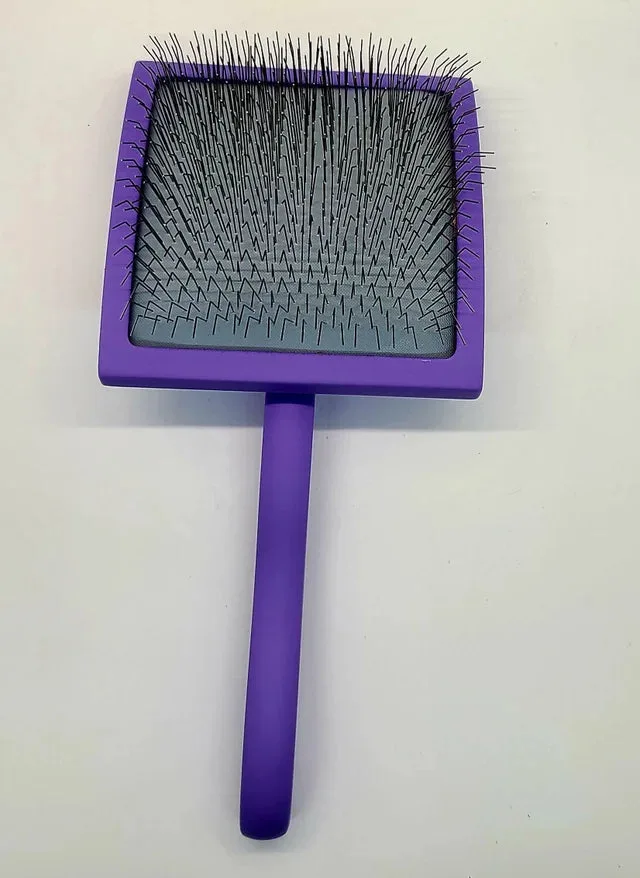
LARGE PURPLE SLICKER BRUSH
Who should choose this brush
Best for
- Owners of medium to large dogs with thick, long, or double coats
- Owners of large cats with dense or long fur
- Groomers who want faster body coverage during shedding season
Not for
- Small pets under 15 pounds or toy breeds
- Short, smooth, or hairless coats
- Face, paw, and sanitary detail work that needs a smaller tool