The real question behind Level 8
If you are eyeing Level Up Puzzles Level 8 - Fairy Tales, you are probably not asking whether your child likes puzzles. You are asking whether this is the right moment to move up. The set is marked for ages 8+, and it holds two puzzles of 280 and 330 pieces, 610 pieces in total. That is a meaningful step for a child who has been finishing smaller jigsaws comfortably.
The honest answer is that age 8 is a starting guide, not a finish line. A child who already sits through a few hundred pieces without losing interest is a better fit than a younger child who rushes the last third of every puzzle. Use the age marking as the floor and your child's actual puzzle habits as the deciding vote.
What the Level 8 box actually contains
-
Level Up Puzzles Level 8 - Fairy Tales (2 puzzles): Two puzzles with 610 total pieces (280 and 330 pieces) Two separate builds mean two sittings or two children, rather than one long project that has to stay out on the table.
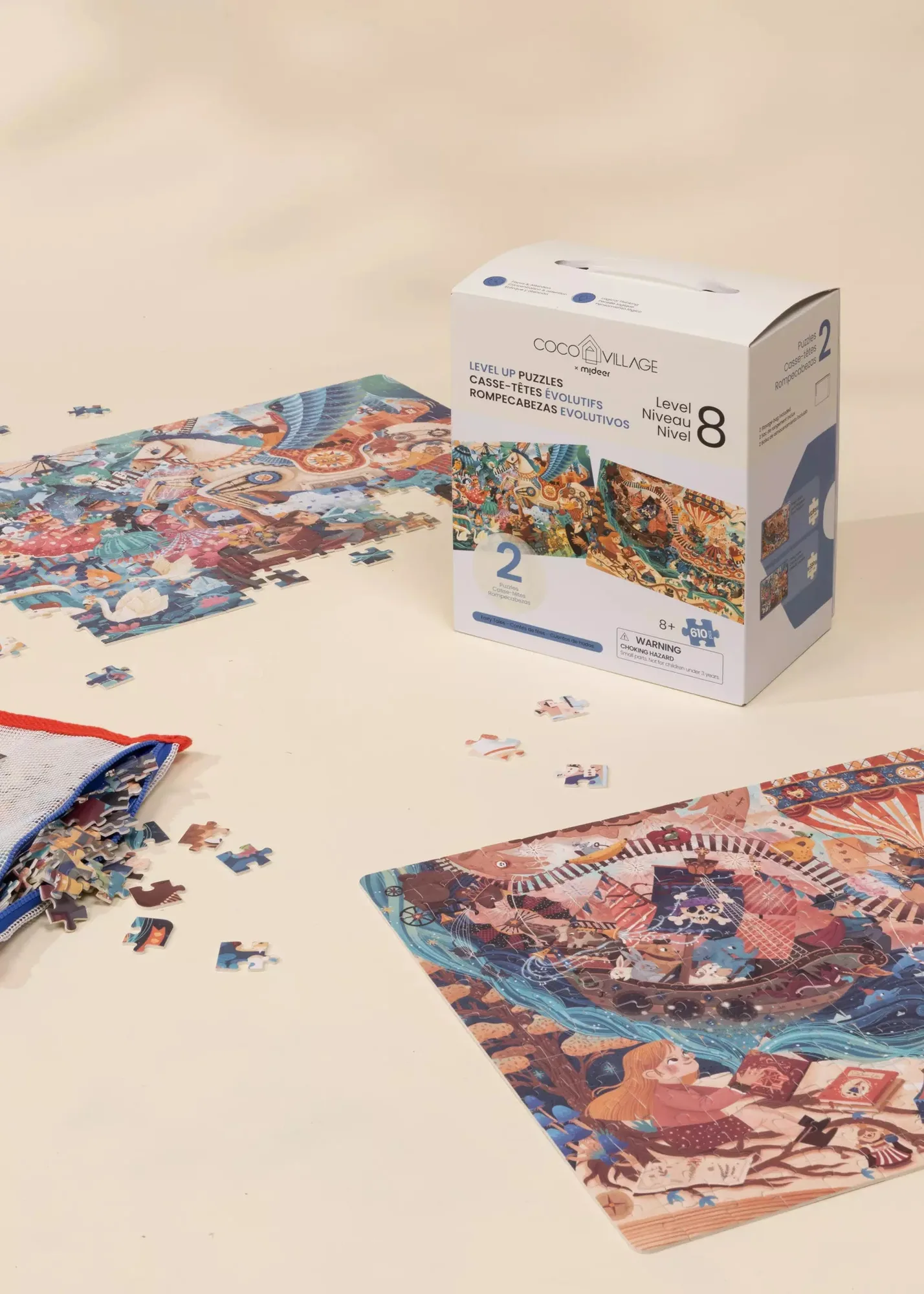
Level Up Puzzles Level 8 - Fairy Tales (2 puzzles)
-
Level Up Puzzles Level 8 - Fairy Tales (2 puzzles): Two storage bags included Keeping the 280 and 330 piece sets apart is the difference between a smooth build and an hour of sorting.
-
Level Up Puzzles Level 8 - Fairy Tales (2 puzzles): A story booklet and stickers included The fairy tale theme gives kids a reason to finish and talk about the picture, not just assemble it.
-
Level Up Puzzles Level 8 - Fairy Tales (2 puzzles): Age 8+, with focus and attention and logical thinking listed as features These are the skills the set is built around, so they double as your readiness checklist.
Signs your child is ready to move up a level
Progressive puzzles for children work best when the next step is a stretch, not a wall. Look for these signals before you buy:
- They finish without a rescue: Your child completes their current puzzle count mostly alone, with you nearby rather than placing pieces.
- They tolerate the slow middle: The hard part of any larger puzzle is the stretch where the obvious pieces are gone. A child who keeps going through that stage is ready for more pieces.
- They ask for more: If your child finishes a puzzle and immediately wants another, the piece count is no longer challenging them.
- They are at or near the age guide: Level 8 is marked 8+. A child below that age may still manage it, but expect more shared table time.
Why two puzzles beat one big one here
A two puzzle set for kids solves a practical problem: stamina. A single 610-piece puzzle is a multi-day commitment that occupies a table and tests patience. Split into 280 and 330 pieces, the same box gives you two complete wins. That matters when you are deciding whether to move up a level, because a finished 280-piece puzzle builds confidence for the 330-piece one.
It also helps if you have two children close in age. They can each take a puzzle, or trade after finishing. The two storage bags are not a bonus detail; they are what makes that work without mixing pieces.
The trade-offs worth knowing before you buy
This is not a first puzzle. At 280 and 330 pieces, it assumes a child who already understands edge pieces, color grouping and patience. If your child is still on 100-piece puzzles, this set will likely sit unfinished, and that is a frustrating experience for everyone.
The fairy tale theme is a good fit for a child who likes stories and pictures with characters. A child who prefers maps, animals or vehicles may engage less with the artwork, and engagement matters more than piece count at this level. The supplied information does not include a completed puzzle size or a manufacturer care routine, so check the box for finished dimensions if table space is tight, and treat storage as simple: keep the pieces bagged and dry.
Level 8 versus staying at a lower level
- Choose Level 8 Fairy Tales if: Your child is around 8 or older, finishes current puzzles with little help, and enjoys story-based pictures. The two-puzzle format suits a child who wants variety.
- Stay at a lower level if: Your child still needs help sorting or loses interest halfway. A smaller piece count will build the focus this set assumes.
- Buy it as a shared project if: A younger eager child can work the 280-piece puzzle with an adult while an older sibling takes the 330. The two bags make that split practical.
A simple way to decide today
Ask one question: can your child finish their current puzzle without you placing pieces? If yes, Level 8 Fairy Tales is a sensible next step, and the story booklet gives the build a purpose beyond the last piece. If no, wait a level. Progressive puzzles for children only work when each step is reachable, and the best time to move up is when the current puzzle has stopped being a challenge.