Quick answer
Add a linen bite roll when your dog snaps at the edge of a pillow or tug instead of opening wide. Its firm, raised shape gives the dog a full-mouth target, and it softens after a few sessions so young dogs can bite hard without punishment.
Why a roll beats a flat pillow for young dogs
A bite pillow is easy to carry and works well for older dogs with a settled grip. For a young or inexperienced dog, though, a flat pillow invites a shallow, front-teeth bite because the dog can only grab the edge. A roll sits up off the ground, so the dog has to open wider to take it. That wider mouth position is the habit you want before you move to a sleeve or suit.
The trade-off is handling. A roll is bulkier than a pillow and less forgiving if your dog is already a confident, hard biter. Keep the pillow for drive-building and quick rewards; use the roll for grip work.
Where the roll fits in your bite training progression
Think of the roll as a bridge between a tug and a sleeve. A tug teaches the dog to chase and hold. The roll teaches the dog to open wide and commit to a full bite. A sleeve or suit comes after the dog reliably opens and holds without slipping off.
Do not skip the roll because your dog bites hard on a tug. Hard biting on a narrow tug is not the same as a full grip on a wider object, and dogs that never learn to open wide often struggle on the sleeve later.
When a roll is the wrong choice
If your dog is already working sleeves confidently, a roll adds little. If your dog is shy or stressed by new objects, start with a soft tug and build confidence before introducing a firm roll. And if you are training alone without a decoy, a roll on the ground is harder to present cleanly than a pillow you can hold close.
Diagnose the bite problem before you switch equipment
- Symptom: dog snaps at the edge and lets go: Likely cause is a target that is too flat or narrow, such as a pillow held at an angle. Corrective action: present the roll squarely at chest height and let the dog open wide before you let it take. Stop and choose another option if the dog avoids the roll after three short sessions. Short sessions beat long ones; end while the dog still wants more.
- Symptom: dog bites hard but slips off: Likely cause is a slick or small surface. Corrective action: use the roll's raised shape so the dog can wrap its mouth around a full section, and reward the hold before the release. Stop if the dog starts biting the handler's arm instead of the roll.
- Symptom: young dog seems worried by the firm roll: Likely cause is a new texture that is still firm. Corrective action: work a few sessions with the roll on the ground and let the dog investigate, then reward any mouth contact. The material softens with use. Stop and go back to a soft tug if the dog avoids the roll entirely.
- Symptom: dog does well on the roll but fails on the sleeve: Likely cause is too fast a jump in equipment. Corrective action: alternate roll and sleeve sessions and reward the full grip on both. Stop pushing the sleeve if the dog reverts to edge biting twice in a row; return to the roll for a week. A dog that opens wide on the roll is ready for the next step only when the grip holds under light pressure.
Product facts
-
Redline Linen Bite Roll: The RedLine K9 Bite Suit Technique roll is made from bite suit material, firm when new and softer after a few sessions. The firm start teaches the dog to open wide, and the softening means young dogs get a strong full bite without a harsh feel.
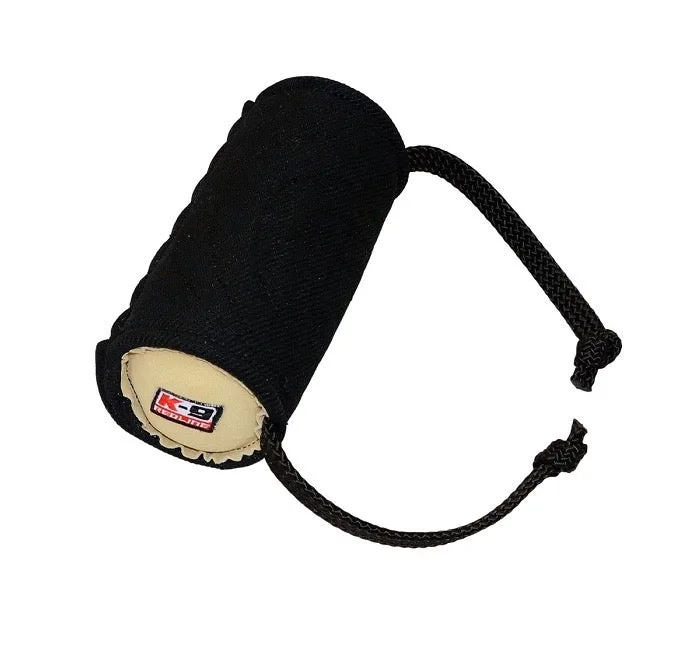
Redline Linen Bite Roll
-
Redline Linen Bite Roll: The roll's design lets a dog get a full bite even when it is on the ground because it sits up high. You can work grip from a standing or kneeling position without holding the roll the whole time.