Quick answer
Play Little Feminist Mini Memory Match by placing all cards face down, taking turns flipping two to find a matching pair, and keeping matched pairs. The player with the most pairs wins, but with young children, focus on turn-taking and picture naming rather than strict competition.
Why this mini version works for young children
The small box and illustrated portraits make this game easy to carry and appealing to preschoolers. Because the set is compact, you can play a short round at a restaurant, in a waiting room, or during a quiet moment at home without needing a large table.
The game naturally builds visual memory, focus, and concentration as children try to remember where each portrait is located. The feminist theme also opens simple conversations about the women shown, even if you keep those talks brief and age-appropriate.
Adjusting rules for different ages
For very young children (around 3–4), start with fewer pairs—perhaps 6 to 8—so the game stays manageable and confidence grows. You can also play cooperatively, working together to find all pairs before the cards run out.
With older preschoolers or early elementary kids, use the full set and introduce the competitive rule of taking another turn after a match. Always model gentle behavior and remind children that it’s okay to forget where a card is; the goal is fun and practice, not perfection.
How to play Little Feminist Mini Memory Match, step by step
- Set up the cards: Shuffle all cards and lay them face down in a grid. For young children, use fewer pairs (6–8) to start. A common mistake is making the grid too large, which can overwhelm preschoolers—keep it to 3 or 4 columns. Check that every card is fully face down before starting.
- Explain the goal: Tell players they will flip two cards at a time to find matching pairs. Show an example by flipping two cards and naming the pictures. A common mistake is assuming children understand the concept of 'matching'—demonstrate it first. Ask your child to name one person they see on a card before you begin.
- Take turns flipping: The youngest player goes first, then play moves clockwise. On each turn, flip two cards face up so everyone can see. If they match, keep the pair and take another turn; if not, turn them back face down. A common mistake is letting children flip too quickly—encourage them to pause and look at each card. Remind players to wait until both cards are turned before reacting.
- Handle a match: When a player finds a match, they place the pair in front of them and go again. If playing cooperatively, place matched pairs in a shared pile. A common mistake is forgetting to take the extra turn—prompt gently if needed. Praise the effort of looking carefully, not just the match itself.
- End the game: Play until all pairs are matched. The player with the most pairs wins, or celebrate together if you played cooperatively. A common mistake is rushing the end—let children count their pairs and name the women they matched. Use the final pairs as a chance to talk about one or two of the women pictured.
Product facts
-
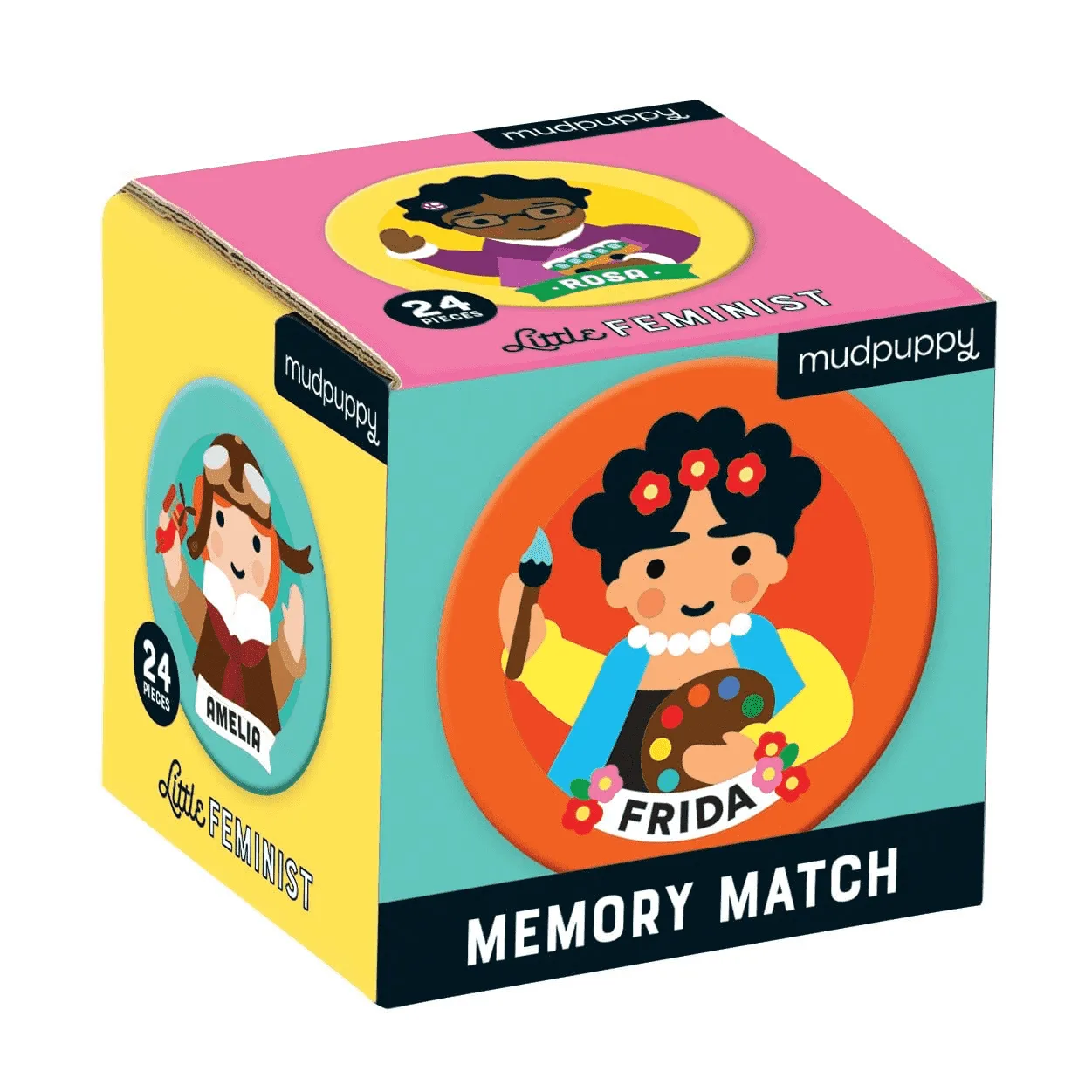
Little Feminist Mini Memory Match Game: Little Feminist Mini Memory Match features colorful illustrated portraits of real women who have made historical impact, with illustrations by Lydia Ortiz. The portraits give children a concrete image to remember and can spark simple questions about the people shown.
Little Feminist Mini Memory Match Game
-
Little Feminist Mini Memory Match Game: The mini box is designed to be perfect for stocking stuffers, party favors, or on-the-go play. Its compact size means you can keep it in a bag for quick games outside the house.