The real question: fixed 5x or a variable low-power scope?
Choosing between the LS 5X50 CB prism scope and an LPVO is not about which is better overall. It is about whether you want one magnification that never changes or a range you can dial from low power up. The LS 5X50 CB is a fixed 5x prism sight with a 50mm objective, an illuminated glass-etched reticle in red, green or blue, and QTA turrets that move in 1/2 MOA clicks. An LPVO gives you a variable zoom range, but that flexibility comes with a different set of tradeoffs in weight, complexity and how you set up the rifle.
This comparison sticks to what the LS 5X50 CB listing confirms and to general differences between fixed prism sights and variable scopes. Where the supplied information does not cover a point, such as exact weight or eye relief, it says so rather than guessing.
LS 5X50 CB specs that shape the comparison
-
LS 5X50 CB Prism Scope, Red/Green/Blue Illuminated Prism Sight, Compact Prism Scope: 5x magnification with a 50mm objective lens and a field of view of 28.4 ft at 100 yards. A fixed 5x sits above typical LPVO low-power settings, so it favors mid-range target identification over close-quarters speed.
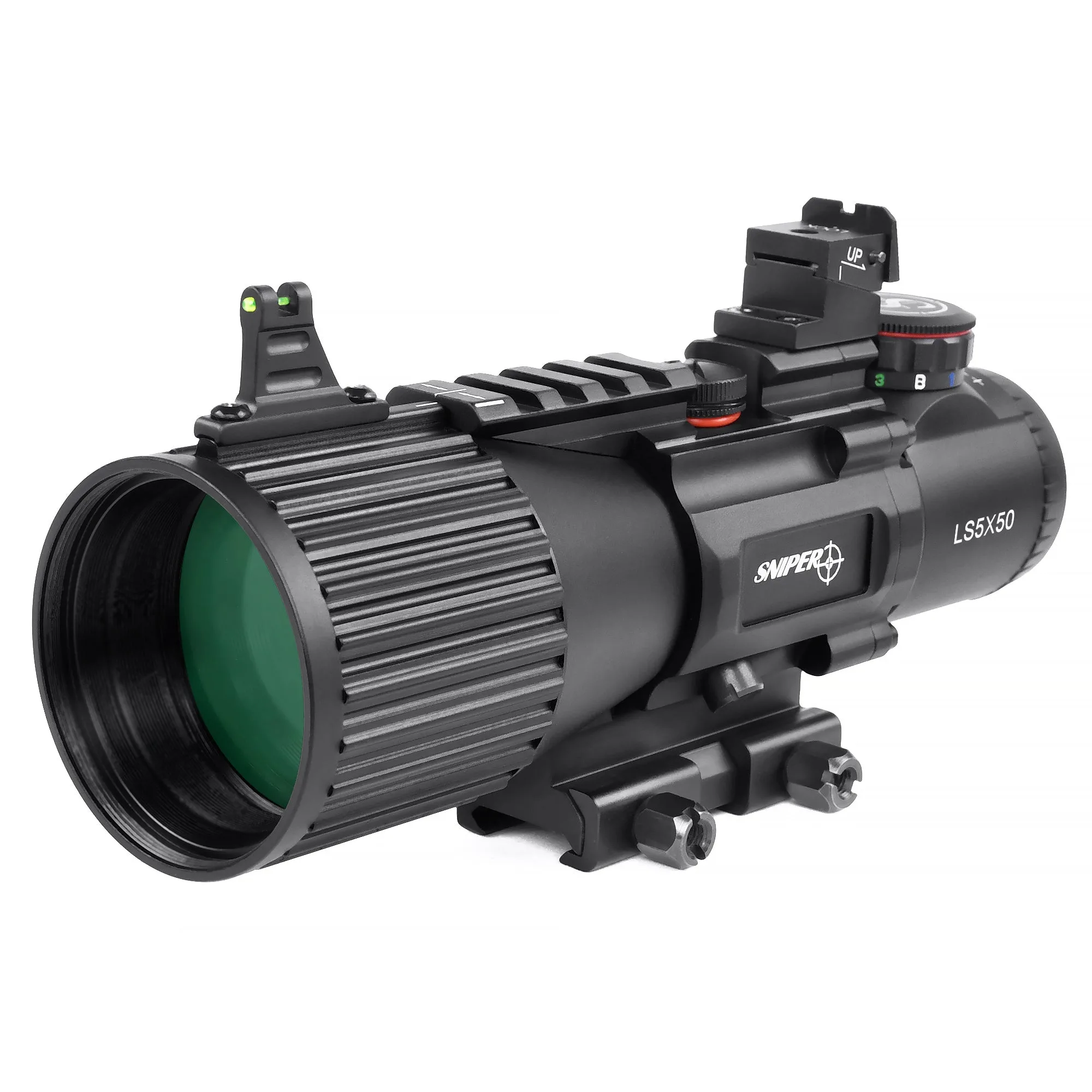
LS 5X50 CB Prism Scope, Red/Green/Blue Illuminated Prism Sight, Compact Prism Scope
-
LS 5X50 CB Prism Scope, Red/Green/Blue Illuminated Prism Sight, Compact Prism Scope: Glass-etched reticle with red, green and blue illumination and multiple brightness levels for each color. You can match reticle brightness to lighting and weather without changing the reticle itself.
-
LS 5X50 CB Prism Scope, Red/Green/Blue Illuminated Prism Sight, Compact Prism Scope: QTA turrets with a 1/2 MOA click value and an adjustment range of ±40 MOA. These are the click values you will use for windage and elevation, and the range limits how far you can adjust from your zero.
-
LS 5X50 CB Prism Scope, Red/Green/Blue Illuminated Prism Sight, Compact Prism Scope: Completely sealed and nitrogen filled, rated shockproof, fogproof and rainproof, with fully coated prism lenses. These environmental ratings matter if the rifle sees weather, recoil and temperature swings.
-
LS 5X50 CB Prism Scope, Red/Green/Blue Illuminated Prism Sight, Compact Prism Scope: Available with either a Chevron or Horseshoe reticle. Reticle choice changes how you pick up the aiming point, so it is worth deciding before you order.
LS 5X50 CB prism scope vs LPVO: side-by-side differences
The table below compares the confirmed LS 5X50 CB features with the general behavior of an LPVO. LPVO details vary by model, so treat the variable-scope column as a category description, not a spec sheet for any one scope.
- Magnification: LS 5X50 CB: fixed 5x. LPVO: variable range, typically starting at 1x and going up to a mid-range top end. A fixed 5x removes the need to check your zoom setting, while an LPVO lets you go wide for close targets.
- Reticle and illumination: LS 5X50 CB: glass-etched reticle with red, green or blue illumination and multiple brightness levels per color, in Chevron or Horseshoe. LPVO: usually a single illuminated color, often with a daylight-bright center dot; reticle designs vary widely.
- Adjustment: LS 5X50 CB: QTA turrets, 1/2 MOA per click, ±40 MOA range. LPVO: click values and adjustment ranges differ by model; check the specific scope before you buy.
- Weight and size: LS 5X50 CB: compact prism design, but the supplied listing does not state a weight. LPVO: usually heavier and longer because of the variable erector and larger turret housing, though exact weight depends on the model. Compare actual published weights before deciding.
- Eye relief: The LS 5X50 CB listing does not state eye relief, so do not assume a figure. LPVOs also vary; check the manufacturer's spec for the model you are considering.
- Environmental sealing: LS 5X50 CB: sealed, nitrogen filled, shockproof, fogproof and rainproof. LPVO: many are similarly rated, but confirm on the specific model.
Fixed prism scope pros and cons for an AR15
A fixed 5x prism scope like the LS 5X50 CB simplifies the rifle. There is no magnification ring to move, so your cheek weld and eye position stay consistent. The etched reticle works even if the illumination is off or the battery dies, which is a practical advantage over battery-dependent designs. The 5x magnification and 28.4 ft field of view at 100 yards give you enough reach for mid-range work without the bulk of a high-power variable scope.
The tradeoff is close-range speed. At 5x, targets inside typical home-defense or close-quarters distances fill the view quickly, and you give up the true 1x wide view an LPVO provides. The LS 5X50 CB also does not offer a variable zoom, so you cannot dial down for a wide field or up for precision. If most of your shooting is at 100 yards and beyond, that is a fair trade; if you need one optic for everything from room clearing to 300 yards, an LPVO is the more flexible tool.
When the LS 5X50 CB is the better fit
- You want a simple, repeatable setup: A fixed 5x removes the variable-power ring and keeps your eye position consistent. The QTA turrets with 1/2 MOA clicks give you a clear adjustment language.
- You value reticle flexibility: Red, green or blue illumination with multiple brightness levels lets you tune the reticle to bright sun, overcast or low light without changing the etched reticle.
- You shoot mostly at mid-range: 5x with a 50mm objective and 28.4 ft field of view at 100 yards is oriented toward target identification and precision beyond close quarters.
- You want a compact prism sight: The prism design is compact, and the sealed, nitrogen-filled body is rated shockproof, fogproof and rainproof. The listing does not publish a weight, so confirm that separately if ounces matter to your build.
When an LPVO makes more sense
- You need a true 1x option: An LPVO can go wide for close targets and then zoom up for distance. The LS 5X50 CB is fixed at 5x, so it cannot match that close-range field of view.
- You want one rifle to cover many distances: A variable range lets you adapt to different target sizes and distances without changing optics. That flexibility is the main reason people choose an LPVO over a fixed prism.
- You accept the weight and complexity: LPVOs are generally heavier and have more controls to manage. If you are optimizing for simplicity, the fixed prism has the edge.
Eye relief and weight: what the listing does not settle
The supplied LS 5X50 CB information does not state eye relief or weight. That is a real limitation for comparison, because eye relief affects how you mount the scope and how forgiving your cheek weld needs to be, and weight affects how the rifle balances. Do not assume the prism scope has long or short eye relief based on its size. If those numbers matter to you, treat them as questions to confirm before ordering, and compare them with the published eye relief and weight of any LPVO you are considering.
The listing does confirm the LS 5X50 CB's adjustment range of ±40 MOA and its 1/2 MOA click value. Those are useful for planning your zero, but they do not tell you how the scope balances on a particular rifle. Weight distribution depends on the mount and the rifle, so the honest answer is that the supplied information supports the magnification, reticle, turret and environmental comparison, not a weight or eye-relief verdict.
A practical way to choose between them
Use this sequence to turn the comparison into a decision for your rifle.
- List your realistic distances: If most of your shooting is beyond 100 yards, a fixed 5x prism is a natural fit. If you regularly shoot inside 50 yards and also at distance, an LPVO's variable range is more adaptable.
- Decide how much simplicity you want: A fixed prism removes the magnification ring and keeps the reticle consistent. An LPVO adds a control you will need to manage under pressure.
- Check the reticle you prefer: The LS 5X50 CB comes in Chevron or Horseshoe. Pick the one that matches how you acquire targets, and confirm the LPVO you are considering offers a reticle you like.
- Confirm the numbers the listing omits: Before ordering, confirm eye relief and weight for the LS 5X50 CB if those matter to you, and compare them with the LPVO's published specs.