What the LS80MT Offers for H-Alpha Observing
The Lunt LS80MT is a modular telescope that can be configured for Hydrogen Alpha, Calcium K, or white light solar observing, as well as nighttime astronomy. In its H-alpha setup, the internal etalon delivers a bandpass of <0.65 Angstroms (single stacked) and can be reduced to <0.45 Angstroms with a double-stack module. The pressure tuning system provides Doppler True Tuning, allowing you to shift the passband toward or away from the observer for enhanced surface detail and a 3D-like view of filaments and active regions.
Because the LS80MT is modular, the initial assembly requires choosing the right blocking filter and focuser, then attaching the H-alpha module. This guide walks through the key decisions and steps based on the supplied configuration options.
Choosing a Blocking Filter and Focuser
The LS80MT requires a blocking filter for daytime solar use. Two options are available from the catalog: the B1200 for visual observing and the B1800 for a wider field of view and imaging. Both can be ordered in standard (diagonal) or straight-through configurations. The focuser choices include a 2" Crayford with 10:1 reduction, a 2" rack & pinion with 10:1 reduction, or a 2" Feather-Touch with 10:1 reduction.
Your selection affects the viewing experience: the B1800 is better for imaging and larger fields, while the B1200 is sufficient for visual work. The Feather-Touch focuser offers finer control for critical focusing.
-
LS80MT Modular Telescope H-Alpha Pressure Tuned: The LS80MT is available with B1200 or B1800 blocking filter and three focuser options. The blocking filter determines the field of view and suitability for imaging; the focuser affects ease of precise focusing.
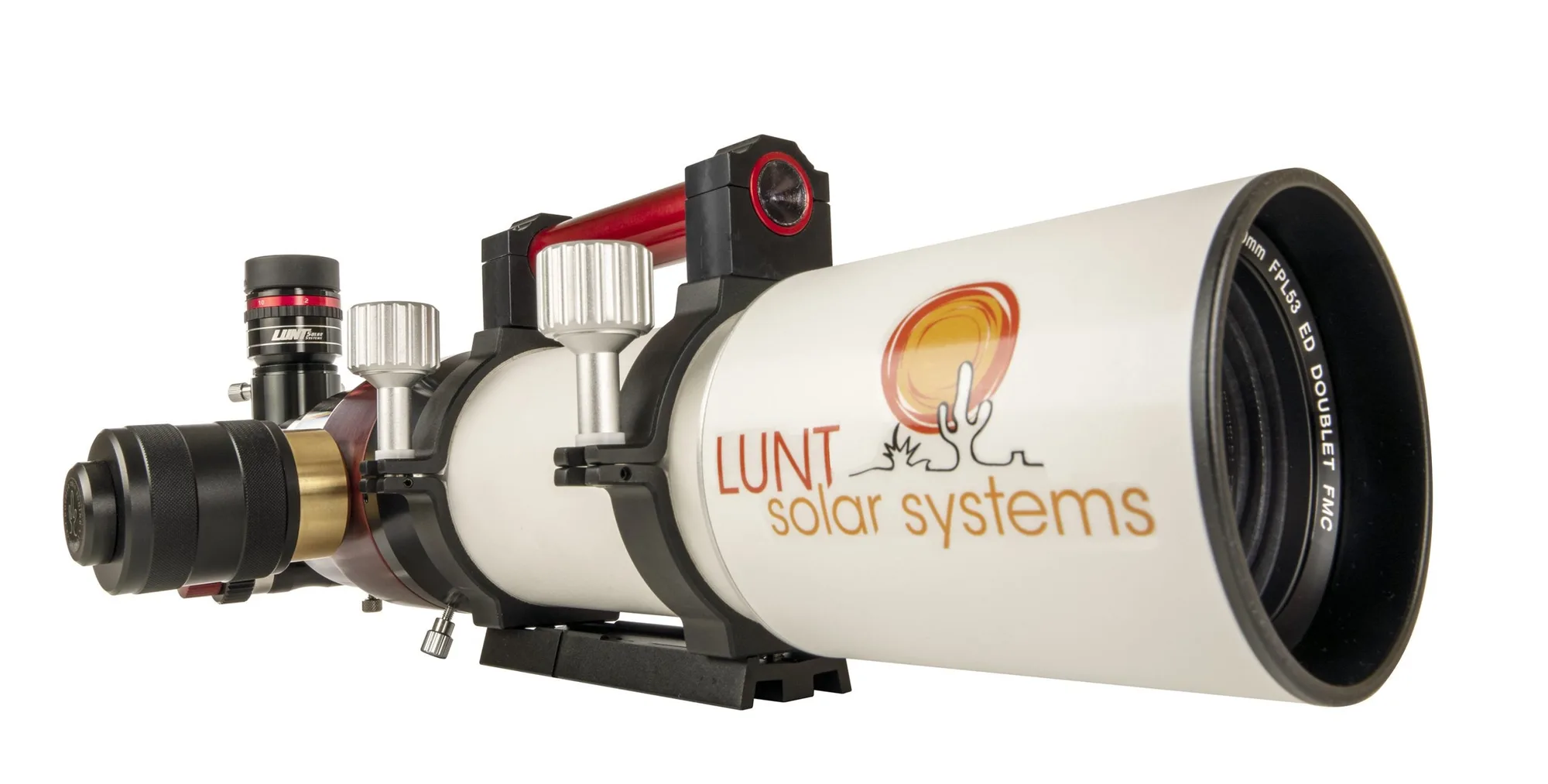
LS80MT Modular Telescope H-Alpha Pressure Tuned
Assembling the LS80MT for H-Alpha Viewing
Follow these steps to configure the LS80MT as an H-alpha solar telescope. Always ensure the blocking filter is installed before pointing at the Sun.
- Attach the blocking filter: Select your blocking filter (B1200 or B1800) and attach it to the rear of the H-alpha module. If you ordered a diagonal version, the blocking filter is integrated into the diagonal. For straight-through, it attaches directly.
- Mount the H-alpha module: The LS80MT comes with the H-alpha module pre-installed in the optical train. Ensure it is securely fastened to the OTA. For double-stack configurations, a second etalon module is added in front of the first.
- Install the focuser: The telescope includes a 2" Crayford focuser with 10:1 reduction as standard. If you ordered a different focuser, replace it now. The 10:1 reduction allows fine adjustments.
- Attach the red dot finder: The included red dot finder handle helps aim the telescope at the Sun. Mount it on the dovetail or tube ring as preferred.
- Set up on a mount: The LS80MT includes a 6" dovetail and mounting ring assembly. Attach it to a sturdy mount capable of supporting the 9.25 lb OTA. Balance the telescope before observing.
Tuning the Pressure System for Best Views
The pressure tuning system adjusts the etalon gap by changing internal air pressure, shifting the passband in wavelength. This allows you to see features at different heights in the solar atmosphere. For example, tuning toward the blue wing enhances material moving toward you, while the red wing shows receding material. This Doppler effect adds a 3D-like appearance to filaments and active regions.
Start with the pressure tuner at its midpoint, then slowly adjust while observing a filament or active region. You will notice the feature become more or less defined as you shift through the bandpass. The system provides an order of magnitude more precision than mechanical tuning, making it easier to dial in the best contrast.
Transitioning to Nighttime Use
One of the LS80MT's key features is its modularity: you can remove the H-alpha module and replace it with a backing plate and focuser (available in packages) to convert the telescope into a nighttime ED refractor. The FPL-53 doublet lens provides excellent color correction for lunar, planetary, and deep-sky observing. The supplied instructions indicate you can simply swap modules to switch between solar and night use.
What the Catalog Does Not Confirm
The supplied information does not include specific instructions for collimation, cleaning the etalon, or using the telescope with a star diagonal for nighttime use. It also does not specify the exact power requirements for the pressure tuning system (if any) or provide a step-by-step guide for double-stack installation. For these details, refer to the manufacturer's manual or contact Cloud Break Optics support.