A matching game that fits a first board game slot
The Lunch Box Game is a memory and matching game from Orchard Toys for children aged 3 and up. Each player takes a jigged lunch box board and turns over food item cards, keeping any card that matches a food shown on their own board. The first player to collect all six matching food items and complete their lunch box wins.
That simple loop is the reason it works as an early board game: one action per turn, a visible goal on each board, and no reading required. The supplied description also frames it as a way to start conversations about nutrition, food groups, colours, shapes and textures.
What you get in the box
-
Lunch Box Game: Contents: 4 jigged lunchbox boards, 24 item cards and 1 instruction leaflet. Four boards means up to four players, which suits a small family or a preschool table group.
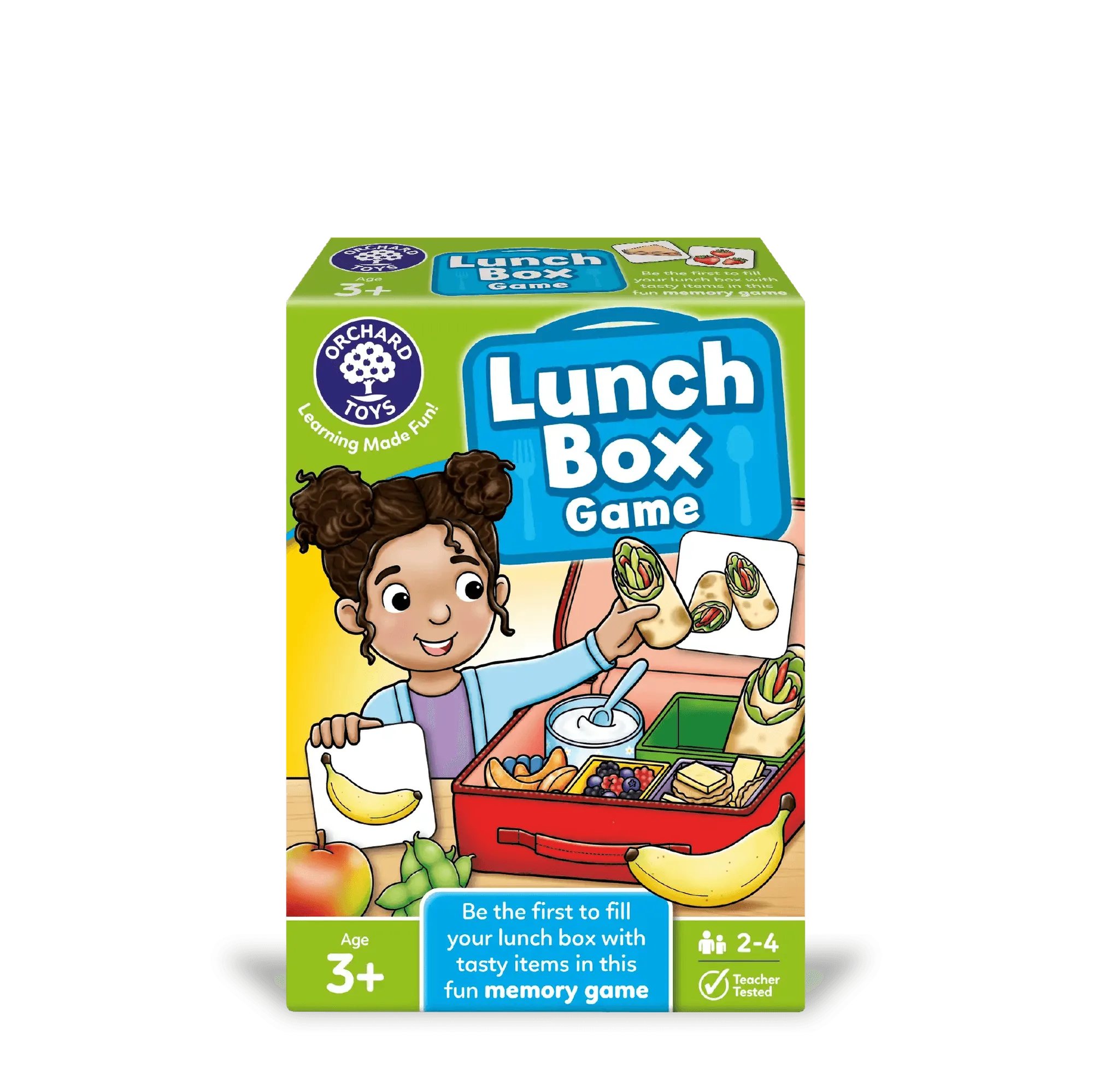
Lunch Box Game
-
Lunch Box Game: Perfect for children aged 3+. The age guidance is the first filter: this is not a toddler game for children under three.
-
Lunch Box Game: Not suitable for children under 3 years due to small parts. Choking hazard. The cards are small parts, so keep the game away from younger siblings and check pieces before each play.
How a turn works
The supplied instructions describe a straightforward turn structure. Set up one board per player, shuffle the food item cards, and take turns.
- Choose a lunch box board: Each player takes one of the four jigged lunchbox boards and looks at the six foods shown on it.
- Turn over a food card: On your turn, turn over one food item card from the pile.
- Keep a match, return a miss: If the card matches a food shown on your board, keep it and place it on the board. If it does not match, the turn passes.
- Complete the lunch box to win: The first player to collect all six matching food items and fill their lunch box wins the game.
Where it fits in a preschool game collection
If you already own a memory game, the Lunch Box Game is a variation on the same mechanic rather than a new one. Its distinct angle is the food theme: the boards and cards give you something concrete to talk about while you play, from naming foods to sorting them by colour or type.
Compared with a free-form matching activity, the game adds turn-taking and a shared finish line. That makes it a reasonable step up from solo puzzles and a gentler introduction to rules than a game with several actions per turn.
Who it suits and who might skip it
Use the supplied age range and player count as the main decision points rather than assuming it will fit every household.
- Good fit: a first or second board game for a three- or four-year-old: One action per turn and a visible goal on each board keep the rules light for a child just learning to wait for a turn.
- Good fit: families of up to four players: Four lunchbox boards are included, so the game supports four players without extra pieces.
- Good fit: adults who want a food-themed conversation starter: The supplied description explicitly links play to talk about nutrition, food groups, colours, shapes and textures.
- Might skip: households with children under three: The small-parts warning makes it unsuitable for under-threes, so a household with a toddler may prefer to wait or play only when the younger child is elsewhere.
- Might skip: families looking for a strategy game: The supplied rules describe memory and matching only; there is no evidence of deeper strategy or variable difficulty levels.
What the supplied information doesn't tell you
The supplied record does not include board or card dimensions, material details, or a playtime estimate. It also does not confirm whether the game includes a storage box or bag. If those details matter to you, check the packaging or the full listing before buying rather than assuming.
The record also does not list any additional difficulty variants or expansion cards. The supplied variant evidence shows only a Standard option, so treat the game as a single, fixed set.
A note on value
The catalog lists the Lunch Box Game at USD 6.39 against a comparison price of USD 9.99. At that level, the decision is less about budget and more about whether the age range and player count fit your household. If you have a three- or four-year-old and up to three other players, the contents are enough for a complete game without extras.