Nylon vs Metal M2 Screws: The Core Difference
When choosing an M2 fastener for your electronics project, the material matters as much as the size. Both nylon and metal M2 screws share the same thread and length options, but they behave very differently in a circuit.
The key difference is electrical conductivity. Metal screws conduct electricity and can cause short circuits if they touch live traces or components. Nylon screws are electrically insulating, so they won't create unintended connections.
When Nylon Screws Are the Better Choice
Nylon M2 screws shine in situations where metal would be a liability. Because nylon does not conduct electricity, it is safe to use near exposed circuit boards, battery terminals, or any area where a metal screw could bridge two contacts.
Nylon is also transparent to radio frequencies (RF). If your project includes an antenna, wireless module, or RF transmitter, a nylon fastener will not block or distort the signal the way a metal screw might.
The M2 x 10mm Countersunk Nylon Screw is a good example: its flat, countersunk head sits flush with the surface, so it won't interfere with nearby components or enclosures. The nylon material keeps the assembly lightweight and eliminates the risk of shorts.
M2 x 10mm Countersunk Nylon Screw Evidence
-
M2 x 10mm Countersunk Nylon Screw: These M2 screws are 10mm in length and the crosshead is countersunk, which means they're perfect for projects where standard screw heads would get in the way. The countersunk profile allows the screw head to sit flush, making it ideal for tight enclosures or stacked boards where clearance is limited.
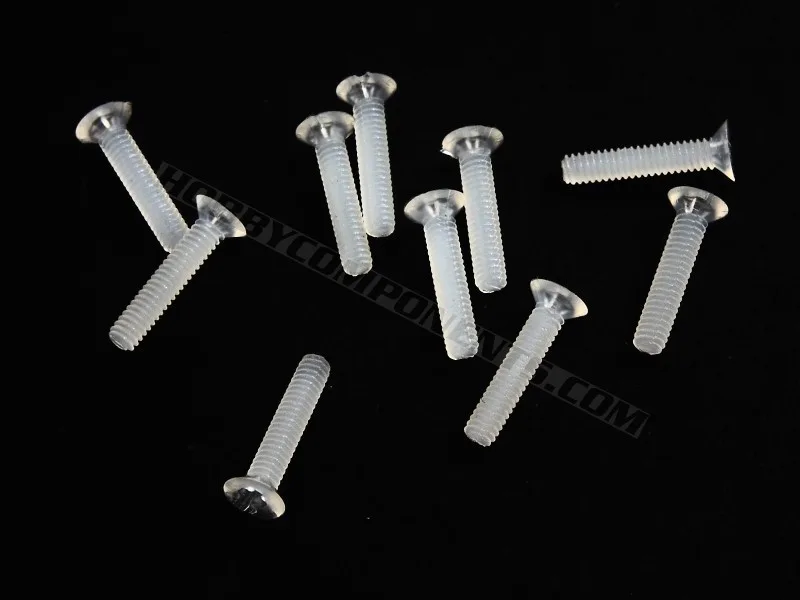
M2 x 10mm Countersunk Nylon Screw
-
M2 x 10mm Countersunk Nylon Screw: The fact that these are nylon and not metal means they are light-weight and won't cause any short circuits or interfere with RF signals. This confirms nylon's key advantage over metal: it is non-conductive and RF-transparent, so it can be used safely near circuits and antennas.
Nylon vs Metal M2 Screws: Key Differences
- Electrical conductivity: Nylon is an insulator; metal conducts electricity. Nylon is safe near live circuits, while metal can cause shorts.
- RF interference: Nylon does not block or reflect radio signals. Metal can detune antennas or shield RF paths.
- Weight: Nylon is significantly lighter than metal, which matters in portable or weight-sensitive builds.
- Strength and torque: Metal screws are stronger and can be tightened more. Nylon is more brittle and can strip if over-tightened.
- Corrosion: Nylon does not rust or corrode. Some metal screws (e.g., steel) can corrode in humid environments.
When Metal Screws Are Still Useful
Metal M2 screws are the right choice when you need high tensile strength, such as mounting a heavy component or securing a metal bracket. They also work well in purely mechanical assemblies where electrical isolation is not a concern.
If your project has no risk of short circuits—for example, fastening a plastic enclosure lid or mounting a non-conductive part—metal screws can be used without issue. Just be careful not to let them touch any PCB traces or exposed wiring.
How to Choose Between Them
Start by asking: could this screw touch a live circuit or an antenna? If yes, choose nylon. If the screw is purely structural and far from any conductors, metal is fine.
For mixed situations—like a screw that passes through a PCB but also holds a metal shield—use nylon to avoid accidental shorts. The M2 x 10mm Countersunk Nylon Screw is a practical option for many electronics projects because its flush head and insulating properties solve both clearance and safety concerns.