Quick answer
For M8 x 22mm cone point set screws, use a hex socket driver, apply moderate torque (typically 10–15 Nm for alloy steel), and ensure the cone point seats fully into the countersink for a flush finish.
Why sizing matters for cone point set screws
Cone point set screws are designed to sit flush or slightly below the surface when installed into a countersunk hole. The M8-1.25 thread pitch is standard, but the 22mm length is specific—too short and the screw won't engage fully; too long and it may bottom out or protrude. Always measure the material thickness plus the depth of the countersink before selecting length.
Alloy steel vs. other materials
Alloy steel offers good strength and wear resistance at a lower cost than stainless or hardened steel. However, it is more prone to corrosion in wet environments. For indoor mechanical assemblies, alloy steel is a practical choice; for outdoor use, consider a coated or stainless variant.
How to install M8 cone point set screws
- 1. Prepare the hole: Drill a clearance hole for the M8 thread (typically 8.5 mm) and countersink the hole to match the cone angle of the screw. Use a countersink bit that matches the screw's cone profile. Common mistake: using a straight drill bit without countersinking will leave the cone head proud.
- 2. Check thread engagement: Insert the screw into the hole by hand to verify it threads smoothly. The M8-1.25 thread should engage at least 1.5 times the screw diameter (12 mm) for proper strength. If the screw binds or feels tight by hand, re-check the hole diameter and thread condition.
- 3. Apply lubricant (optional): For alloy steel screws, a drop of light machine oil on the threads reduces friction and helps achieve consistent torque. This is especially helpful in blind holes. Do not use heavy grease; it can trap debris and alter torque readings.
- 4. Drive with a hex socket driver: Use a correctly sized hex socket (usually 5 mm for M8) in a torque wrench or driver. Turn the screw until the cone head contacts the countersink, then apply final torque. Common mistake: using a ball-end hex key can strip the socket under high torque—use a straight hex bit.
- 5. Torque to specification: For alloy steel M8 set screws, a typical torque range is 10–15 Nm (7–11 ft-lb). Always refer to your assembly's torque spec. Over-torquing can strip the threads or break the screw. If no spec is available, start at 10 Nm and increase in 1 Nm increments until snug—do not exceed 15 Nm for alloy steel.
- 6. Verify flush fit: After installation, run a finger over the head. The cone point should be flush or slightly below the surface. If it protrudes, the countersink is too shallow; if it sinks too deep, the hole is too large or the screw is too short. A proud head can interfere with mating parts; re-countersink or use a shorter screw.
Product considerations
-
M8 X 22mm Cone Point Socket Set Screws | Alloy Steel (250 / Pkg.): M8 x 22mm cone point socket set screws in Alloy Steel, hex socket drive, thread size M8-1.25, package of 250. The hex socket drive allows high-torque adjustment in tight spaces, and the cone point ensures a flush finish when used with a matching countersink.
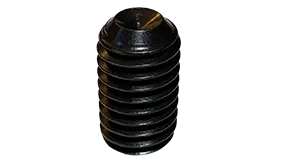
M8 X 22mm Cone Point Socket Set Screws | Alloy Steel (250 / Pkg.)