Quick answer
Magnetic shims hold alignment by sticking to the cast-iron or steel surfaces of your saw, fence, or drill press, so you can stack them to a precise height or gap without clamps or tape. They work best for repeatable setup tasks like blade height, fence spacing, and router bit depth, not for heavy lifting or permanent machine leveling.
Where magnetic shims earn a place in the shop
The real advantage is speed and repeatability. Instead of hunting for a ruler or test-cutting a scrap, you stack a known shim thickness against a reference surface and lock your adjustment. Because the shims stay put magnetically, you can use both hands for the wrench or lock lever.
They are especially handy when you change setups often: switching from a ripping blade to a dado stack, moving a fence for a repeated cut, or setting a drill press depth for a batch of holes. The shims act as a physical reminder of the dimension you set, so you can return to it quickly.
Limits you should know before relying on them
Magnetic shims only stick to ferrous metal. Aluminum fence extrusions, stainless steel tops, and most plastic or wood surfaces won’t hold them. On those machines you’ll need a different setup block or a mechanical stop.
Stacking thin shims can introduce small errors if the surfaces aren’t clean or if the shims aren’t seated flat. For critical joinery, verify the final setting with a test cut or a dial indicator rather than trusting the stack alone. Also, magnetic shims are not a substitute for locking a fence or blade height—they are a setup aid, not a clamp.
Common questions about magnetic shims for saw setup
How do magnetic shims actually hold alignment?
The magnets in each shim stick to the steel or cast-iron table, fence, or drill press column. You stack shims until the stack matches the height or gap you need, then adjust the machine until it touches the stack. The magnetic hold keeps the shims from sliding while you tighten the lock.
Can I use magnetic shims to set blade height on a table saw?
Yes, if your table top or blade arbor area is ferrous metal. Stack the shims on the table next to the blade, raise or lower the blade until it just touches the stack, then lock the height. For repeat cuts, note the shim combination so you can return to it. Always unplug the saw before reaching near the blade.
What about fence spacing and router bit depth?
Place the stack between the fence and the blade or bit, or use it as a spacer against the fence and the table. For router bit depth, stack shims on the router table surface and lower the bit until it touches. The same magnetic hold works on any ferrous surface.
Do magnetic shims work on aluminum or stainless steel machines?
No. Magnets won’t stick to aluminum or most stainless steel. Check your machine with a magnet before buying. For non-ferrous surfaces, use a setup block with a mechanical clamp or a magnetic base that attaches elsewhere.
How accurate are stacked magnetic shims?
Accuracy depends on the shim thickness and how cleanly they stack. Keep the shims clean and flat, and avoid mixing inch and millimeter sets in one stack. For critical work, confirm with a test cut or a measuring tool rather than assuming the stack is exact.
Product facts
-
FastCap Magnetic Shim Sets: FastCap Magnetic Shim Sets are available in inch or millimeter units and are designed to stick together or pull apart for stacking. Choosing the unit that matches your drawings or existing rulers avoids conversion mistakes when you stack shims for a target height.
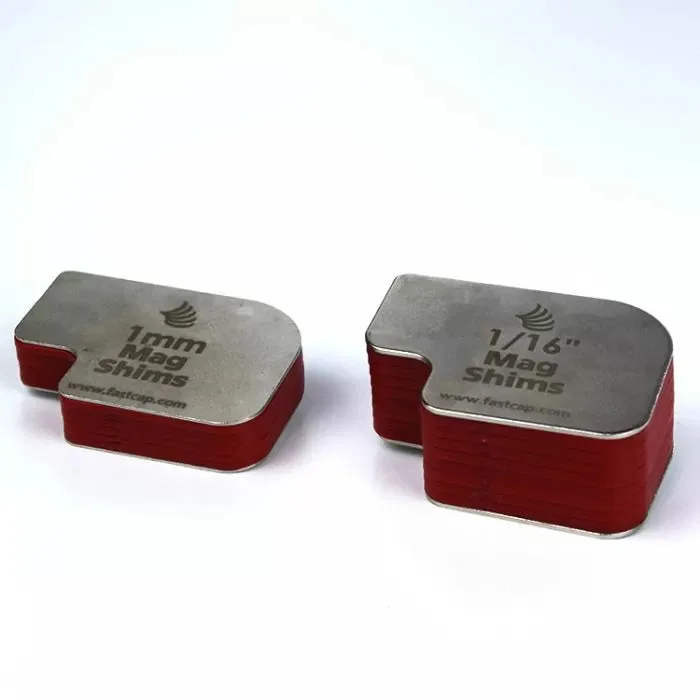
FastCap Magnetic Shim Sets