The game in one sentence
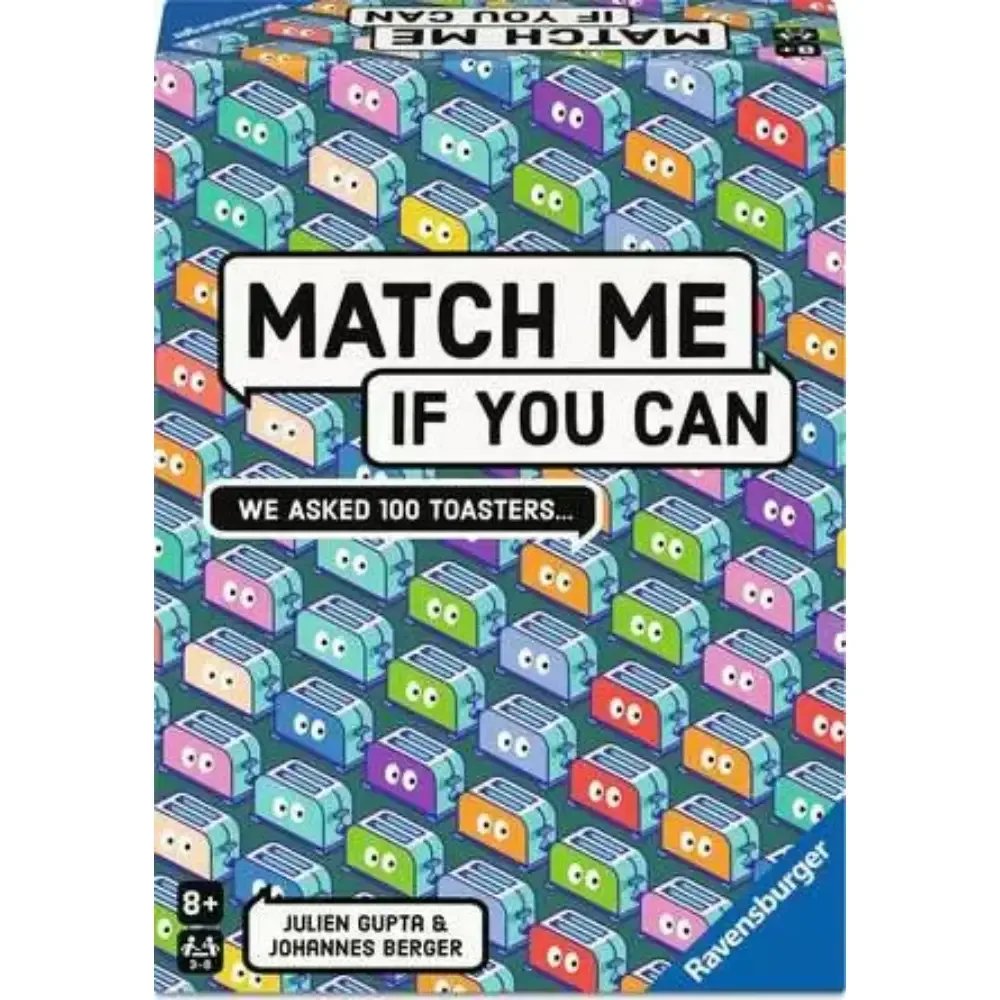
Match Me If You Can is a party game of nonsense questions: you invent answers for toasters, donuts, dodgeballs, and other everyday objects, then see whether your friends thought the same way. The catalog is explicit that there’s no right or wrong — the goal is to match, not to be correct. That single rule is what makes it easy to teach kids: nobody can get the answer wrong, so the pressure is off.
What the catalog confirms
-
Match Me If You Can: In this party game of nonsense questions, invent answers for toasters, donuts, dodgeballs, and other everyday objects. The everyday-object prompts are the whole play loop, so you can explain the game to kids by pointing at things in the room.
Match Me If You Can
-
Match Me If You Can: There’s no right or wrong. You just have to think the same way as your friends! This is the rule to repeat first: matching is the win condition, not correctness.
-
Match Me If You Can: Can you match and make it to the next level? The catalog frames play as progressing through levels, so expect rounds to build rather than one flat session.
How to teach it to kids in four steps
The catalog does not supply a formal rulebook, setup sequence, player count, or age range, so treat the steps below as a teaching approach built from the confirmed play idea rather than manufacturer instructions. Check the packaging for the official rules before your first game.
- 1. Say the one rule out loud: Tell kids there’s no right or wrong — you just have to think the same way as your friends. Repeat it before every round until it sticks.
- 2. Model a nonsense answer: Pick an everyday object the catalog names, such as a toaster or a donut, and give a silly answer yourself. Kids copy the format faster than they follow an explanation.
- 3. Let them invent, then compare: Each player gives an answer for the same object. The fun is in hearing how differently everyone thinks, then noticing who matched.
- 4. Track matches toward the next level: The catalog asks whether you can match and make it to the next level, so celebrate matches as progress rather than scoring mistakes.
Making it work with younger players
- Use objects they can see: The catalog’s examples — toasters, donuts, dodgeballs — are familiar household and playground items. Pointing at a real toaster or holding up a dodgeball gives preschoolers a concrete starting point.
- Accept any answer as valid: Because there’s no right or wrong, resist correcting a child’s answer. The matching happens afterward, when players discover who thought alike.
- Keep rounds short: The catalog confirms levels but not round length, so watch attention spans and stop while it’s still fun rather than pushing to a fixed number of rounds.
What to check on the box before family night
The supplied catalog information does not confirm an age range, player count, play time, or a component list, so check the packaging for those details before you plan a family game night around it. What the catalog does confirm is the core activity — inventing answers for everyday objects and trying to match your friends — which is enough to know whether the group will enjoy the format. At a catalog price of USD 13.19 (compared with USD 19.99), it sits in the low-cost range for a party card game, but the catalog does not state how many cards or components are included.