What This Kit Helps You Build
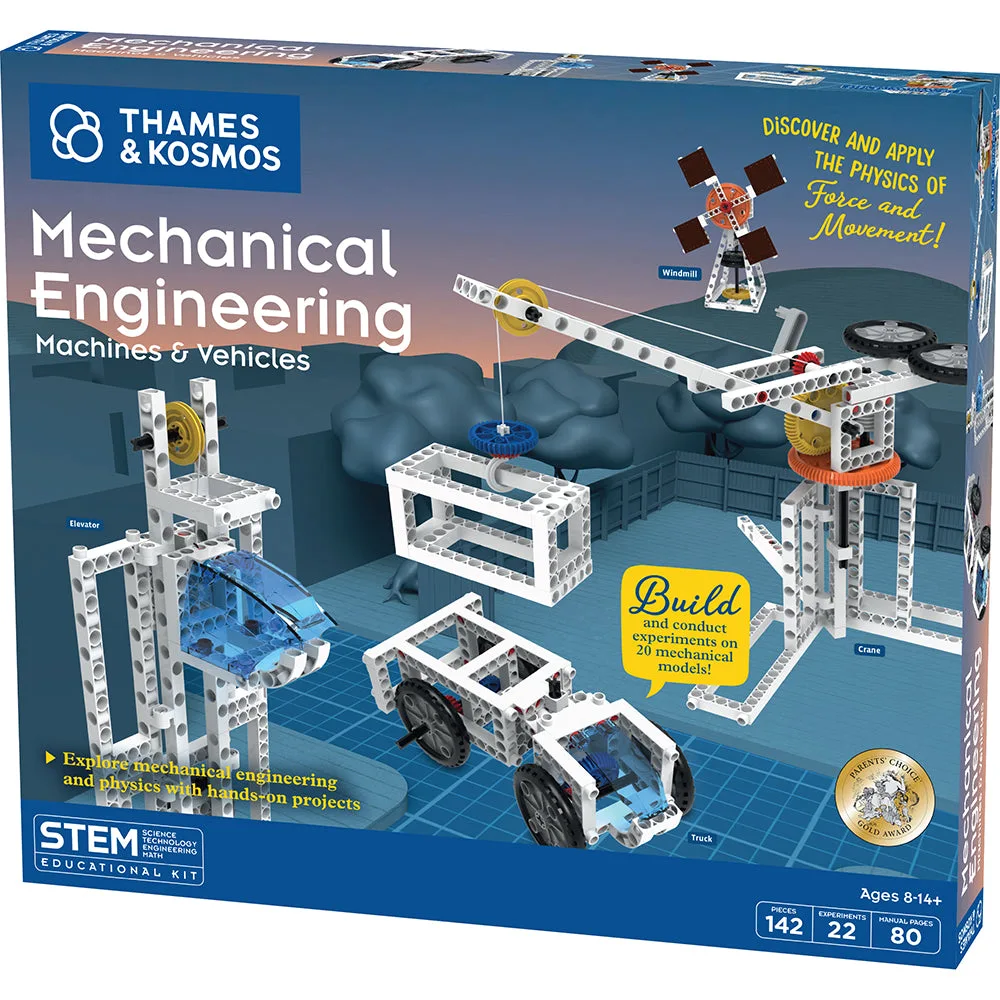
The Mechanical Engineering: Machines & Vehicles kit from Thames & Kosmos is designed for ages 8 and up. It includes 142 pieces and a full-color 80-page manual that guides you through 20 building projects and 22 experiments. The durable, reusable building system can be reconfigured into models like a tightrope walker, elevator, crane, windmill, and an all-wheel drive ATV. Each project demonstrates a core mechanical engineering concept, such as forces, gravity, and storing and converting energy.
Kit Specifications at a Glance
-
Mechanical Engineering: Machines & Vehicles: The kit contains 142 pieces and an 80-page manual with step-by-step illustrated assembly instructions and thorough explanations of the 'why' and 'how' of each experiment. The manual is the primary resource for understanding the science behind each build, making it essential for both assembly and learning.
Mechanical Engineering: Machines & Vehicles
-
Mechanical Engineering: Machines & Vehicles: Product dimensions: 13 x 11.5 x 1.8 in. Weight: 2.3 lbs. No batteries required. The kit is compact and lightweight, easy to store or take to a workspace. No need to source extra batteries.
-
Mechanical Engineering: Machines & Vehicles: Country of origin: Taiwan. Year released: 2025. A relatively recent release, so the design and learning approach reflect current STEM education practices.
A Practical Build Sequence for Your First Project
Start with one of the simpler models to get comfortable with the building system. The manual groups projects by difficulty, but you can choose any order. Here is a suggested sequence for a first session.
- 1. Set up your workspace: Clear a flat surface with good lighting. Open the box and sort the 142 pieces by type—gears, axles, connectors, and structural parts. This saves time during assembly.
- 2. Choose a first project: The manual's first few projects (like the tightrope walker) use fewer pieces and introduce basic mechanisms. Follow the step-by-step illustrated instructions carefully.
- 3. Build and test: Assemble each step as shown. After completing the model, use it to conduct the associated experiment. The manual explains what to observe, such as how weight distribution affects balance or how a pulley reduces effort.
- 4. Disassemble and reconfigure: The building system is reusable. After testing, take the model apart and sort pieces again before starting the next project. This reinforces the idea that engineering often involves iteration.
What You Learn from Each Experiment
The 22 hands-on experiments are designed to demonstrate key mechanical engineering principles. For example, building the elevator model teaches about pulleys and mechanical advantage. The windmill shows how wind energy can be converted into rotational motion. The all-wheel drive ATV illustrates how gears and axles transmit power to wheels. Each experiment includes real-world examples that connect the model to everyday machines and vehicles.
Practical Tips for Success
Keep the manual open to the current step and check each piece against the illustration. If a piece does not fit, do not force it—verify you have the correct part. Younger builders may need help reading the instructions or handling small pieces. The kit is designed for ages 8+, but adult supervision can enhance the learning experience. No batteries are required, so all experiments rely on mechanical energy alone.