The claim worth testing: a timer with no batteries is automatically better
The pitch for a mechanical kitchen timer usually rests on one promise: it works without batteries, so it can't die on you mid-bake. That part is real for the Deco Essentials Mechanical 60 Minute Kitchen Timer, whose catalog record states plainly that it is mechanical and needs no batteries. What the record does not do is prove the timer is more accurate, more durable, or better suited to every kitchen than the phone in your pocket.
So the honest question isn't whether a no battery kitchen timer is a nice idea. It's whether the specific limits of a wind up kitchen timer fit how you cook, and whether the claims you've heard about it hold up.
Four claims about mechanical timers, sorted by what we can confirm
Each claim below is checked against the supplied product record, not against general timer folklore.
- Claim: it never needs charging or batteries: Supported. The record says the timer is mechanical and no batteries are needed. That removes one failure point, but it does not tell you how long the internal mechanism lasts.
- Claim: it counts down any time you need: Partly supported. The record confirms you can set 1-60 minutes and that it counts down to zero. Anything beyond 60 minutes is outside the stated range, so long braises and overnight proofs need a different tool.
- Claim: you'll hear it from another room: The record describes an extra-long, can't miss ring. That is the manufacturer's wording, not a measured loudness figure, so treat it as a description rather than a guarantee for a noisy house.
- Claim: it's more accurate than your phone: Not confirmed either way. The record says it accurately counts down to zero but gives no tolerance or drift figure. A phone timer is typically precise to the second; a mechanical timer's real-world accuracy is not documented in the supplied information.
Kitchen timer vs phone: the tradeoffs that actually matter
Neither tool wins outright. The useful split is about attention and failure modes, not about which one is more modern.
- Battery and charge dependence: Phone: needs charge and can be silenced or buried in notifications. Mechanical timer: the record confirms no batteries are needed, so it is always ready as long as the mechanism is wound and set.
- Setting speed: Phone: fast if the screen is unlocked and the app is open. Mechanical timer: the record says it is easy to read and set, with a 1-60 minute range, but it is a physical dial rather than a keypad.
- Range and precision: Phone: handles hours-long and multi-step timers. Mechanical timer: capped at 60 minutes per the record, with no stated accuracy tolerance.
- Placement: The record says the timer can stand upright on a counter or stove, or lie on its back on any flat surface. A phone usually needs a stand or a safe, dry spot away from heat and splashes.
What the Deco Essentials timer record actually confirms
-
Deco Essentials Mechanical 60 Minute Kitchen Timer, No Batteries Needed, Easy to Read and Set: Mechanical design with no batteries needed. This is the core reason to choose it over a phone or battery timer: one less thing to charge or replace.
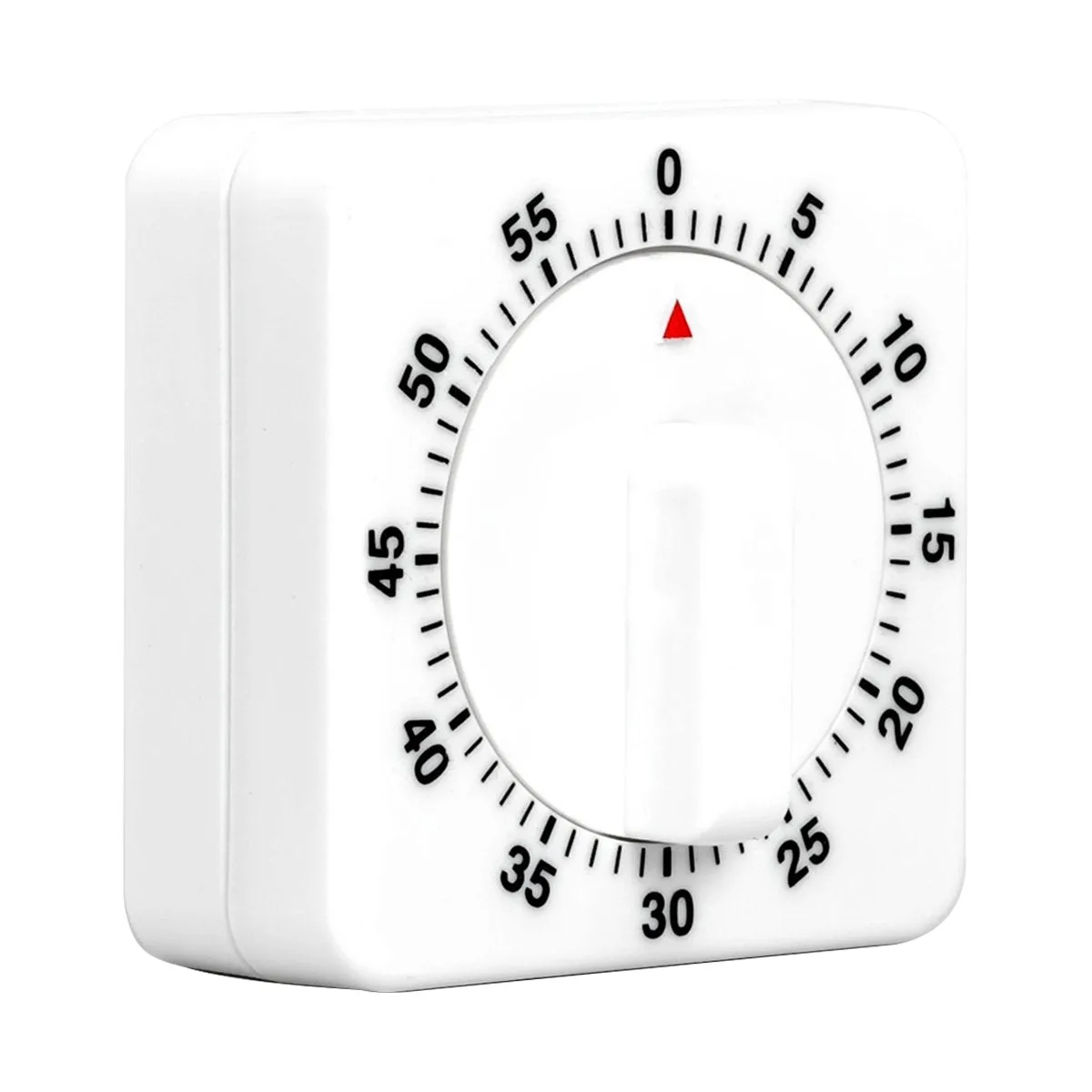
Deco Essentials Mechanical 60 Minute Kitchen Timer, No Batteries Needed, Easy to Read and Set
-
Deco Essentials Mechanical 60 Minute Kitchen Timer, No Batteries Needed, Easy to Read and Set: Settable from 1-60 minutes and counts down to zero. Defines the jobs it suits, such as baking, cooking and short reminders, and rules out anything longer than an hour.
-
Deco Essentials Mechanical 60 Minute Kitchen Timer, No Batteries Needed, Easy to Read and Set: Extra-long, can't miss ring. Addresses the main worry with a timer you walk away from, though the record gives no decibel rating.
-
Deco Essentials Mechanical 60 Minute Kitchen Timer, No Batteries Needed, Easy to Read and Set: Stands upright on a counter or stove, or lies on its back on a flat surface. Two placement options make it easy to keep within earshot without a stand.
Cooking timer tips that play to a wind-up timer's strengths
These tips follow from the confirmed 1-60 minute range and mechanical operation. They are habits, not manufacturer instructions.
- Use it for the tasks you'd otherwise forget: Baking, steeping, resting meat, or a short reminder while you're busy are exactly the jobs the record names. Set the dial once and walk away.
- Keep a phone timer for anything over an hour: Because the range stops at 60 minutes, long roasts and overnight dough need a different timer. Splitting the jobs avoids forcing one tool past its limit.
- Place it where you'll hear it: Stand it upright on the counter or stove, or lay it flat, per the record. If your kitchen is loud, test the ring once before relying on it from another room.
- Don't expect a smart timer: The record describes a single mechanical dial with no app, presets or memory. If you want multi-step alerts, a phone is the better fit.
What the listing leaves open before you buy
The record does not state an accuracy tolerance, a ring volume in decibels, a materials list, or cleaning instructions. It also doesn't say how the timer should be stored or whether the mechanism needs any maintenance. Those aren't reasons to avoid it, but they are reasons not to repeat claims the listing doesn't support.
The variant evidence lists color as none, so don't expect a color choice beyond what the store shows. If a specific finish matters to you, confirm it on the product page before ordering rather than assuming.
The verdict: a useful tool, not a universal upgrade
The myth is that a mechanical timer replaces your phone. The evidence supports something narrower: the Deco Essentials Mechanical 60 Minute Kitchen Timer is a dependable no battery kitchen timer for 1-60 minute jobs, with a loud ring and flexible placement, and it removes charging from the equation entirely. It does not claim better accuracy than a phone, and it can't handle timers longer than an hour.
Buy it if you want a dedicated, always-ready cooking timer for baking and short reminders and you're happy with a physical dial. Skip it if you need multi-step timers, hour-plus ranges, or documented precision. In 2026, the sensible setup is often both: a wind-up timer on the counter for the everyday jobs, and your phone for everything the dial can't reach.