A cuff is a different kind of bracelet
Most bracelets close around your wrist. A cuff does not. It is an open band that holds its shape and slides on from the side of your wrist, which means the fit depends on the gap and the curve of the metal rather than on a clasp. That changes how you choose one: the size has to suit your wrist, and the style has to suit how much movement you want from the piece.
The Men's Silver Grain Cuff is a good example of what to look for. It is a thin, oxidized silver cuff with a subtle, edgy finish, and it is designed to be worn alone or stacked with other bracelets. Because it is thin, it sits close to the wrist without feeling bulky, which makes it an easy first cuff if you are used to closed bracelets.
The piece in this guide
-
Men's Silver Grain Cuff: Men's Silver Grain Cuff: thin, oxidized silver cuff available in sizes, designed to wear alone or stacked. The thin profile and oxidized finish are the two features that most affect how it fits and how you style it.
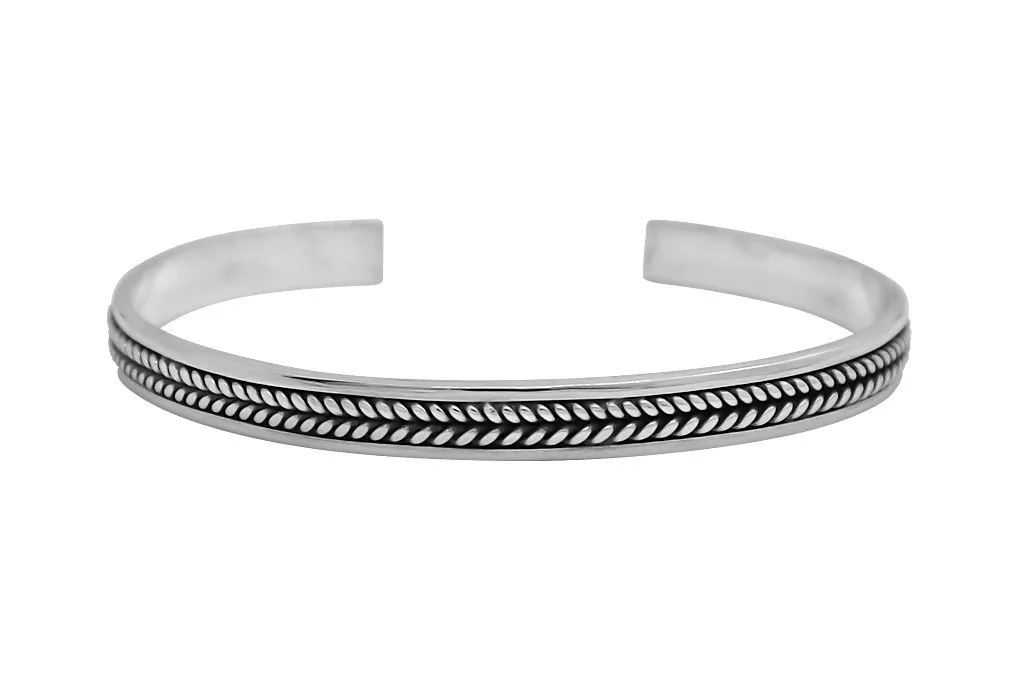
Men's Silver Grain Cuff
How to get cuff bracelet sizing right
Cuff sizing is less forgiving than a chain bracelet, so check these points before you order.
- Measure your wrist, not your old bracelet: Wrap a soft tape or a strip of paper around your wrist just below the wrist bone and note the circumference. Use that number as your starting point rather than guessing from a bracelet you already own.
- Check the size options on the product page: The Silver Grain Cuff is offered in sizes, so match your measurement to the size chart on the listing. If you are between sizes, think about whether you want the cuff to sit snugly or to slide slightly.
- Consider the opening: A cuff has a gap that lets you put it on. A gap that is too wide makes the cuff feel loose and prone to rotating; one that is too narrow makes it hard to slide over your hand. The right size should go on with a little pressure and then sit still.
- Adjust gently, and only once: Thin cuffs can be eased slightly to fit, but repeated bending weakens the metal. If the size is clearly wrong, exchange it rather than reshaping it every time you wear it.
How to wear a silver cuff without overdoing it
The advantage of a thin oxidized cuff is that it reads as detail rather than statement. Wear it alone on the wrist you use less, and it becomes a quiet finishing touch with a shirt, knit or jacket. The dark oxidized finish gives it a slightly worn, antique look that pairs well with denim, leather and earth tones.
If you want to stack, keep the other pieces close in weight. A thin cuff stacked with a leather bracelet or a simple chain works because the cuff still shows. Stacking it with a heavy watch or a wide bangle can make the thin band disappear, and it also increases the chance of scratches. The Silver Grain Cuff is described as suitable for wearing alone or stacking, so treat that as permission to experiment, not a requirement to pile on pieces.
For a cleaner look, match the cuff to the rest of your metal. Silver-toned hardware on a watch, belt or ring will make the cuff feel intentional. A single silver cuff with no other wrist jewelry is often the stronger choice for formal or office wear.
Silver bracelet care that actually matters
Oxidized silver needs slightly different handling from polished silver, because the dark finish is part of the design.
- Keep it dry: Put the cuff on after lotion, perfume and hair products have dried. Repeated contact with moisture and cosmetics dulls the surface and can wear the oxidation unevenly.
- Store it flat and separate: Keep the cuff in a pouch or a compartment of its own so it does not rub against harder pieces. A thin band is more likely to bend or scratch when it is loose in a drawer.
- Clean gently: Wipe with a soft, dry cloth after wearing. Avoid abrasive polishes and rough cloths, which can strip the oxidized finish that gives the cuff its character.
- Take it off for rough work: Remove the cuff for gym sessions, heavy lifting, gardening or anything that puts pressure on the wrist. Thin silver can bend under force, and an open cuff is more exposed than a closed bracelet.
Common questions about men's silver cuffs
Can I wear a silver cuff every day?
Yes, if you accept some wear. Oxidized silver will gradually lighten in high-friction spots, and a thin cuff can bend if it catches on something. Daily wear is realistic as long as you remove it for rough activity and store it carefully.
Should a cuff be tight or loose?
It should be secure enough not to slide over your hand or spin freely, but loose enough to slide on without force. If it leaves marks or restricts movement, it is too tight.
Can I stack a silver cuff with a watch?
You can, but keep the watch on the other wrist if you want to avoid scratches. If you wear both on the same wrist, a thin cuff like the Silver Grain Cuff is less likely to crowd the watch than a wide bangle.
Will the oxidation rub off?
Oxidation is a surface finish, so it can lighten over time with friction and cleaning. Gentle care and avoiding abrasive polishes will help it last longer, but some change is normal with wear.