Why metal puzzles stall you before the shape does
Metal brainteasers rarely fail because the piece is too small or too plain. They stall because you keep making the same move. The Green Hashtag and Golden Knot in the Bits and Pieces set are two different shapes in the same aluminum alloy material, so the habit that works on one will not automatically transfer to the other.
The supplied catalog does not include printed solutions or step-by-step instructions for either puzzle. That is a decision limitation, not a flaw in the product: it means your approach has to come from observation and careful handling rather than a folded answer sheet. The strategy below stays within what the catalog confirms and focuses on how to think, not on a sequence of moves we cannot verify.
What the two-piece set actually gives you
-
Metal Brainteaser Puzzles: The set includes two metal brainteasers: the Green Hashtag (2" X 2") and the Golden Knot (2" x 11⁄4"), both made from aluminum alloy. Two distinct shapes mean you can compare approaches side by side instead of repeating one method on a single puzzle.
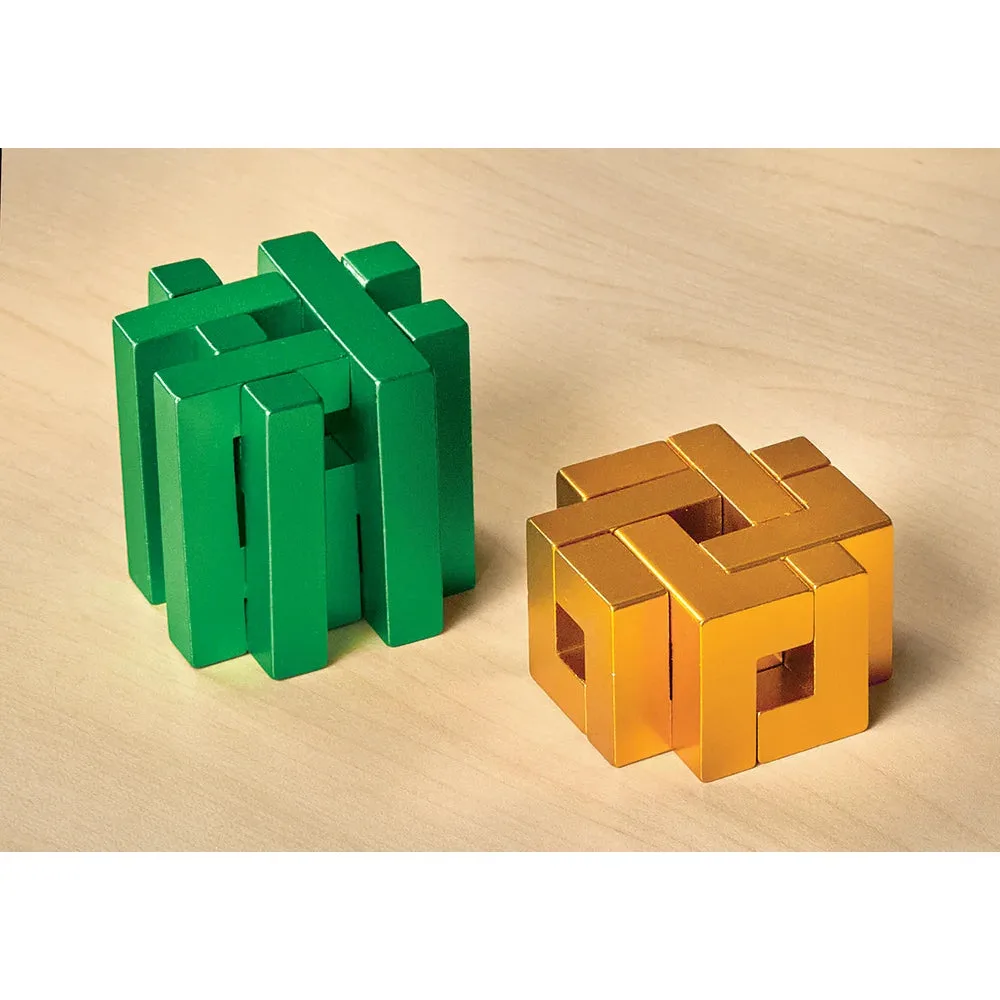
Metal Brainteaser Puzzles
-
Metal Brainteaser Puzzles: The puzzles are recommended for ages 14 and up. This is the catalog's stated age guidance, which matters when you are buying for a teenager or an adult gift exchange.
-
Metal Brainteaser Puzzles: The catalog describes the pair as a modern, tactile twist on classic brainteasers, suited to gifting or keeping on a desk for a quick mental break. It sets the intended use: short, repeatable puzzling sessions rather than a long build or a group game.
A wire puzzle strategy you can reuse on both shapes
Treat these as disentanglement puzzles: the goal is to separate or navigate the metal forms, and the useful skill is noticing what your last move changed. The steps below are general problem-solving habits, not manufacturer instructions.
- Start with a slow full rotation: Turn the puzzle over in your hands before you try anything. Note where the metal crosses, where a gap exists, and which end is closed. The Green Hashtag's open, grid-like form and the Golden Knot's tighter loops will present different gaps.
- Name the blocking point: Instead of saying 'it's stuck,' identify the single contact point that stops movement. On a wire puzzle, one crossing usually controls the whole position.
- Change one variable at a time: If a move fails, reverse it fully before trying a different angle or a different end of the piece. Stacking several changes makes it impossible to learn what worked.
- Use the table, not force: Aluminum alloy is light and the pieces are small. Work with gentle pressure and let the shape guide you rather than bending or forcing the metal.
- Stop before frustration sets in: Put the puzzle down and come back later. A short mental break is exactly how the catalog frames the product's intended use, and a fresh look often reveals the gap you kept overlooking.
Green Hashtag vs. Golden Knot: which to pick up first
The catalog does not publish a difficulty rating for either puzzle, so treat the notes below as handling observations from the supplied descriptions, not a ranked difficulty scale.
- Green Hashtag (2" X 2"): The larger footprint and open hashtag form give you more to grip and more visible crossings. A reasonable starting point if you want to build the habit of reading a wire shape before moving to a tighter piece.
- Golden Knot (2" x 11⁄4"): The smaller, knot-style piece packs its crossings into a tighter area, so small adjustments matter more. Try it second if you want a change of pace, or first if you prefer a compact desk puzzle.
- The set of two: Buying both gives you a natural comparison and a spare puzzle to hand to someone else. Single-style variants are also listed, which suits a buyer who already knows which shape they want.
Reading brain teaser puzzle difficulty honestly
Difficulty in a metal disentanglement puzzle comes from the number of interlocking paths and how much of the solution is hidden from view. Because the supplied information does not include a difficulty score, solving time, or a move count, any specific claim about how long these take would be invented. What you can rely on is the shape difference: a wider open form and a tighter knot form will not feel the same in the hand.
A practical way to judge fit is to ask what kind of puzzling you enjoy. If you like visible progress and a puzzle you can pick up and set down, the open hashtag shape is the more forgiving entry. If you like compact objects that reward small, precise adjustments, the knot is the more interesting challenge. Neither answer depends on a rating the catalog does not provide.
Making it a metal puzzle gift for adults
The catalog recommends the set for ages 14 and up and describes it as suitable for gifting. A few practical checks will tell you whether it fits the person you have in mind.
- Match the recipient's patience, not their age alone: The age guidance is 14 and up, but the better question is whether the person enjoys sitting with a small problem. Someone who likes crosswords or logic games is a natural fit; someone who wants a group activity is not.
- Consider the desk: The catalog explicitly frames the pair as something to keep on a desk for a quick mental break. That makes it a sensible small gift for a coworker or a student, and the two pieces let two people puzzle at once.
- Set expectations about instructions: The supplied information includes no printed solutions or step-by-step guide. If the recipient expects an answer key, pair the gift with the strategy above or solve one piece together first.
- Check the size before you wrap it: At 2" X 2" and 2" x 11⁄4", these are small, pocketable pieces. They suit a stocking, a desk drawer, or a gift bag rather than a large presentation box.
What the supplied information does not cover
The catalog does not confirm care instructions, a storage pouch, printed solutions, or a difficulty rating for either puzzle. It also does not state a solving time or a recommended age below 14. If any of those details matter to your purchase, treat them as unconfirmed rather than assuming a feature is present or absent.
What is confirmed is straightforward: two aluminum alloy brainteasers, the Green Hashtag at 2" X 2" and the Golden Knot at 2" x 11⁄4", recommended for ages 14 and up, and offered as a set or as individual styles. That is enough to choose between the shapes and to start puzzling with a calm, observant approach.