Quick answer
For a modern Metro Waves quilt, start with eight assorted solid fabrics in a controlled palette, keep the background and binding in the same color family, and reserve four yards for backing. The pattern's 54 x 72-inch size and Quick Curve Ruler requirement mean your fabric choices should support clean curved piecing rather than busy prints.
Why solids work harder than prints in this wave design
The Metro Waves pattern asks for eight assorted solids, and that is not an accident. Curved seams create their own visual rhythm, and a solid fabric lets that rhythm read clearly across the quilt. A large-scale print can hide the wave movement and make seam matching feel more difficult than it needs to be.
If you want prints, keep them small-scale and low-contrast within each color family. Save the boldest print for the backing, where it will not compete with the pieced top.
Background and binding: one decision, not two
The pattern lists 1/2 yard for binding but does not specify a separate background yardage. That means the eight assorted solids are doing the work of both the wave elements and the background. Treat your lightest or most neutral solid as the background and let the other seven carry the color story.
Choosing a binding that matches or slightly darkens the background creates a clean frame. A contrasting binding can work, but it draws the eye outward and can make a modern quilt feel more traditional.
Where the fabric budget actually goes
The largest single fabric commitment is the four yards for backing, not the pieced top. That changes how you should shop. Spend time getting the top palette right, then choose a backing that either repeats one top color or provides a deliberate contrast.
Because the pattern requires the Quick Curve Ruler, confirm you have it before cutting. Fabric selection cannot fix curved piecing that was cut with the wrong template.
Decision rules for choosing Metro Waves fabrics
- Palette size: Choose exactly eight solids as the pattern specifies. If you are tempted to add a ninth, replace one of the eight rather than adding yardage. Write your eight colors down before you shop so the palette stays controlled.
- Background color: Use your lightest solid as the background and keep it distinct from the binding. If the background and binding are too close, the quilt edge disappears.
- Print versus solid: Keep the eight main fabrics solid or near-solid. Use a print only for the backing, where it will not interrupt the wave design.
- Backing choice: Pick a backing that repeats one color from the top palette or contrasts with the whole top. Avoid a backing that introduces a new dominant color.
- Ruler check: Confirm you have the Quick Curve Ruler before cutting any fabric. The pattern requires it, and no fabric choice can compensate for missing the correct template. Lay the ruler on your cutting table before you prewash or press fabric.
Pattern facts that shape your fabric plan
-
Metro Waves (Paper): Metro Waves (Paper) is rated for easy to intermediate skill levels and finishes at 54 x 72 inches. The size and skill range mean you can plan a manageable fabric palette without advanced curved-piecing experience.
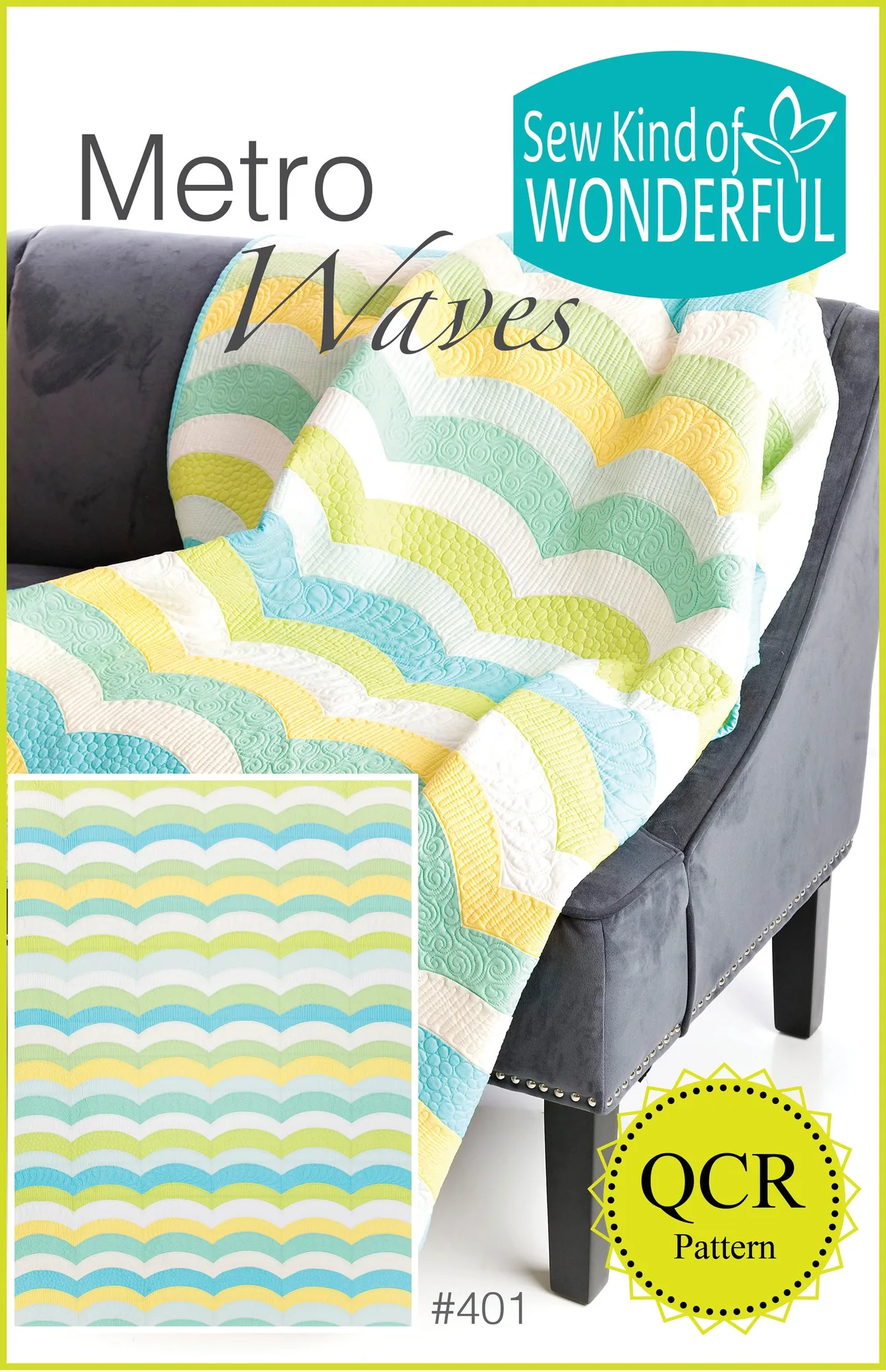
Metro Waves (Paper)
-
Metro Waves (Paper): The pattern calls for eight 2/3-yard assorted solids, 1/2 yard for binding, and 4 yards for backing, and requires the Quick Curve Ruler. Buying to these amounts prevents last-minute substitutions that can break the color balance of the finished quilt.
Who this fabric plan suits
Best for
- Quilters who want a modern, solid-forward look and are comfortable with easy to intermediate curved piecing.
- Shoppers who prefer to buy fabric in one planned trip using the pattern's stated yardage.
Not for
- Quilters who want a scrappy, print-heavy quilt where every fabric is different.
- Sewists who do not own the Quick Curve Ruler and do not plan to buy it.