Guacamole 2724: A Green That Likes Contrast
Milan Card Guacamole 2724 is a bright, avocado-leaning green that can wake up a canvas or blend into a leafy background. The difference usually comes down to what you place next to it. This guide walks through a practical process for using this thread to create green tones that pop, from reading the canvas to testing contrast and stitching with confidence. All product details come from the supplied catalog record for Guacamole 2724; where information is not provided, we note the limitation rather than guess.
What Guacamole 2724 Actually Gives You
-
Milan Card - Guacamole 2724: Planet Earth Milan Fiber: 50% silk / 50% wool, non-strandable, 10 yards, suited for 13 or 18 mesh. These are the fixed properties that determine how the thread handles, how much you get, and which canvases it fits. Knowing them first prevents mismatches before you plan color.
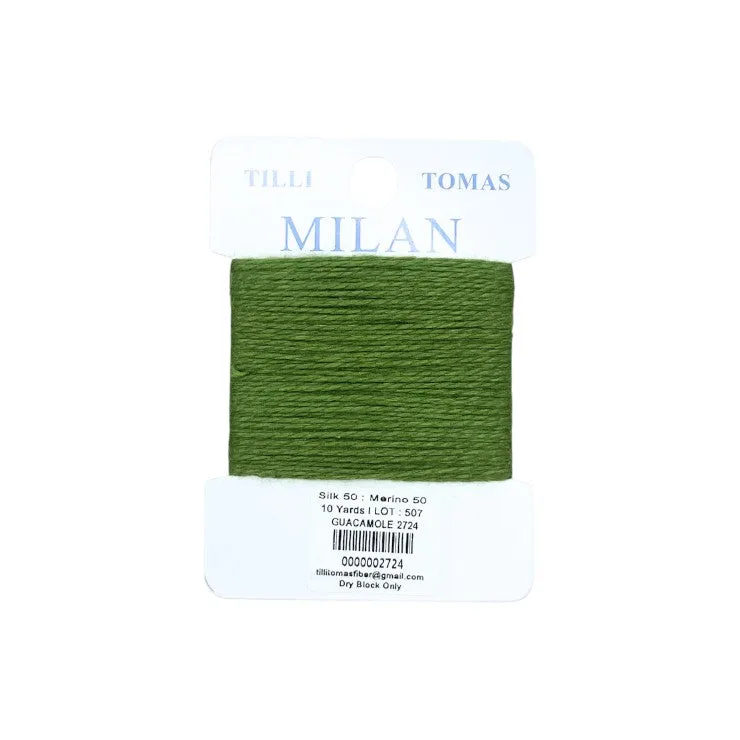
Milan Card - Guacamole 2724
-
Milan Card - Guacamole 2724: Colors may differ based on computer graphics and dye lots. The green you see on screen may not match the card in hand, and dye lots can vary. This affects how you build a palette and how much you buy for a project.
Read the Canvas Before You Pick Up the Card
- Identify the mesh size: Guacamole 2724 is suited for 13 or 18 mesh. Check your canvas mesh first; if it is not 13 or 18, this thread is not confirmed as a match by the supplied information.
- Note the painted greens already on the canvas: Hand-painted canvases often contain several greens. List them from lightest to darkest so you can see where Guacamole 2724 might sit—whether it repeats a painted green or introduces a new one.
- Decide the thread's job: Will Guacamole 2724 be the main green, a highlight, or a contrast accent? That decision shapes what you pair it with and how much you stitch.
Build Contrast in Three Directions
To make a bright green pop, you need something for it to pop against. There are three reliable directions: value contrast (pair it with a much lighter or darker thread), temperature contrast (pair it with a warmer or cooler thread), and saturation contrast (pair it with a more muted or more vivid thread). You do not need all three at once. Choose one direction, test it on a small area, and adjust.
For Guacamole 2724, value contrast is often the easiest starting point because the thread's avocado tone sits in the middle range. A very light neutral or a deep forest green can frame it without competing. Temperature contrast works when you want a lively, sunlit feel—think a warm yellow-green or a cool blue-green. Saturation contrast is useful when the canvas already has many greens; a muted sage or olive can make Guacamole 2724 read as the bright note without adding another loud color.
A Practical Order for Testing Green Contrast
- Stitch a small sample on the same mesh: Use a scrap of canvas in the same mesh as your project (13 or 18). Stitch a few stitches of Guacamole 2724 next to each candidate thread. This shows the real interaction under your lighting.
- Check the sample in the light you will stitch in: Thread colors can shift between daylight and lamplight. View your sample in the same conditions as your stitching spot to avoid surprises.
- Choose one contrast direction and commit to a section: Pick the value, temperature, or saturation contrast that best supports your canvas. Stitch a small section of the actual design before committing the whole area.
- Adjust with a second card if needed: If the contrast is too strong or too weak, try a neighboring shade. The 10-yard card gives you enough for testing and a small area, but plan your quantities before you begin a large fill.
Pairing Guacamole 2724 with Other Greens
When you pair Guacamole 2724 with other greens, think in families. A light yellow-green (like a spring green) will make Guacamole 2724 look deeper and richer. A dark blue-green (like a pine or teal) will make it look brighter and more yellow. A muted olive or sage will make it look more saturated. These are perceptual effects, not rules, so always trust your sample.
If your canvas has painted greens that you want to match rather than contrast, bring the canvas to your thread stash or order a few candidates. The catalog note that colors may differ from computer graphics is especially important here: the on-screen Guacamole 2724 may not match the painted green exactly. Use the card as a starting point, then verify in person.
Thread Handling and Quantity Notes
- Milan Card - Guacamole 2724: Non-strandable, 10 yards per card. Non-strandable means you use the thread as it comes, without separating plies. The 10-yard length is your total supply per card, so estimate coverage before you commit to a large area.
- Milan Card - Guacamole 2724: 50% silk / 50% wool blend. The blend affects the thread's texture and sheen. Silk adds a subtle luster; wool adds body. This can influence how contrast reads on the stitched surface, especially under light.
Checkpoints Before You Thread the Needle
- Mesh compatibility confirmed: Your canvas is 13 or 18 mesh. If it is another size, the supplied information does not confirm a match.
- Color verified in person: You have seen the actual card or a stitched sample, not just a screen image, because colors may differ by monitor and dye lot.
- Contrast direction chosen: You have picked value, temperature, or saturation contrast and tested it on a small sample.
- Quantity estimated: You know how many cards you need for your design area. The catalog gives 10 yards per card; calculate your stitch count and coverage before buying.
Where This Guide Stops
The supplied record for Guacamole 2724 does not include specific care instructions, recommended needle sizes, or detailed coverage estimates. Those decisions depend on your canvas, stitch choice, and tension. Use the checkpoints above to guide your own testing, and when in doubt, stitch a sample first. The goal is not a perfect formula but a confident start with a thread that can bring real life to green areas of your needlepoint.