Start with the card's fixed properties
Milan Card Hang Ten 2522 is a single-color card, so the pairing work begins with what the card itself supplies: a 50% silk / 50% wool blend, 10 yards, and suitability for 13 or 18 mesh. It is non-strandable, which means you use it as it comes rather than dividing the fiber. Those facts set the boundaries for any surf-inspired palette you build around it.
Because the card is non-strandable, you cannot adjust coverage by pulling plies apart. Instead, let the mesh count guide where the thread works best: 13 mesh uses fewer, larger stitches, while 18 mesh uses more, smaller stitches. The same 10 yards will cover less surface on 18 mesh than on 13 mesh, so plan quantities with the mesh in mind.
The catalog also notes that colors may differ based on computer graphics and dye lots. Treat any on-screen shade as a starting point, not a guarantee, and check the physical card against your canvas before committing to a full palette.
Hang Ten 2522 at a glance
-
Milan Cards - Hang Ten 2522: Planet Earth Milan Fiber, 50% silk / 50% wool, non-strandable, 10 yards, suited for 13 or 18 mesh. These are the fixed parameters for every pairing decision: fiber blend affects sheen and drape, non-strandable means no ply splitting, and mesh range tells you where the thread is intended to work.
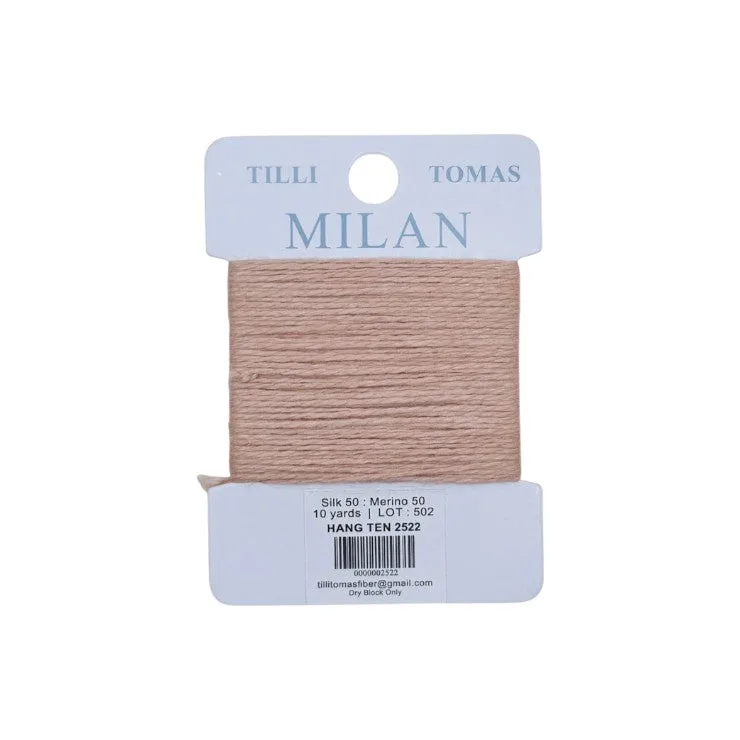
Milan Cards - Hang Ten 2522
-
Milan Cards - Hang Ten 2522: Colors may differ based on computer graphics and dye lots. Surf-inspired palettes depend on precise blue and sand tones, so verify the actual card under your lighting before buying multiple cards for a larger design.
Build the surf palette in three passes
A surf-inspired needlepoint palette usually needs three roles: a water family, a sand or foam neutral, and a small accent. Hang Ten 2522 can serve as any one of these, but the most practical approach is to decide its role first. If the card is your ocean blue, build the rest of the palette around it. If it is a neutral or accent, let the water family lead.
Pass one: choose the water. If Hang Ten 2522 is the water, pair it with one lighter blue and one deeper blue from the same thread line so the sea reads as moving water rather than a flat block. If Hang Ten 2522 is not the water, select two or three blues that sit close to it in value so the card does not look isolated.
Pass two: add sand and foam. A pale neutral for foam and a warmer neutral for sand keep the palette coastal without competing with the blues. Because the card is silk-wool, its sheen may differ from a cotton neutral; test the combination on a small stitched area before filling a large background.
Pass three: place one accent. Surf designs often benefit from a single warm accent, such as a sunset coral or a board color. Keep the accent to a small area so the blue and neutral families remain dominant.
A practical pairing order for a surf canvas
- Confirm the mesh count: Check whether your canvas is 13 or 18 mesh. Hang Ten 2522 is listed for both, but stitch size and thread coverage differ, so this determines how far 10 yards will go.
- Assign Hang Ten 2522 a role: Decide whether the card is your main water color, a secondary blue, or a neutral accent. Write that role down before adding other cards so the palette stays intentional.
- Choose one lighter and one deeper companion: Select blues that sit on either side of Hang Ten 2522 in value. This creates depth without introducing a second unrelated color family.
- Add a sand or foam neutral: Pick a pale neutral for foam and a slightly warmer neutral for sand. Test both against the card under your usual stitching light.
- Limit the accent: Choose one warm accent and restrict it to a small motif such as a surfboard stripe or a sunset detail. Too many accents will break the coastal read.
- Estimate quantity by mesh: For 13 mesh, 10 yards covers a larger area per stitch; for 18 mesh, expect more stitches and less coverage per card. Buy enough cards for the largest area Hang Ten 2522 will fill.
Where this pairing approach stops
The supplied information does not include a specific color name or swatch for Hang Ten 2522 beyond the card identifier, so the exact hue must be judged from the physical card. The catalog also does not provide stitch coverage estimates, care instructions, or a recommended number of cards for a given canvas size. Those decisions depend on your mesh, stitch choice, and the area you plan to fill.
Use the three-pass structure as a planning tool, not a formula. The card's silk-wool blend and non-strandable format are fixed, but the surrounding palette is yours to test on the canvas before you commit.