Start with the coffee, then adjust the variables
Mister Collins Manhattan Dark Knight is a single origin coffee, which means its flavor reflects a specific farm or region rather than a blend. That traceability is useful when you dial in: you are not chasing a moving target, but learning the coffee's own brightness, sweetness, body, and finish. The roast profile is designed for this coffee specifically, so your job is to let those characteristics show through the machine and grinder.
Before you change anything, make sure your equipment is clean and your grinder is in good working order. The coffee is the product; everything else—machine, grinder, water—is infrastructure. A consistent starting point makes every adjustment meaningful.
What the bag tells you
-
Mister Collins Manhattan Dark Knight (single origin): Single Origin Traceability: sourced from a single farm or region, with distinct, identifiable flavor characteristics that reflect the terroir, variety, and processing of a specific origin. Knowing the coffee is single origin helps you expect a specific flavor profile rather than a blend's balance, so you can judge whether your extraction is highlighting or masking those characteristics.
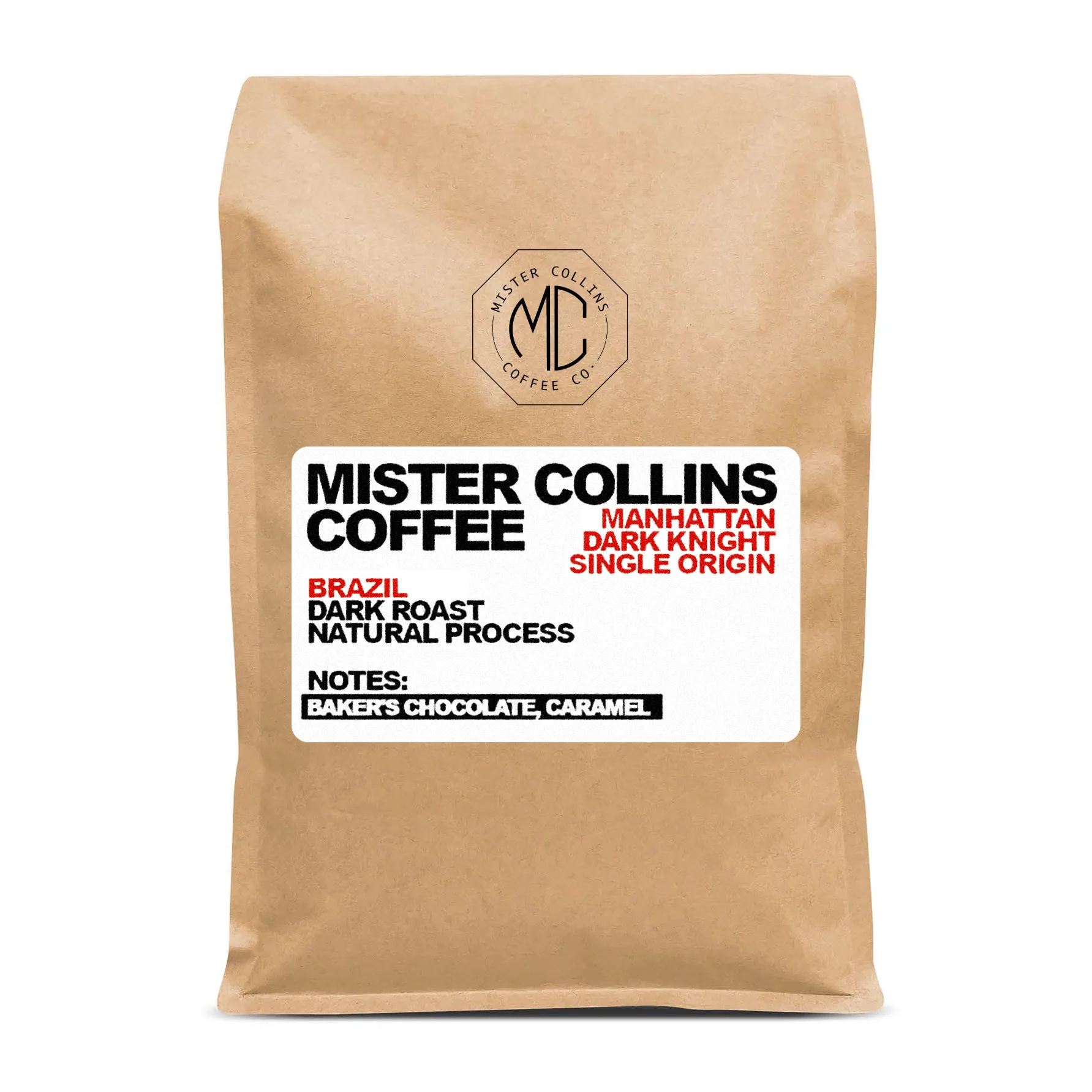
Mister Collins Manhattan Dark Knight (single origin)
-
Mister Collins Manhattan Dark Knight (single origin): Specialty Grade: scored above 80 on the SCA scale, cupped, graded, and selected for quality. Specialty grade sets a quality baseline. If your shots taste harsh or flat, the coffee itself is unlikely to be the weak link—look first at grind, dose, and yield.
-
Mister Collins Manhattan Dark Knight (single origin): Roast Profile: roasted to highlight the specific attributes of the origin, developing brightness, sweetness, body, and finish through a roast profile designed for this coffee specifically. This tells you the roaster intended a balanced expression of the origin. Your dial-in should aim to preserve those four attributes rather than pushing one to dominate.
-
Mister Collins Manhattan Dark Knight (single origin): Fresh Roast: roasted to order or in small batches—the difference between coffee at peak flavor and coffee that's been sitting in a warehouse. Freshness affects how the coffee extracts. Use the roast date on the bag to prioritize bags that are recently roasted, and avoid letting beans sit open to air.
Set a baseline dose and yield
Dose and yield are the two numbers you control most directly. Start with a dose that fits your basket and a yield that gives you a balanced shot—typically a ratio in the range of 1:2 to 1:2.5 (espresso weight out relative to dry coffee weight in). For example, if you dose 18 grams, aim for a yield between 36 and 45 grams. These are starting points, not rules; adjust based on taste.
Use a scale that reads to 0.1 grams for both dose and yield. Consistency in weighing is more important than hitting a specific number. Once you have a repeatable dose and yield, you can change one variable at a time.
A practical dial-in sequence
- 1. Lock in a dose: Choose a dose that fits your basket without touching the shower screen. Weigh it every time. A common starting point is 18 grams, but use what your basket is designed for.
- 2. Set a target yield: Pick a yield ratio, such as 1:2 (e.g., 18 g in, 36 g out). This gives you a consistent reference for comparing grind changes.
- 3. Choose a grind starting point: For a dark roast single origin espresso, start with a grind that feels like fine sand—slightly coarser than you might use for a light roast. Darker beans are often more soluble, so they can extract quickly.
- 4. Pull a shot and taste: Evaluate for brightness, sweetness, body, and finish. If the shot is harsh or ashy, it may be over-extracted; if it is sour or thin, it may be under-extracted.
- 5. Adjust grind first, then dose or yield: Change grind in small increments and keep dose and yield constant until you taste a clear direction. Then fine-tune with dose or yield if needed.
Tasting notes: what to look for in Manhattan Dark Knight
The supplied information does not list specific flavor notes for Manhattan Dark Knight, but it does describe the coffee as single origin with brightness, sweetness, body, and finish developed through its roast profile. When you taste, ask: Is there a pleasant brightness, or does it taste sharp? Is the sweetness clear, or is it buried under bitterness? Does the body feel round, or thin? Does the finish linger pleasantly, or turn dry and ashy?
Because this is a dark roast, you may find that it extracts more readily than lighter coffees. That means small grind changes can have a big impact. Keep notes on each shot—dose, yield, grind setting, and taste—so you can repeat what works.
Troubleshooting common dark roast issues
- Shot tastes bitter or ashy: This often points to over-extraction. Try a slightly coarser grind, or reduce yield slightly. Keep dose constant while you test.
- Shot tastes sour or sharp: This can indicate under-extraction. Try a slightly finer grind, or increase yield. Again, change one variable at a time.
- Shot runs too fast or too slow: If the shot gushes, the grind may be too coarse; if it drips, too fine. Adjust grind in small steps and aim for a flow that looks like warm honey.
- Flavor is flat or muted: Check freshness of the beans and your water. The supplied information does not specify water requirements, but clean, filtered water is a basic infrastructure element for any espresso setup.
Sizes and storage
Manhattan Dark Knight is available in 5 lb and 12 oz. sizes. Choose the size that matches your turnover: a 5 lb. bag is practical for a busy cafe or a household that pulls many shots daily, while 12 oz. suits lighter use. Store beans in an airtight container away from light and heat, and avoid transferring them to a hopper for long periods if you are not using them quickly.
The supplied information does not include a specific shelf life or storage temperature, so use the roast date and your own sense of freshness as your guide.