Quick answer
Choose monolithic cubicles with doors when speech privacy and visual separation matter more than open collaboration. Verify the actual wall height, door swing, and footprint before you commit, because those three details decide whether the cubicle feels private or cramped.
Why doors change the privacy equation
A door does more than close a gap. It creates a boundary that occupants read as control over interruptions, which matters for focused work and confidential calls. The trade-off is that a door only helps if the surrounding panels and ceiling conditions support it; a door in a low-wall cubicle still leaks sound over the top.
Treat door presence as one layer of privacy, not the whole solution. Pair it with panel height, acoustic treatment, and a layout that keeps noisy zones away from focused zones.
Wall height is the real noise lever
High wall cubicles reduce sound transmission by blocking direct paths between seated workers, but they also reduce airflow and daylight. The right height depends on whether the main problem is visual distraction, speech privacy, or both. If speech privacy is the priority, plan for taller panels and check how the top of the panel meets any ceiling or soffit.
Do not assume a product name tells you the height. Confirm the specified panel height in the quote and compare it with the eye level of seated and standing occupants.
Footprint and door swing decide comfort
A 20x10 cubicle footprint can feel generous or tight depending on where the door sits and how it swings. Inward-swinging doors consume floor space inside the cubicle; outward-swinging doors can block aisles. Measure the clear space behind the door and the aisle in front of it before you finalize a layout.
Also account for the depth of the panels and any door frame. A nominal footprint is not the same as usable interior space, so mark the actual panel lines on the floor with tape and walk the route.
Privacy panels are not all equal
Cubicle privacy panels vary in construction and surface. Solid panels block sightlines; perforated or fabric panels absorb some sound but may not stop speech from carrying. Ask what the panel is made of and whether it is intended for acoustic separation or only visual division.
If conversations are confidential, plan for sound masking or white noise in addition to panels. Panels alone rarely make speech unintelligible from a neighboring cubicle.
Decision rules for buying cubicles with doors
- Set the privacy goal first: If occupants need to take confidential calls or handle sensitive data, require doors plus panels tall enough to block seated sightlines; if the goal is only to reduce visual distraction, a lower panel with a door may be enough. Write the privacy goal into the quote so the supplier can confirm panel height and door type against it.
- Verify the 20x10 footprint against your room: Mark the full 20×10 footprint on the floor, including panel thickness, then add the door swing arc. Confirm that the door can open fully without hitting an aisle, desk, or neighboring cubicle. If the swing arc crosses a walkway, ask about an outward swing or a different door position before ordering.
- Check high wall cubicles against ceiling and airflow: Taller panels improve acoustic separation but can block HVAC airflow and daylight. Confirm that the panel top does not conflict with sprinklers, lights, or supply diffusers, and ask how air will circulate inside the cubicle. Treat any ceiling obstruction as a reason to revisit panel height, not as a field fix after delivery.
- Confirm what the panels are made of: Ask whether the privacy panels are solid, fabric-wrapped, or perforated, and whether they are rated for acoustic separation or visual only. Do not assume a door makes speech private. If speech privacy is required, budget for sound masking alongside the cubicles.
- Plan the door hardware and access: Decide whether doors need locks, closers, or glass inserts, and confirm that the hardware is included or priced separately. Check that the door width accommodates the people and equipment that will use it. List every door option in the quote so you can compare delivered cost, not just the base price.
Product facts to weigh
-
Friant Novo Office Cubicles with Doors 20×10 7 High: Friant Novo Office Cubicles with Doors are listed as a 20×10, 7-high configuration. The 7-high panels and included doors give you a concrete starting point for privacy planning, but you still need to confirm door swing and aisle clearance for your room.
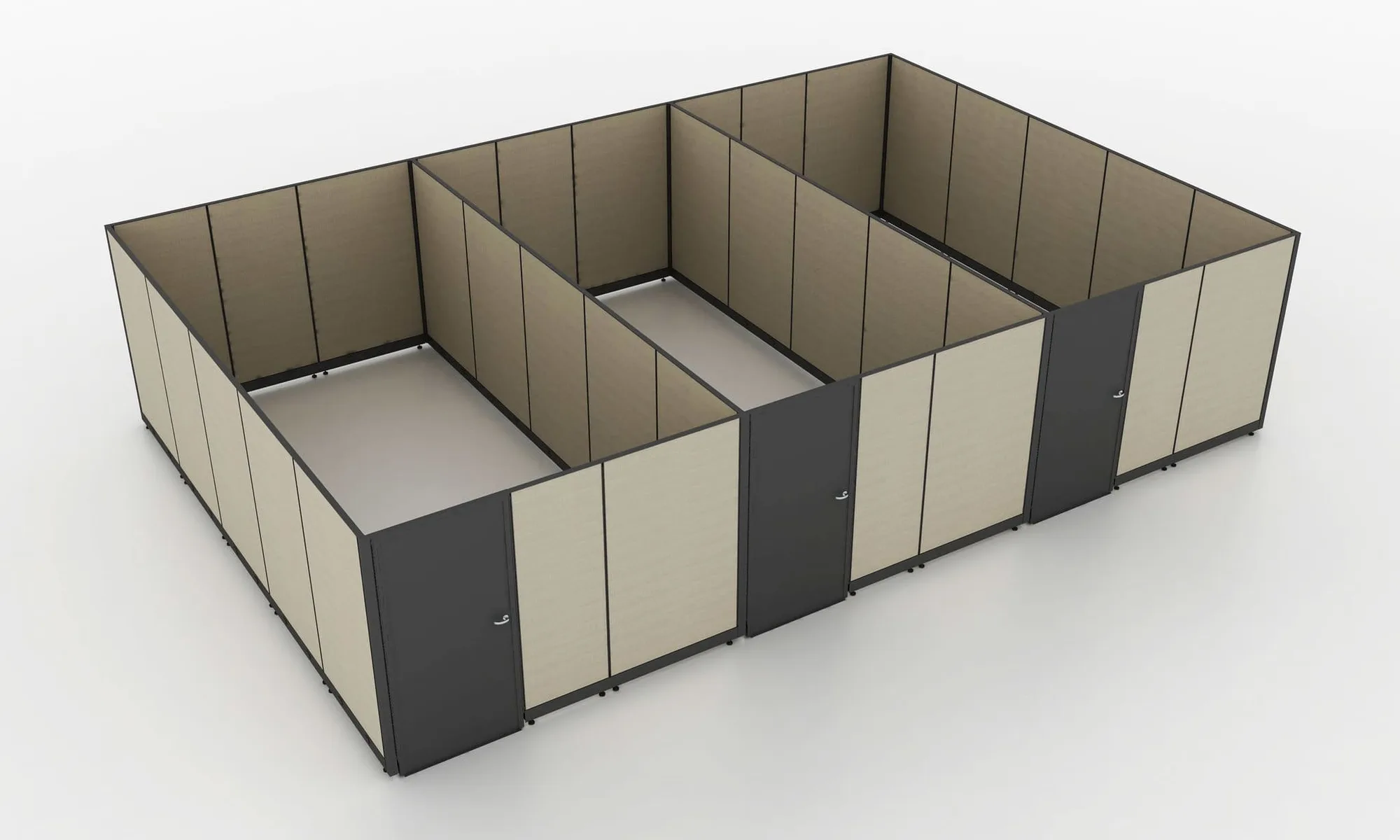
Friant Novo Office Cubicles with Doors 20×10 7 High
Who should choose monolithic cubicles with doors
Best for
- Teams that need visual and acoustic separation for focused or confidential work
- Offices with enough floor area to absorb a 20×10 footprint and door swing
- Buyers who want a defined, private workspace rather than an open benching layout
Not for
- Dense floor plans where door swing would block aisles or egress
- Teams that rely on quick face-to-face collaboration across desks
- Spaces with low ceilings or limited airflow where tall panels would create stuffiness