Quick answer
Buy the Montessori Wooden Trays & Felt Baskets set if you want one simple system for shelf organization and work-tray rotation. Use the wooden trays for focused activities and the felt baskets for loose-piece storage, then rotate only a few items at a time.
Why containers do more than tidy up
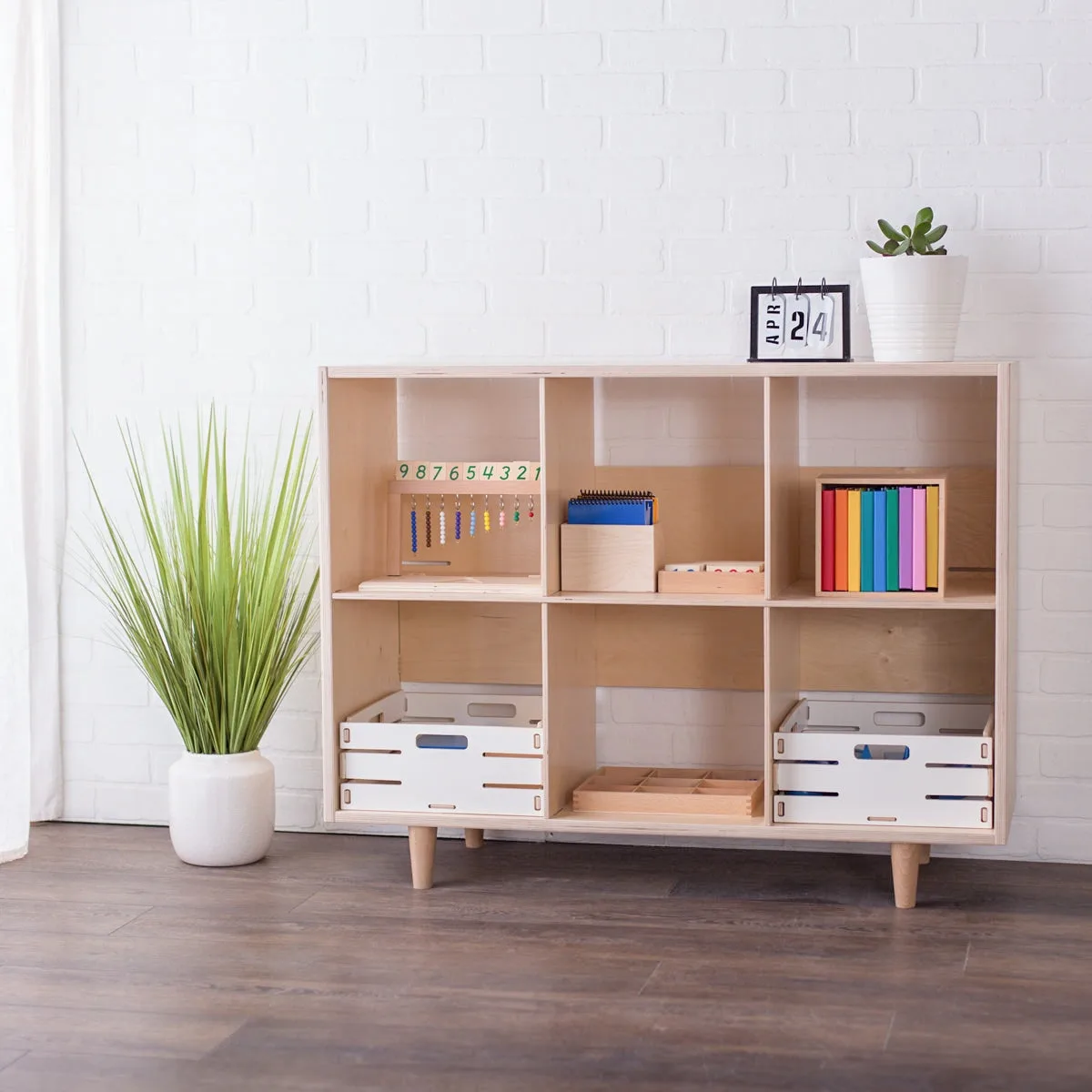
A container is not just storage; it tells your child what belongs together. When small related pieces live in one tray or basket, your child can see the activity as a whole and return it to the shelf without help. That is the practical reason Montessori spaces rely on open containers rather than deep toy bins.
The trade-off is visibility. A felt basket softens noise and keeps pieces contained, but it hides contents more than a clear bin. If your child needs a visual cue to choose an activity, keep the basket shallow or pair it with a tray that displays the main material.
Wooden trays vs. felt baskets: a simple division of labor
Use wooden trays when the activity has a clear sequence or a defined work area: pouring, sorting, stacking, or any task where pieces need to stay in view. Use felt baskets for loose parts that do not need a flat surface, such as small figures, felt shapes, or collection pieces.
This split matters because a tray invites a child to carry the whole activity to a mat, while a basket invites putting pieces away. Mixing the two roles usually creates clutter: loose pieces slide off trays, and flat work gets buried in baskets.
When a tray-and-basket set is the wrong purchase
Skip this set if your child is still mouthing small pieces or if you need closed storage that keeps everything out of sight. Open trays and felt baskets are designed for accessible, child-led play, not for childproof containment.
Also reconsider if you already own a shelf full of open containers. The set is most useful when you are starting a shelf from scratch or replacing mismatched bins that make rotation harder.
Decision rules for your setup
- Choose a tray when the activity has a sequence: If the activity involves steps, a flat work surface, or pieces that must stay visible, put it on a wooden tray. If the pieces are loose and do not need a surface, use a felt basket. Sort your current activities into tray-first and basket-first piles before buying more containers.
- Limit the shelf to a few complete activities: Place only a small number of tray-and-basket activities on the shelf at once. Each container should hold one complete activity, not a mix of unrelated pieces. Rotate the rest out of reach. A shelf with fewer complete activities is easier for your child to choose from and clean up.
- Match container size to piece size: Use shallow trays for flat materials and small baskets for loose pieces. If pieces fall out when your child carries the tray, the container is too deep or the activity is too large for the tray. Test carrying the activity yourself before placing it on the shelf.
- Keep felt baskets for quiet storage, not display: Felt baskets are best for storing loose pieces on a shelf or rotating them out of sight. If your child needs to see the contents to choose an activity, place the basket next to a tray that shows the main material. Label or pair baskets with a visible tray when choice is the goal.
Product facts
-
Montessori Wooden Trays & Felt Baskets: The set is designed to categorize materials into containers so your child can conceptualize what goes where. That makes it a practical first container system for a shelf where each activity needs one clear home.
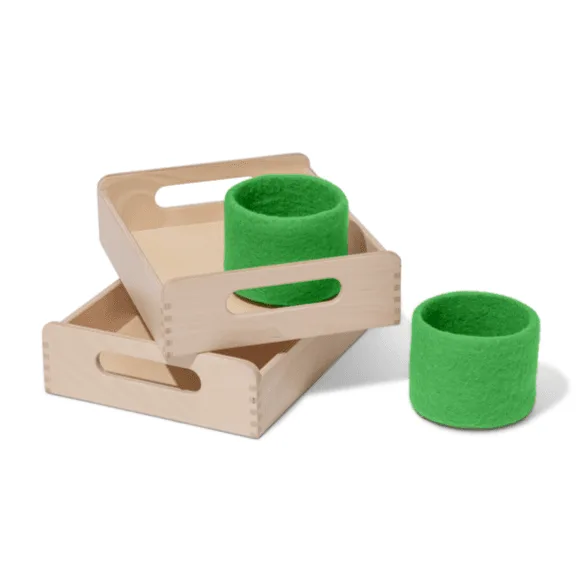
Montessori Wooden Trays & Felt Baskets
Who this setup fits
Best for
- Parents starting a Montessori shelf and wanting one matching container system
- Caregivers who rotate a small number of activities and need trays and baskets that work together
- Families replacing mismatched bins that make clean-up confusing for toddlers
Not for
- Households that need closed, childproof storage for mouthing infants
- Families with a large toy collection who need deep bins rather than open display containers
- Parents who already have a full set of open trays and baskets that fit their shelf