Quick Answer
Build your Mounted Serjeants as a six-to-ten-model unit with a clear front rank of lances and a supporting rank of hand weapons, then paint them in a unified retinue scheme. Check that every model sits flat on its base before you prime.
Why Mounted Serjeants Play Differently from Knights
Mounted serjeants are the working cavalry of a medieval force: skilled riders in mail or padded armour who support the charge rather than lead it. That role should shape how you build the unit. Where a knight unit can be a small, elite hammer, serjeants reward a slightly larger footprint that can absorb a round of shooting and still threaten a flank.
The 1150–1320 span covers a long transition in armour and tack, so decide early whether your unit represents the earlier mail-and-round-shield look or the later reinforced style. Mixing both across one unit is fine for a retinue that has campaigned for years, but keep the mix deliberate rather than accidental.
Common Assembly and Painting Trade-offs
Multi-part cavalry kits give you variety, but every arm and weapon joint is a potential weak point on the table. Clean the contact surfaces and test-fit before glue so you are not filling gaps later. For painting, a unified scheme reads better at arm's length than individually detailed riders; save your sharpest work for the front rank and banners.
If you plan to use the unit across several rule sets, avoid permanently fixing weapons that some games treat differently. A small amount of planning at the assembly stage saves repainting or rebasing later.
Step-by-Step Unit Build
- Set the unit size and role: Decide whether the unit is a flanking force of six or a main-line squadron of eight to ten, and note which models will carry lances and which will carry hand weapons. Common mistake: buying and building before checking your rule set's minimum and maximum unit sizes. Write the intended front-rank and support models on a note before you open the kit.
- Clean and test-fit every horse and rider: Remove mould lines from the horse's back and the rider's legs, then dry-fit the rider to the saddle before gluing. Check that the horse stands level on a flat surface. Common mistake: gluing the rider before the horse is square, which leaves a rocking model that will not sit on its base. A horse that rocks on a flat desk will rock on the table; fix it now.
- Assemble weapons for durability: Pin or reinforce lance arms at the shoulder and keep the lance angle forward and slightly down so it clears neighbouring models. Common mistake: posing lances straight up or across the body, which makes ranking up impossible. Rank the unit up on the table before the glue fully cures.
- Base before you prime: Fix each rider to its base, check the frontage matches your movement tray or sabots, and add basing texture after the model is secure. Common mistake: priming loose riders and then discovering the bases do not fit the unit's footprint. Confirm the whole unit fits its movement tray before painting begins.
- Paint in a unified retinue scheme: Choose two or three main colours for the unit, paint horses in varied but natural tones, and use one accent colour on shields or trappings to tie the riders together. Common mistake: giving every rider a different heraldic scheme, which makes the unit look like a gathering rather than a retinue. Reserve your finest detail for the front rank and any banner bearer.
- Seal, base, and store with care: Apply a protective varnish, finish the bases to match your collection, and store the unit in a foam tray with individual cavalry slots. Common mistake: stacking cavalry loosely, which snaps lances and bends weapon arms. Label the tray so the unit is ready for its next game without repairs.
Product Facts
-
Mounted Serjeants (1150-1320): Mounted Serjeants (1150-1320) depicts heavily armed riders in mail or padded armour, equipped as part of a lord's retinue. The mail-and-padding look suits both earlier and later retinue schemes, so you can paint them as veteran campaigners without changing the models.
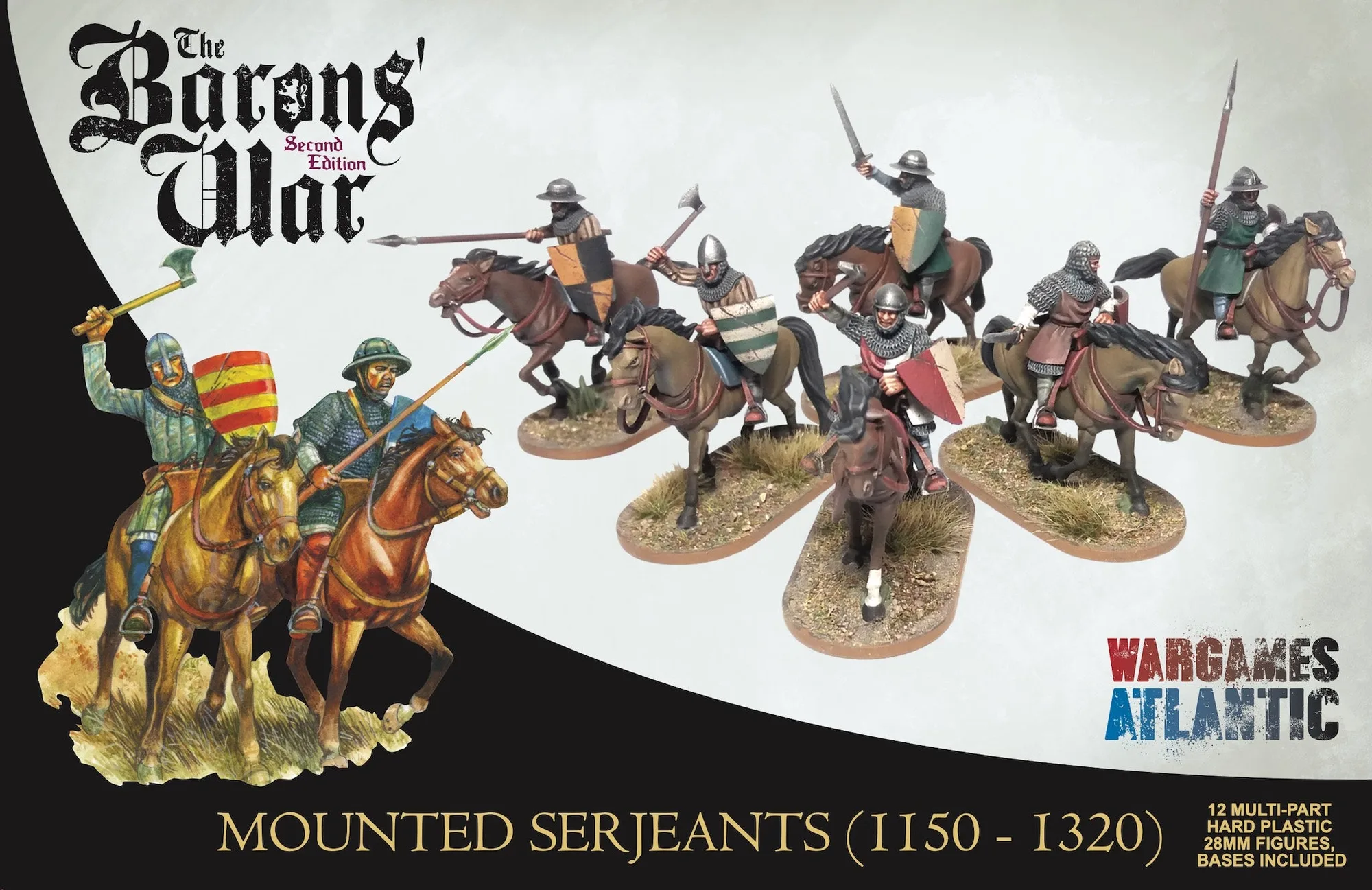
Mounted Serjeants (1150-1320)