What the MPU-6050 Brings to Your Arduino Project
The MPU-6050 combines a 3-axis gyroscope and a 3-axis accelerometer on a single chip, with an onboard Digital Motion Processor (DMP) that handles quaternion fusion. This means your Arduino can request stable roll, pitch, and yaw angles without running heavy filter calculations. It communicates over I2C, leaving plenty of pins free for other sensors or actuators.
The module includes a 3.3V regulator and is 5V compatible, so it works directly with standard Arduino boards. The I2C address defaults to 0x68 when AD0 is low, or 0x69 when AD0 is high — useful if you want two MPU-6050s on the same bus.
Wiring the MPU-6050 to Your Arduino
Connect the module to your Arduino using four jumper wires. The I2C pins are fixed: SDA and SCL. Power comes from the Arduino's 3.3V or 5V pin — the onboard regulator handles either.
- VCC → 3.3V or 5V (Arduino): The module accepts 3.3V–5V, so you can use either voltage pin on the Arduino.
- GND → GND (Arduino): Common ground is required for I2C communication.
- SCL → A5 (Arduino Uno) or SCL pin: On an Arduino Uno, SCL is pin A5. On a Mega, use pin 21. On a Leonardo, use pin 3.
- SDA → A4 (Arduino Uno) or SDA pin: On an Arduino Uno, SDA is pin A4. On a Mega, use pin 20. On a Leonardo, use pin 2.
Getting Orientation Data with the DMP
The DMP runs quaternion calculations onboard and delivers orientation data at up to 200Hz over I2C. This reduces the processing load on the Arduino significantly compared to running a complementary filter in software. The result is more stable yaw readings with less drift.
To use the DMP, install the i2cdevlib MPU6050 library by Jeff Rowberg. Open the MPU6050_DMP6 example sketch (or MPUTeapot) from the Arduino IDE. The sketch extracts quaternion data from the DMP FIFO buffer and converts it to Euler angles — roll, pitch, and yaw — directly in the code. Upload the sketch, open the Serial Monitor at 115200 baud, and you'll see orientation angles streaming in real time.
MPU-6050 Key Specs for Your Build
-
MPU-6050 3 Axis Analog Gyroscope Accelerometer: 3-axis gyroscope — +/-250/500/1000/2000 deg/s, selectable Choose a lower range for slow, precise rotation (e.g., a pan/tilt mount) or a higher range for fast spins (e.g., a self-balancing robot).
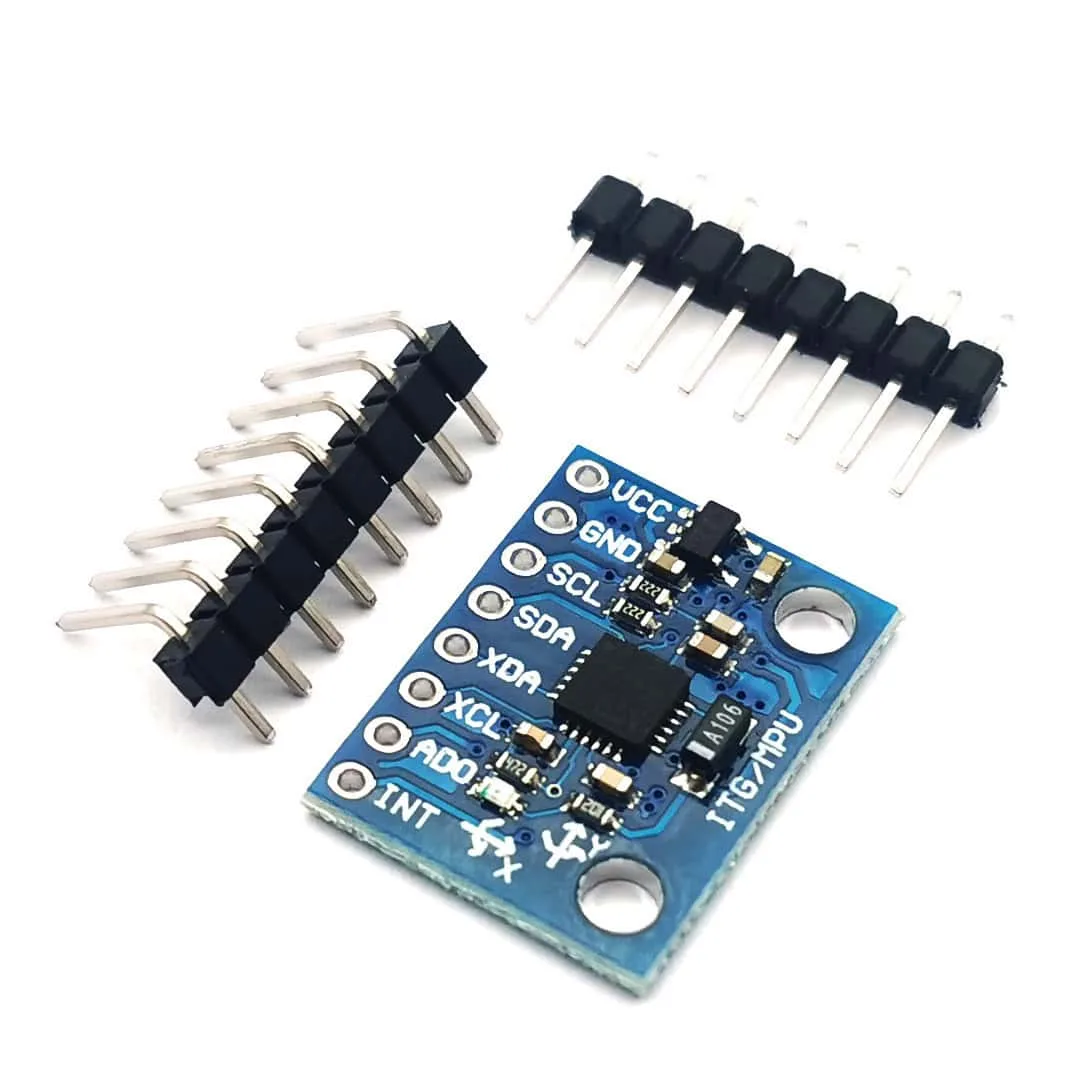
MPU-6050 3 Axis Analog Gyroscope Accelerometer
-
MPU-6050 3 Axis Analog Gyroscope Accelerometer: 3-axis accelerometer — +/-2/4/8/16g, selectable Lower g-ranges give finer tilt resolution; higher ranges handle impacts or fast motion without saturating.
-
MPU-6050 3 Axis Analog Gyroscope Accelerometer: Quaternion output at up to 200Hz 200 Hz update rate is fast enough for drone flight controllers and gesture recognition without missing motion.
-
MPU-6050 3 Axis Analog Gyroscope Accelerometer: I2C interface — 0x68 or 0x69 The two possible addresses let you use two MPU-6050s on the same bus for applications like dual-IMU sensor fusion.
Practical Considerations for Your Project
The MPU-6050 is well suited for self-balancing robots, drone flight controllers, gesture recognition, gimbal stabilisation, and wearable motion capture. Its DMP-based orientation is significantly more stable than a complementary filter calculated on the Arduino, especially for yaw drift.
If your project runs on battery power, note that the MPU-6050 draws more current than some newer IMUs. For comparison, the BMI160 6-axis IMU draws roughly 950 microamps at full operation — about a quarter of the MPU-6050 current. For most wired or short-duration battery projects, the MPU-6050's proven library support and low cost make it an excellent choice.
The module is shipped from UK stock with fast Royal Mail delivery, and Kunkune offers 60-day returns with no minimum order.