Start with the whisk ball, not the powder
Most clumpy shakes come down to one part: the whisk ball. The MUD Shaker is designed around a free-rolling whisk ball that moves inside the bottle and breaks up clumps as you shake. If the ball is missing, stuck, or sitting outside the bottle when you shake, the powder has nothing to collide with and clumps survive.
Before you change your powder or your liquid, check the ball. It should be inside the main bottle, under the lid, and free to move. If it rattles when you shake, it is doing its job.
The order that prevents clumps
The shaker's own instructions describe a specific sequence. Following it removes the most common cause of clumping: powder sitting at the bottom before liquid reaches it.
- Drop the whisk ball into the main bottle first: The springy whisk ball goes in before anything else, so it is already in position when the liquid and powder arrive.
- Add your liquid: Pour the liquid in before the powder. This gives the powder something to disperse into rather than a dry bottle floor to stick to.
- Add your Nourish powder: Add the powder after the liquid, on top of it.
- Screw the lid on tight, whisk ball still inside: The lid must be secure, and the whisk ball must remain in the bottle. Do not remove the ball before shaking.
- Shake it like you mean it: The whisk ball moves freely inside, breaking up clumps and blending everything into a smooth, sippable shake. A gentle swirl will not give the ball enough movement to do that.
If clumps still survive the shake
When the sequence above is followed and clumps remain, the likely issue is that the whisk ball is not moving freely. Check that it is not wedged under the lid or trapped against the side of the bottle. The design relies on the ball rolling through the liquid, not sitting still.
The supplied product information does not include a recommended powder-to-liquid ratio, a maximum fill level, or a minimum or maximum shake time. If you are adjusting quantities or shaking duration, treat those as your own variables rather than manufacturer instructions. Change one at a time so you can tell what made the difference.
A leaking lid: what to check first
The MUD Shaker lid is a screw-on design, and the product record describes it as having no tricky attachments and no mystery parts. That simplicity is useful for leak diagnosis: there is no gasket maze to reassemble incorrectly. The first check is simply that the lid is screwed on tight, as the instructions specify.
The second check is the whisk ball. If the ball is caught between the lid and the bottle threads, the lid cannot seat fully. Open the bottle, let the ball drop into the main chamber, and screw the lid back on.
The supplied information does not describe a gasket, a leak-proof guarantee, or a maximum fill line. If the lid is tight and the ball is free and liquid still escapes, that is outside what the supplied product details can resolve.
What the 25oz MUD Shaker is built to do
-
MUD Shaker: A 25oz stainless steel shaker equipped to keep your Nourish cool. The 25oz capacity and stainless steel body define how much you can mix at once and how the bottle handles temperature; the record does not state a fill limit, so leave room for the shake to move.
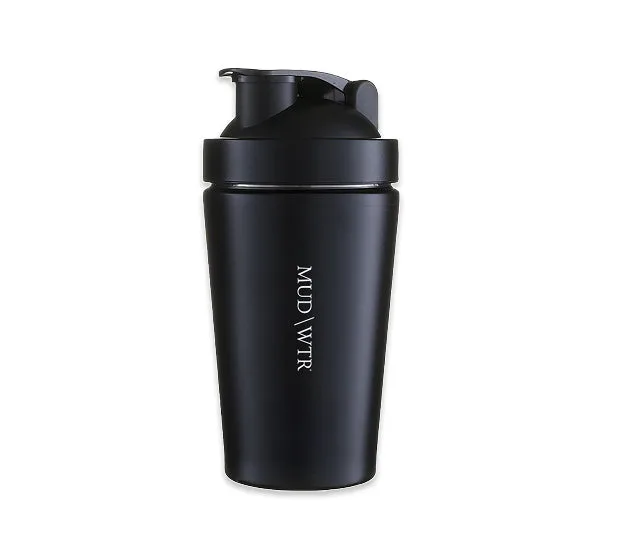
MUD Shaker
-
MUD Shaker: The whisk ball moves freely inside, breaking up clumps and blending everything into a smooth, sippable shake. This is the mechanism behind clump-free mixing. If the ball is not free to move, the shaker cannot do the job it was designed for.
-
MUD Shaker: Screw the lid on tight—whisk ball still inside. The lid instruction and the ball instruction are linked. A tight lid with the ball still in the bottle is the operating state the shaker expects.
-
MUD Shaker: No tricky attachments. No mystery parts. Fewer parts means fewer places for a leak or a clump to hide, and simpler reassembly after cleaning.
Cleaning habits that keep the shaker working
Residue is the quiet cause of both problems. Dried powder on the whisk ball or around the lid threads can stop the ball rolling freely and stop the lid seating flush. The supplied record does not include a cleaning procedure, so the points below are practical habits rather than manufacturer instructions.
- Rinse the whisk ball: The ball is the part that touches the powder most directly. A ball coated in dried residue will not roll as freely.
- Clean the lid threads: Powder caught in the threads can prevent the lid from screwing down tight, which is the first thing to check on a leak.
- Keep the parts together: With no tricky attachments and no mystery parts, the shaker is quick to take apart and reassemble. Losing the whisk ball removes the clump-breaking mechanism entirely.
What this guide cannot settle
The supplied product information covers the shaker's capacity, material, whisk ball, lid, and the shake sequence. It does not include a powder-to-liquid ratio, a fill limit, a leak-proof claim, a cleaning method, or storage instructions for the shaker itself. If your problem persists after checking the ball, the lid, and the order of ingredients, those are the details to confirm with the brand rather than guess at.