Quick answer
Use the Multicultural Community Helpers Playset as the anchor for a three-part block play sequence: build a community scene, introduce career figures with a simple problem, then let children rebuild and retell. Keep the figures in a labeled tray and rotate a small subset each day.
Why block play and career figures work well together
Blocks give children a physical way to map a community—roads, buildings, and open spaces—while career figures add people and purpose. The combination supports storytelling, spatial reasoning, and vocabulary as children decide where a firefighter, farmer, or mail carrier belongs.
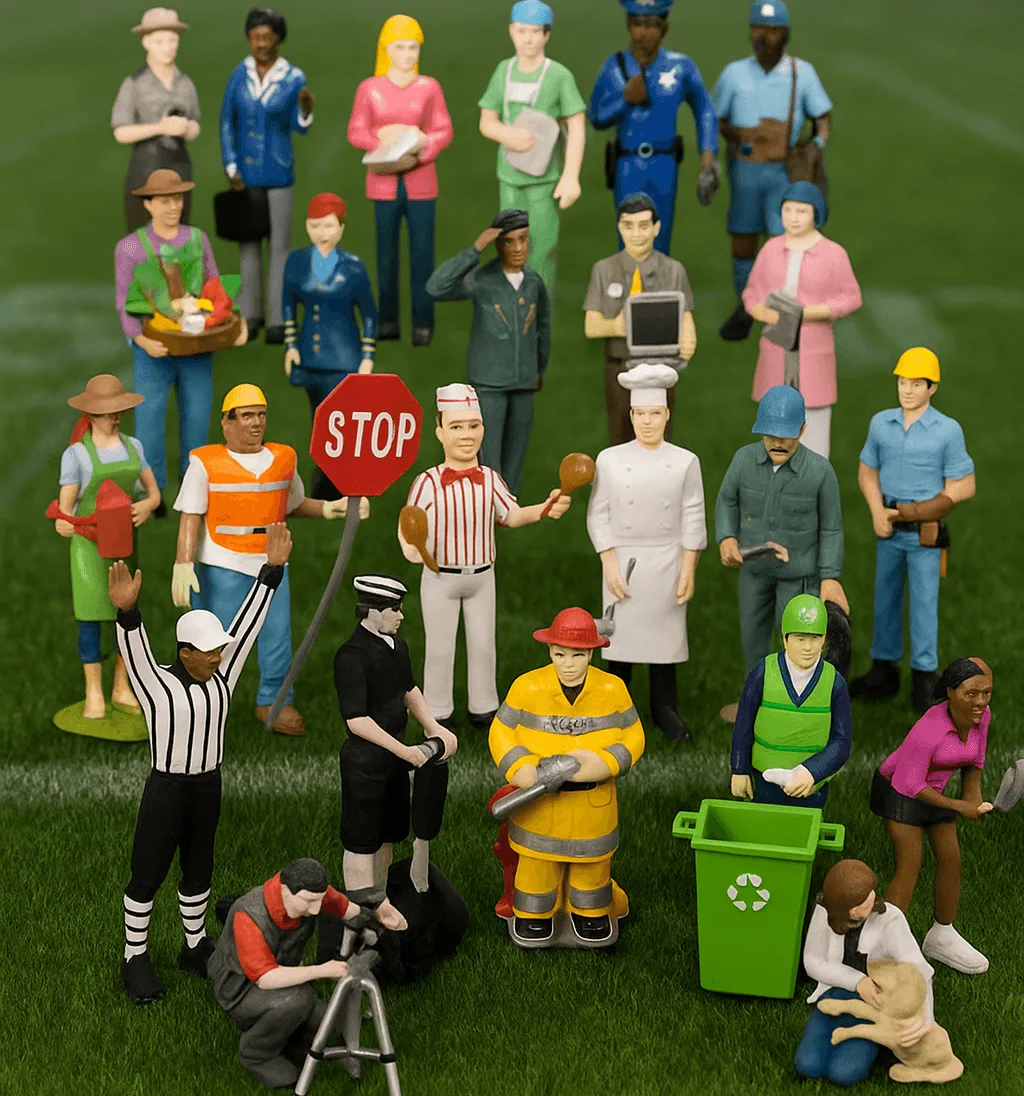
The 24-piece set includes roles such as firefighter, veterinarian, mail carrier, farmer, and photographer. That range lets you connect block play to many familiar routines without buying multiple themed sets.
Setting up the block area for career play
Before children arrive, clear a low-traffic floor space and set out a mix of unit blocks, small signs, and a shallow tray for the figures. Keep the full set visible but not crowded; too many figures at once can turn play into sorting rather than building.
Label the tray with simple text and picture labels for a few roles. This makes cleanup easier and helps children return figures independently.
Adapting for different ages and abilities
Toddlers may simply carry figures and stack blocks side by side; focus on naming roles and copying actions. Preschoolers can plan a route and assign jobs. Older children can add signs, count figures, or describe a sequence of events.
If a child is not ready for group storytelling, offer a parallel play option with two or three figures and a small set of blocks.
Step-by-step block play career activities
- 1. Choose a community scene: Pick one setting for the day—a neighborhood, farm, or main street—and gather only the figures that fit. For a neighborhood, start with mail carrier, firefighter, and veterinarian. Common mistake: putting out all 24 figures at once, which overwhelms children and scatters the story. Checkpoint: can each child name one role and one place it belongs?
- 2. Build the setting together: Invite children to build roads, buildings, or animal pens with blocks before adding figures. Ask open questions like “Where does the mail carrier walk?” Common mistake: building the entire scene yourself, which reduces ownership. Checkpoint: does the block layout include at least one path or entrance for each figure? Keep the build simple enough that children can rebuild it after a story.
- 3. Introduce a simple problem: Give the play a purpose: “The veterinarian needs to reach the farm animal, but the road is blocked.” Let children move figures and blocks to solve it. Common mistake: solving the problem for them or making it too complex. Checkpoint: did children move at least one block and one figure to respond?
- 4. Let children retell and rebuild: After the first problem, ask children to retell what happened and then rebuild the scene differently. This reinforces sequencing and vocabulary. Common mistake: skipping the retell, which loses the language opportunity. Checkpoint: can a child describe who went where and why? Photograph the rebuilt scene and use it as a discussion prompt later.
- 5. Rotate and store with a purpose: At cleanup, have children sort figures into labeled trays by role or setting. Rotate the set weekly so it stays novel. Common mistake: storing all figures in one bin, which makes selection slow and damages pieces. Checkpoint: are figures sorted and the tray label visible for the next session?
Product facts
-
Multicultural Community Helpers Playset | 24 Career Figures for Block Play: The set includes 24 figures representing roles such as firefighter, veterinarian, mail carrier, farmer, and photographer. You can rotate a handful of roles each session to keep block play focused and fresh.
Multicultural Community Helpers Playset | 24 Career Figures for Block Play