A standard leash is fixed; the Multilong Leash II is not
A standard leash gives you one length and one hand position. That's fine for a quick block walk, but it limits you when your dog needs more room to explore, when you want your hands free, or when you're walking two dogs. The Multilong Leash II is built around stepless length adjustment from 100 to 300 cm, so you can change the amount of freedom without swapping gear. That single feature is the main reason to choose it over a fixed leash.
This guide covers the situations where the Multilong Leash II earns its place in your kit, how to switch between its modes, and the trade-offs to accept before you buy.
When the Multilong Leash II replaces a standard leash
- You want one leash for both close control and sniffing room: Set it near 100 cm for pavement and crowds, then extend toward 300 cm on a quiet trail or in a park. The stepless adjustment lets you find the length that suits the moment instead of carrying two leashes.
- You need your hands free for running or relaxed walks: The leash can be worn around the waist or across the shoulder, which is useful for hands-free runs or when you're carrying a water bottle or treating along the way.
- You walk two dogs at once: Strong, reliable carabiners on both ends let you walk two dogs with a single leash. That's a real convenience, but it also means you need to manage the pair together rather than giving each dog a separate line.
- You're training recall and want a long line without a separate purchase: A long line gives your dog room to make choices while staying connected. The Multilong Leash II's adjustable length can serve that role, but see the safety notes below before you use it for recall work.
- You walk in low light and want built-in visibility: A removable reflector keeps visibility high during nighttime outings, so you can add it for evening walks and take it off for daytime use.
How to switch the Multilong Leash II between modes
The leash adapts by changing length and attachment point rather than by adding parts. Start with the leash at a short setting, attach it to your dog's harness, and then adjust outward as you move into a more open area. Because the adjustment is stepless, you can fine-tune rather than choose between preset clips.
For hands-free use, wear the leash around your waist or across your shoulder before you extend it. Keep the length shorter when you're near roads or other dogs, and save the longer settings for open spaces where you can see what's coming.
For anti-pull control, attach the leash to the front ring of a harness. The supplied instructions describe this as an anti-pull feature that provides better control during energetic moments. That's a handling setup, not a training program—pair it with your normal loose-leash work rather than expecting the attachment alone to change behavior.
Multilong Leash II details that affect how you use it
-
Multilong Leash II: Stepless length adjustment from 100 to 300 cm. This is the core difference from a standard leash: you can match length to the environment without carrying a second leash.
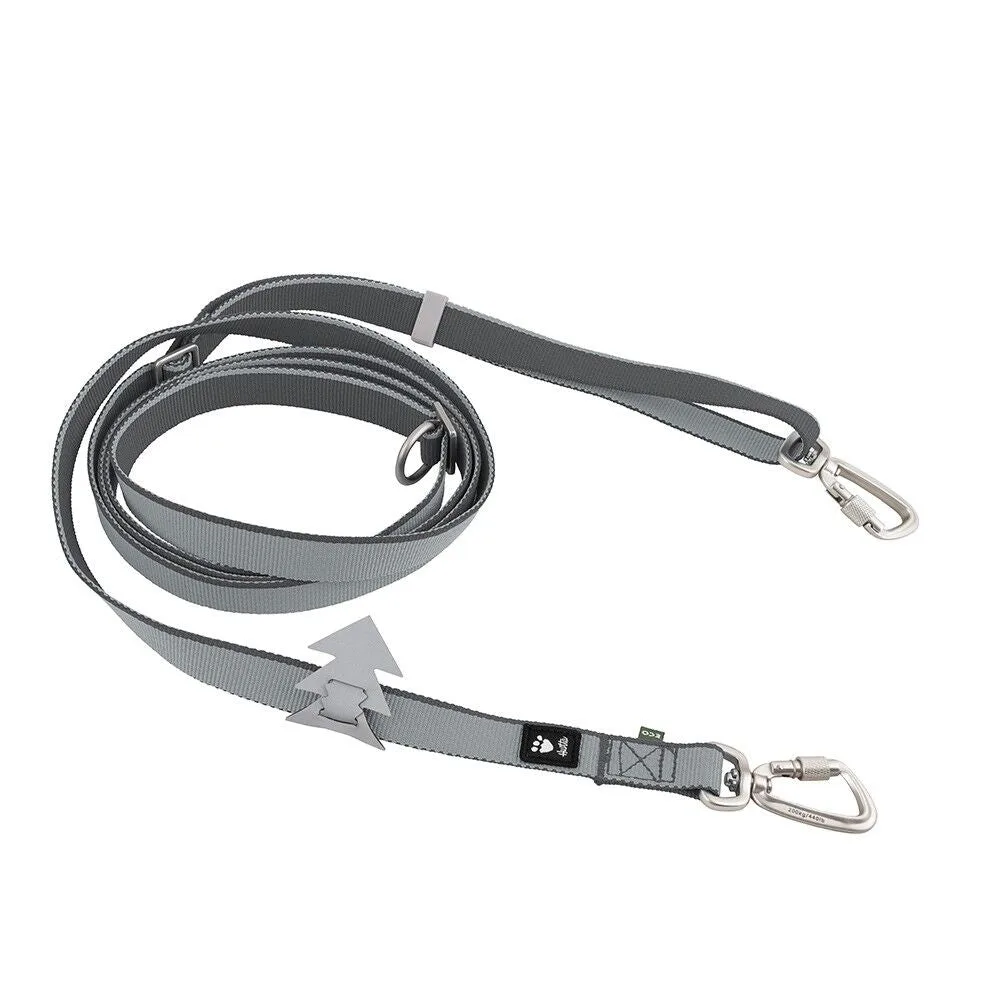
Multilong Leash II
-
Multilong Leash II: Wear it around the waist or across the shoulder for hands-free runs or relaxed walks. Hands-free carrying is the main reason to pick this leash for jogging or multi-task walks.
-
Multilong Leash II: Strong, reliable carabiners on both ends let you walk two dogs with a single leash. Dual-dog capability replaces two separate leashes, but it also means both dogs share one line and one handler.
-
Multilong Leash II: Attach the leash to the front ring of a harness to use it as an anti-pull feature. This gives you a supported handling option for energetic moments without buying a separate training lead.
-
Multilong Leash II: Made from eco-friendly 100% recycled polyester. Material choice matters if you prefer recycled fabrics in your dog gear.
-
Multilong Leash II: A removable reflector keeps visibility high during nighttime outings. You can add visibility for evening walks and remove it for daytime use.
Where a standard leash still makes more sense
The Multilong Leash II is not automatically the right leash for every walk. A standard leash is simpler to handle in tight spaces, easier to shorten quickly in an emergency, and less likely to tangle around your body when you're managing a dog in a crowd. If your walks are short, predictable, and always on a fixed route, a standard leash may be all you need.
The Multilong Leash II asks more of you as a handler. Hands-free modes and dual-dog setups both mean the leash is doing more than one job, so you need to think about how you'll shorten it, where the extra length is, and how you'll keep it clear of your legs and your dog's. If you're not comfortable managing that, a standard leash is the lower-risk choice.
Safety checkpoints before you extend the leash
- Check the environment before you lengthen: Longer settings give your dog more room to move. Use them where you can see approaching traffic, cyclists, or other dogs, and keep the leash shorter near roads and in crowded areas.
- Confirm your attachment point: The anti-pull setup uses the front ring of a harness. Make sure the carabiner is closed and attached to the ring you intend before you start walking.
- Manage the extra length: A 300 cm leash leaves a lot of line to handle. Keep it gathered rather than looped loosely around your hand, and shorten it before you need to, not after.
- Treat dual-dog mode as a two-dog job: One leash with two carabiners means both dogs are connected to the same line. If your dogs pull in different directions or one is much stronger, a standard leash per dog may be easier to control.
- Use the reflector for low light: Attach the removable reflector for nighttime outings and check that it's secure before you set off.
Choosing a color and size
The Multilong Leash II comes in one size, 100–300*20, and three colors: Blackberry, Ocean, and Strawberry. The colors are designed to match other Hurtta products, so you can coordinate with gear you already own. Size is not a variable here—the adjustment range covers the length difference—so pick the color that suits your kit and focus your decision on whether the modes fit how you walk.