Quick answer
Choose belt carry if you need the tool on your person without a pack; choose PALS webbing if you want it fixed to a pack or chest rig; choose a belt loop woven through the attachment strap only when your belt is 45–50 mm wide and you accept a softer, fabric-mounted position.
Belt carry trades speed for stability
A belt-mounted pouch keeps the multitool within reach when you set your pack down, but it adds bulk to your waistline and can interfere with hip belts or seatbelts. The Multitool pouch supports this through its rear PALS attachment strap, which can be woven into a belt loop for 45–50 mm wide belts. That range covers many trouser and utility belts, but not every narrow dress belt or wide duty belt. If your belt falls outside it, belt carry is not a secure option for this pouch.
PALS mounting keeps the pouch off your waist
PALS webbing on a pack, chest rig, or belt pad gives you a fixed, predictable position that moves with the platform rather than your body. The trade-off is that the tool leaves your person whenever you take off the platform. The pouch’s standard PALS attachment webbing with tuck tab is designed for this kind of mounting, so it stays put on webbing rows rather than sliding along a plain belt. Check that the host platform has at least one full PALS row free where the pouch will not block other pouches or access to pack pockets.
Tool size and closure affect which mounting works
The pouch fits most common multitools, including Leatherman Wave and Charge, Swisstool Spirit and Military FIN, and similar medium-size models. Elastic sides and a hook-and-loop flap closure let it accommodate tools of varying size. A larger tool fills the pouch more fully, which can make flap closure slower on a belt where you may be reaching one-handed. On a pack or chest rig, the same tool is easier to access with both hands, so the closure matters less. If you carry a tool outside the listed models, treat fit as unverified rather than assuming it will work.
Decision rules for mounting your multitool pouch
- Choose belt carry when: Your belt is 45–50 mm wide and you need the multitool available without wearing a pack. Weave the attachment strap through the belt loop and confirm the pouch sits flat against your hip without pressing into your leg when seated. Measure your belt first; a belt outside 45–50 mm rules out this mounting method.
- Choose PALS mounting when: You already carry a pack, chest rig, or belt pad with free PALS rows and want the pouch to move with that platform. Thread the tuck tab through a full webbing row and check that the pouch does not cover adjacent PALS columns you need. Leave at least one clear PALS row above or below for future pouches.
- Choose a pack-side position over a chest position when: You mostly access the tool while stopped or with the pack removed. A pack-side PALS position keeps the pouch out of the way during movement, but you will need to take the pack off or reach around to open the flap. If you need the tool while walking, a chest or belt position is faster to reach.
- Check tool fit before committing: The pouch is listed for Leatherman Wave and Charge, Swisstool Spirit and Military FIN, and similar medium-size models. If your multitool is outside that list, test the closed flap and elastic sides with your actual tool before relying on the pouch for daily carry. A tool that fits loosely may still close, but it can shift inside the pouch during movement.
Product facts
-
Multitool pouch: Rear PALS attachment webbing with tuck tab; attachment strap can be woven into a belt loop for 45–50 mm wide belts. This gives you two distinct mounting methods from one pouch, but belt carry depends on your belt width.
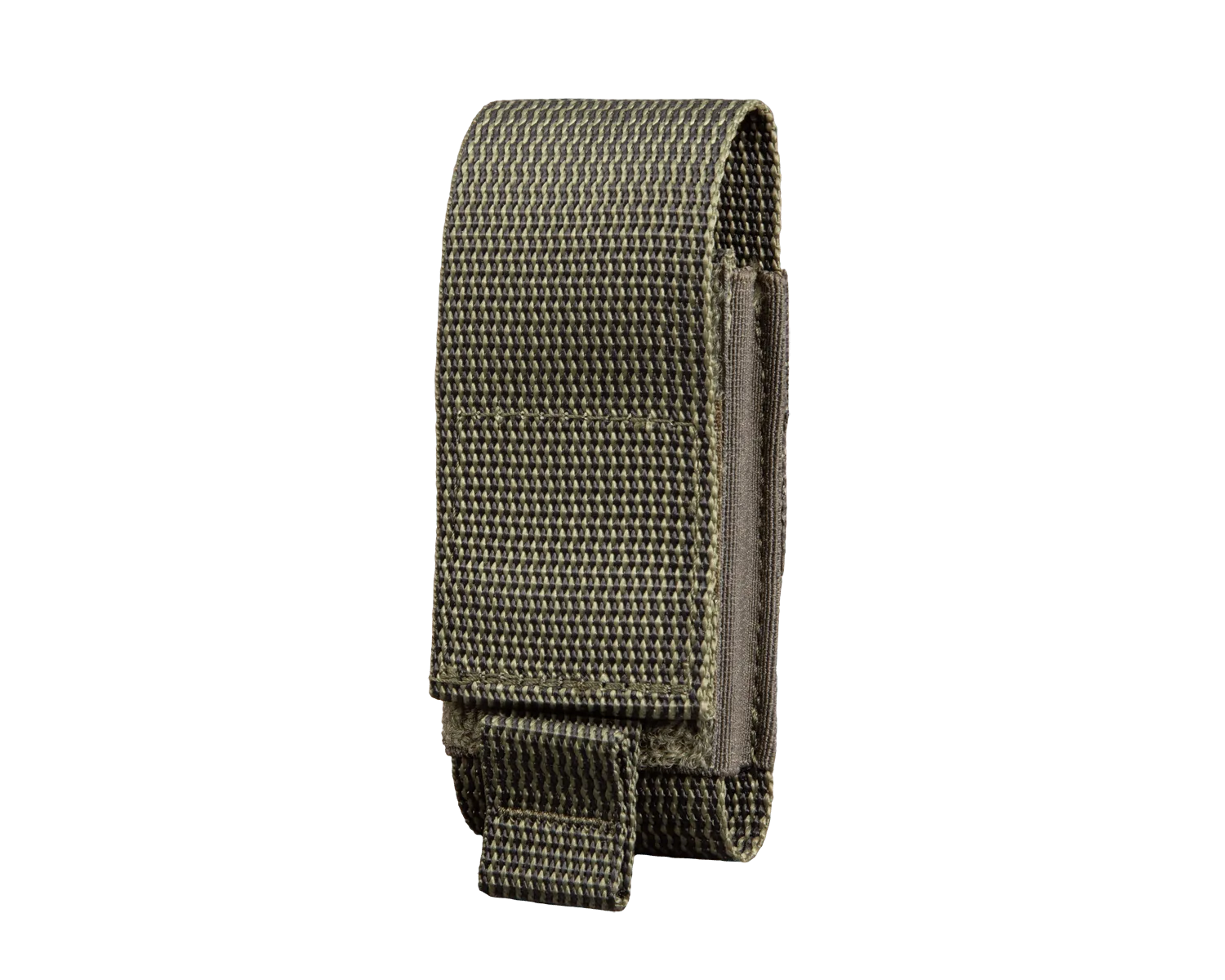
Multitool pouch
Who this pouch suits
Best for
- Carrying a medium-size multitool on a 45–50 mm belt or a PALS-equipped pack
- Users who want one pouch that can move between belt and pack mounting
Not for
- Belts narrower than 45 mm or wider than 50 mm if you plan to use the belt loop
- Multitools larger than the listed medium-size models without first testing fit