The claim that musical toys are just noise
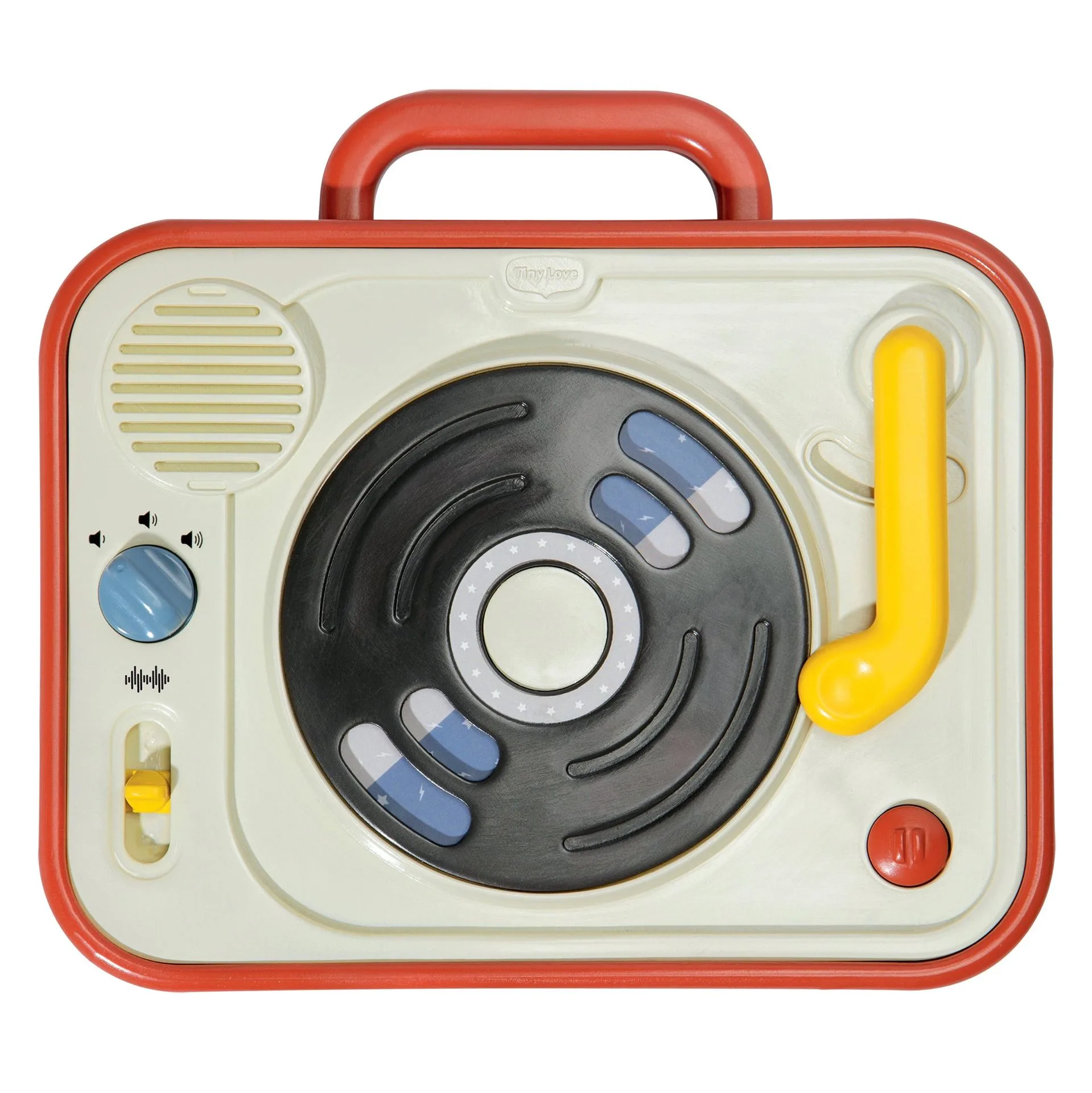
A common worry is that a musical toy only entertains. The Tiny Rockers DJ Station is a useful test case because its play pattern is built around cause and effect, not passive listening. The responsive tune switch arm changes between 13 original rock 'n' roll melodies, and the sound switch slider lets a child explore sound, pitch, and rhythm. Spinning the peek-a-boo record reveals colorful patterns underneath.
That does not prove a developmental outcome, and the supplied record makes no such guarantee. What it does show is a toy designed around motor skills, senses, creativity, and cognition, with each element tied to a specific action. Whether your child uses it that way depends on age, interest, and how you play together.
What the DJ Station actually lets a child do
These are the supplied play features, not inferred benefits.
- Switch melodies: The responsive tune switch arm switches between 13 original rock 'n' roll melodies.
- Explore pitch and rhythm: The sound switch slider lets a child explore sound, pitch, and rhythm.
- Spin and discover: The peek-a-boo record spins to reveal colorful patterns underneath.
The claim that musical toys help development in a measurable way
Parents often ask whether musical toys help development. The honest answer is that the supplied product information describes intended play, not measured outcomes. Tiny Love states that each element of the DJ Station is designed to develop motor skills, senses, creativity, and cognition. That is a design intention, not a research result, and it should not be read as a promise of milestones.
A more useful question is whether the toy creates repeated, hands-on actions a child can control. The DJ Station does: switching, sliding, and spinning are all cause-and-effect moves. If you want to support development, treat the toy as one input among many and watch what your child actually does with it.
The claim that all musical toys are too loud
Baby toy volume safety is a fair concern, but it cannot be settled by a general rule. The supplied record for the Tiny Rockers DJ Station does not include volume levels, a volume control specification, or sound-level guidance. That means you should not assume a specific maximum volume, and you should not treat this article as a substitute for the packaging or manufacturer instructions.
What you can do is check the toy yourself before handing it over. Listen at the distance your child will use it, test the melodies and slider at their highest setting, and keep the toy away from your child's ear during play. If the supplied information does not confirm a volume control, verify that on the product or packaging rather than guessing.
Product facts behind these claims
-
TINY ROCKER DJ STATION TOY: The Tiny Rockers DJ Station is described as a toy for toddlers and kids, with a responsive tune switch arm that switches between 13 original rock 'n' roll melodies. It supports the cause-and-effect claim and shows the toy's intended audience, without extending it to newborns.
TINY ROCKER DJ STATION TOY
-
TINY ROCKER DJ STATION TOY: The sound switch slider lets a child explore sound, pitch, and rhythm, and the peek-a-boo record spins to reveal colorful patterns underneath. These are concrete play actions, which is stronger evidence than a general claim that music is good for babies.
-
TINY ROCKER DJ STATION TOY: The supplied record states that each element is designed to develop motor skills, senses, creativity, and cognition. It is a design intention, not a measured outcome, so it should be presented as such.
The claim that musical toys overstimulate babies
Musical toy overstimulation is real for some children, but it is not a fixed property of every musical toy. The DJ Station combines melodies, a slider, and a spinning record, which gives you several ways to moderate the experience. You can start with one feature at a time, such as the tune switch arm, and add the slider or record later.
The supplied record does not include a volume setting, a timer, or a calming mode, so do not rely on the toy to regulate itself. Watch your child's cues and put the toy away when interest fades or play becomes agitated. That is general parenting judgment, not a manufacturer instruction.
The claim that screen-free musical toys are automatically better
Screen-free musical toys for babies can offer hands-on play, but screen-free is not a guarantee of quality. The DJ Station has no screen in the supplied description, and its play is physical: switching, sliding, and spinning. That is a meaningful difference from a passive video, but it still depends on how the toy is used.
The record also describes the Tiny Rockers collection as harmonizing music, development, bonding, and fun, with popular lullabies given a rock 'n' roll twist and exclusive melodies composed for the collection. That is a brand description, not an independent finding. Use it to understand the toy's intent, not as proof of an outcome.
What the supplied information does not confirm
The record does not list a minimum or maximum age in months, materials, care instructions, battery requirements, or safety certifications. It also does not confirm a volume limit or a volume control. If any of these matter for your child, check the packaging or ask the retailer before buying.
Absence from this record is not proof that the product lacks a feature. It simply means the supplied information does not establish it. That distinction matters when you are comparing toys or deciding whether the DJ Station fits your child's current stage.