A shaped punch set built for repeatable novelty blanks
A mustache blank cutter solves a specific bench problem: you want a row of matching novelty shapes for pendants, charms or mixed-media pieces, and you want them to come off the bench the same every time. The Novelty Blank Cutter — Mustache set does that with four hardened, tempered carbon tool steel punches and a 76 mm die block, so the shape is set by the tool rather than by your sawing hand.
This is a how-to for getting clean blanks from sheet metal. It covers what the set contains, how to prepare the metal, and the strike habits that matter most on the smallest punch.
What the mustache blank cutter includes
-
Novelty Blank Cutter — Mustache, 4 Steel Punches, 5-25 mm, Jewellery Making Set: Four mustache punches in sizes 5.55 × 13.8 mm, 6.82 × 16.9 mm, 8.43 × 20.87 mm and 10.22 × 24.87 mm. You get a graduated family of shapes from one set, so a batch of charms can share a motif at different scales.
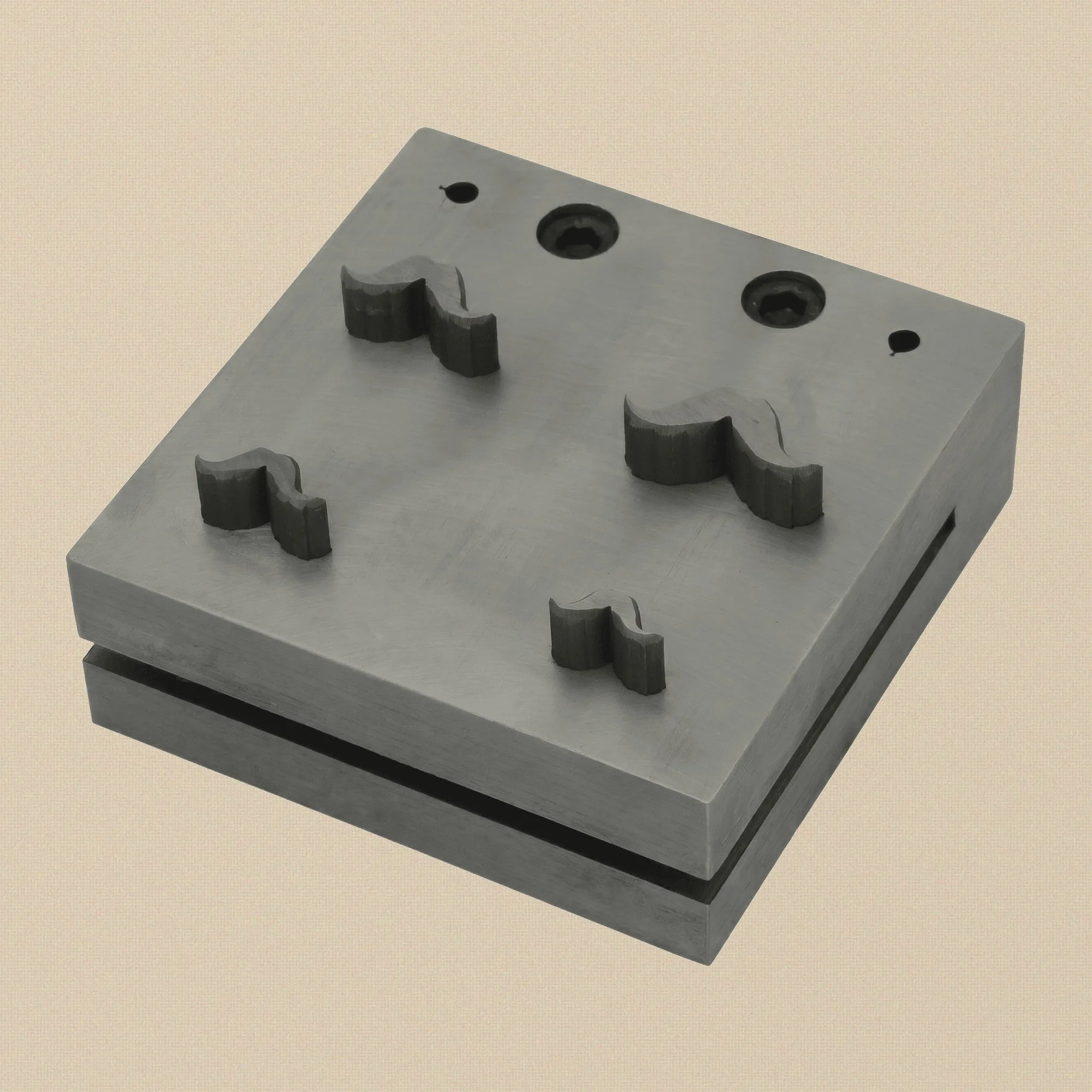
Novelty Blank Cutter — Mustache, 4 Steel Punches, 5-25 mm, Jewellery Making Set
-
Novelty Blank Cutter — Mustache, 4 Steel Punches, 5-25 mm, Jewellery Making Set: Die block and punches are machined from hardened and tempered carbon tool steel, with a solid 76 mm × 76 mm (3" × 3") block. The block gives a steady platform for the hammer, which helps keep the punch square to the sheet.
Cutting a mustache blank: a bench routine
The supplied instructions are short but specific: anneal the metal, keep it to 18 gauge (1.02 mm) or thinner, and use a cutting lubricant. The smallest punch especially rewards careful, square strikes. Work through these steps in order.
- Anneal the sheet: Anneal your silver, copper or brass before punching. Soft metal flows under the punch instead of cracking, and the blank comes out cleaner.
- Check the gauge: Keep the sheet to 18 gauge (1.02 mm) or thinner. The set is intended for soft metals up to that thickness; thicker stock is outside the supplied guidance.
- Set the block on a steady surface: Place the 76 mm die block on a firm, level bench surface. The block is the cutting base, so any rock or bounce under it shows up in the cut.
- Lubricate the cut: Apply a cutting lubricant to the punch and the sheet. This reduces friction and helps the punch release cleanly.
- Align the punch and strike square: Seat the punch upright in the block over the sheet and strike squarely. The smallest punch is the least forgiving, so slow down and check alignment before each strike.
- Repeat for matching pieces: Because the shape is fixed by the punch, successive blanks match across the batch. That consistency is the main reason to use a shaped punch set rather than sawing each shape by hand.
Why the smallest punch needs the most care
The 5.55 × 13.8 mm punch has the least cutting edge and the least room for error. A strike that is slightly off-square concentrates force on one side of the punch, which is where you see rolled edges or a blank that will not sit flat. The supplied guidance singles out this punch for careful, square strikes, and that is the habit to build first.
On the larger punches, the same routine applies but the tool is more forgiving. If you are new to the set, cut a few blanks with the 10.22 × 24.87 mm punch to learn the feel of the block and hammer before moving down to the smallest size.
Metal compatibility at a glance
- Novelty Blank Cutter — Mustache, 4 Steel Punches, 5-25 mm, Jewellery Making Set: Suitable for soft metals up to 18 gauge (1.02 mm) like silver, copper and brass. These are the standard jewellery bench metals, so the set fits the sheet you already keep on hand.
- Novelty Blank Cutter — Mustache, 4 Steel Punches, 5-25 mm, Jewellery Making Set: Cuts four distinct mustache shapes from non-ferrous sheet metal. Non-ferrous is the material boundary; ferrous sheet is not part of the supplied compatibility guidance.
Where these blanks go after cutting
The supplied product information describes the blanks as novelty pendants and charms, embellishments for models, and details for mixed-media pieces. That is a useful range for gift making because the same four sizes can serve different projects.
- Novelty pendants and charms: A mustache blank is a ready-made focal shape. Drill or punch a hanging point and it becomes a pendant or a charm without sawing or filing the outline.
- Embellishments for models: Small metal shapes add detail to scale models and mixed-media scenes where a flat, consistent motif is wanted.
- Mixed-media details: The four sizes let you layer the same motif at different scales in one piece, which is hard to do consistently by hand.
What the supplied information does not cover
The supplied record does not include hammer weight, striking force, number of strikes, or a recommended lubricant type. Treat those as bench decisions rather than manufacturer instructions, and start with light, square strikes until you know how the metal responds.
The record also does not describe sharpening or reconditioning the punches. If a punch stops cutting cleanly, the supplied evidence does not give a service procedure, so avoid guessing at a fix that could damage the hardened steel.