The goal: build a complete tiny tale
Nanofictionary is a storytelling card game for 3 to 6 players, ages 8 to adult. Each player works toward a complete story made of four elements: a Character, a Setting, a Problem, and a Resolution. You collect these cards, trade for the ones you still need, and then tell your story aloud. After everyone has told a tale, the group votes on the best-told story.
The game also works as a creative writing prompt: draw a random set of story elements and use them as a starting point for writing. The supplied description notes that play builds public speaking skills and develops comprehension.
How to play Nanofictionary: setup and round flow
The exact dealing procedure and turn order are not specified in the supplied product information, so use the rules included with your copy for those details. The general flow below follows the game's described structure.
- 1. Gather 3 to 6 players: Nanofictionary supports 3 to 6 players. With fewer players, you may need to adjust the trading dynamic; the supplied information does not give a two-player variant.
- 2. Collect story elements: Each player builds a hand of cards representing Characters, Settings, Problems, and Resolutions. Your goal is to hold one of each type to form a complete story.
- 3. Trade for missing pieces: Trade cards with other players to fill gaps in your story. The supplied description says you trade for new story elements until you have a great yarn to tell.
- 4. Tell your tale: Once you have all four elements, tell your story aloud using the cards you collected. The game is designed to build public speaking skills, so the telling is part of play, not a separate step.
- 5. Vote on the best story: After the stories are told, players vote on the best-told story. The supplied information does not specify a tie-breaking method or scoring; check your included rules for those details.
Nanofictionary at a glance
-
Nanofictionary: 3-6 Players | 15-20 min | Ages 8-Adult Confirms the supported player count, age range, and the publisher's stated play time so you can judge whether it fits your group.
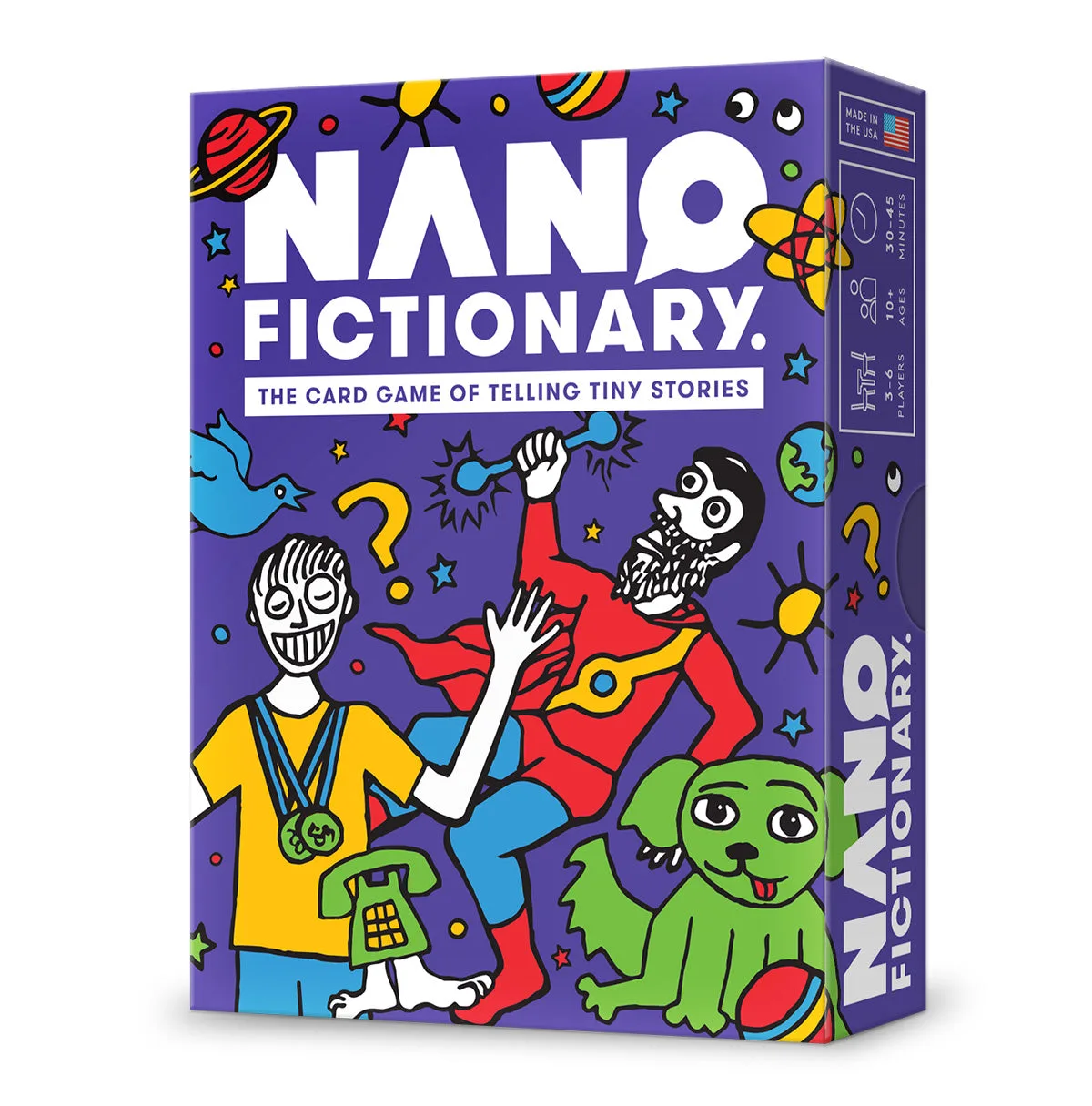
Nanofictionary
-
Nanofictionary: Tell your own tiny tale by collecting all the elements of a complete story--Characters, Settings, Problems, and Resolutions. This is the core loop: your hand must contain one of each element type before you can tell a complete story.
-
Nanofictionary: Trade for new story elements until you’ve got a great yarn to tell, then vote on the best told story. Trading is the main interaction during play, and voting determines the winner after the stories are told.
Using Nanofictionary as a writing prompt
The same deck doubles as a writing tool. Instead of playing a full game, draw a random set of story elements—a Character, a Setting, a Problem, and a Resolution—and use them as a creative writing prompt. This works for solo writing or for a classroom or group exercise. The supplied description does not give a specific procedure for the writing-prompt variant, so treat it as a flexible starting point rather than a formal mode.
What the supplied information does not cover
The product record gives the game's structure and goals but omits some procedural details. The following points are not confirmed by the supplied information; check the rules included with your copy before your first game.
- Exact card counts and deck composition: The supplied record does not list how many Character, Setting, Problem, or Resolution cards are included.
- Dealing and hand size: The number of cards each player starts with is not specified.
- Turn order and trading rules: The supplied description says you trade for new story elements but does not define how trades are initiated or limited.
- Voting and tie-breaking: The record says players vote on the best-told story but does not describe the voting method or how ties are resolved.
Who Nanofictionary suits
Nanofictionary fits groups of 3 to 6 who enjoy telling stories aloud and light trading. The 8-adult age range and the supplied note that play builds public speaking skills and comprehension make it a reasonable choice for family game nights or classrooms where speaking and listening are part of the goal. Because the game depends on storytelling and voting, groups that prefer purely mechanical card play may find it less satisfying. The supplied information does not include care instructions, safety warnings, or compatibility notes, so check the packaging for any warnings before play.