What the Nature Kaleidoscope Set Offers
The KiwiCo Nature Kaleidoscope Set is a hands-on kit that lets kids build their own kaleidoscope and explore how light and reflection create colorful patterns. Instead of just looking through a toy, children assemble the tube, adjust mirror panels, and choose what to place in the display dish. This turns a classic visual experience into a small science experiment about light, symmetry, and color mixing.
Because the kit is designed for open-ended exploration, it fits well with preschool STEM activities or a rainy afternoon of hands-on learning. The focus is on discovery, not instructions, so kids can experiment freely with different objects and angles.
Build and Adjust the Kaleidoscope
Start by assembling the kaleidoscope tube according to the kit's directions. The key feature is the adjustable mirror panels inside the tube. These panels let you change the reflection angles, which directly affects the patterns you see.
After building, test the kaleidoscope with the tube empty. Look through the eyepiece and slowly rotate the mirror panels. Notice how the view changes. This step helps kids understand that the mirrors are creating the repeating patterns, not the objects themselves.
- Assemble the tube: Follow the kit's build steps to create the kaleidoscope body. Make sure the mirror panels are placed correctly so they can be adjusted later.
- Test reflection angles: Before adding anything to the display dish, look through the tube and turn the mirror adjustment ring. Observe how the pattern changes with each angle.
What the Kit Provides for Light Experiments
-
Nature Kaleidoscope Set | KiwiCo: Build the tube with adjustable mirror panels that allow you to experiment with reflection angles, then arrange (and swap out!) whatever you want in the display dish. The adjustable mirrors are the core of the light experiment. They let kids see how changing the angle of reflection alters the pattern, which is a direct lesson in how light behaves.
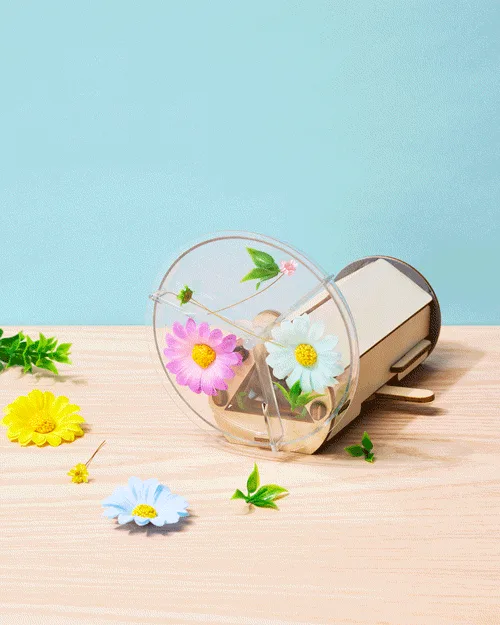
Nature Kaleidoscope Set | KiwiCo
Color Mixing Activities with the Kaleidoscope
Once the kaleidoscope is built, the real fun begins. The display dish is designed to hold small objects, and swapping them out changes the colors and patterns you see. This is a simple but effective way to explore color mixing.
Try these activities to turn the kaleidoscope into a color mixing lab. No special materials are needed; just use what you already have at home.
- Use colored paper or translucent items: Place small pieces of red, blue, and yellow paper or cellophane in the dish. Look through the kaleidoscope and see how the colors combine. Then try overlapping two colors to see a new one appear.
- Swap in natural objects: Collect leaves, flower petals, or small pebbles. Arrange them in the dish and observe the patterns. Natural items have varied colors and textures that create unique kaleidoscope views.
- Create a rainbow sequence: Arrange items in the dish in a rainbow order (red, orange, yellow, green, blue, purple). Look through the kaleidoscope and rotate the mirror panels to see how the pattern repeats and blends.
What to Keep in Mind
The Nature Kaleidoscope Set is designed for exploration, not for producing a specific result. The catalog confirms that you can 'arrange (and swap out!) whatever you want in the display dish,' which means the experiments are limited only by your imagination. However, the kit does not come with pre-printed instructions for specific light experiments beyond building the kaleidoscope. The learning happens through trial, observation, and discussion.
Because the mirrors are adjustable, children may need help understanding that the patterns are created by reflection, not by the objects themselves. A simple explanation like 'the mirrors bounce the light and make the same object look like many copies' can go a long way.