What the 28mm f/1.4E ED is built for
The Nikon AF-S 28mm f/1.4E ED is an FX-format AF-S Nikkor prime with a bright f/1.4 maximum aperture. On a DX body it behaves as a wider-than-normal lens, which is why DX shooters often ask whether it makes sense as a fast wide prime. The supplied record describes high-contrast images of distant subjects or low-light scenes without stopping down, well-controlled distortion, and minimised axial chromatic aberration and colour dispersion. Those are the qualities to weigh when you are deciding whether this Nikon F mount fast prime earns a place in a DX kit.
Catalog facts that shape the decision
-
Nikon AF-S 28mm f/1.4E ED Lens: FX-format AF-S Nikkor 28mm f/1.4 ED prime lens This tells you the lens is designed for the FX format, so on a DX body you are using the central part of the image circle rather than the full frame.
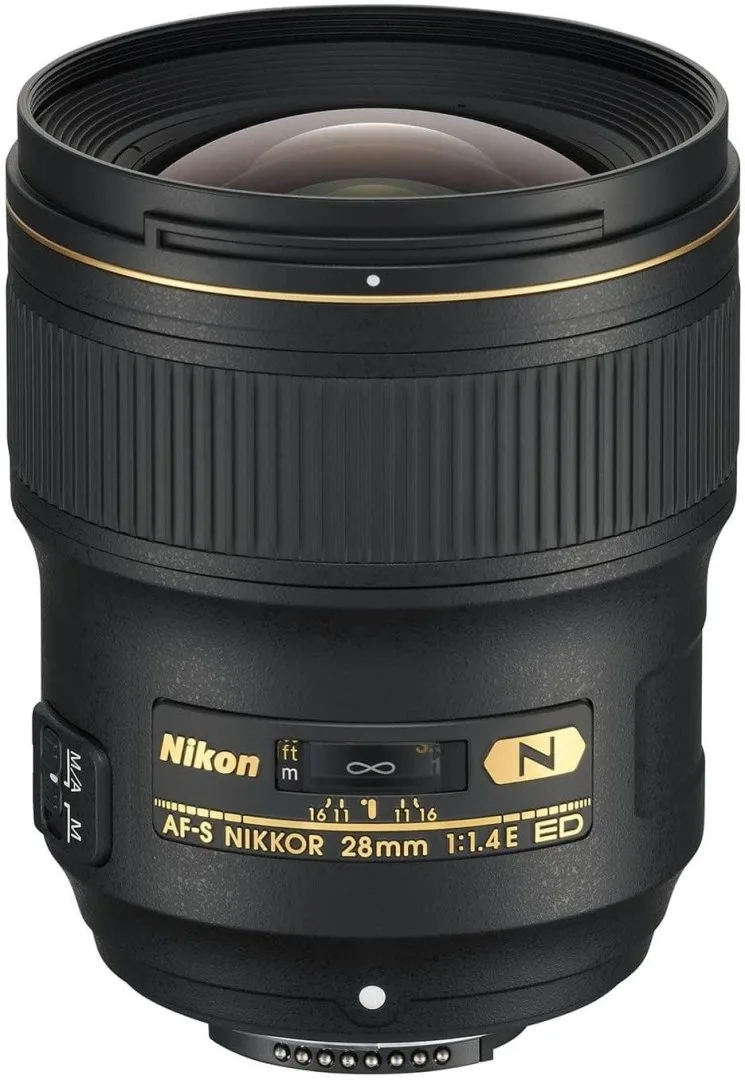
Nikon AF-S 28mm f/1.4E ED Lens
-
Nikon AF-S 28mm f/1.4E ED Lens: Aperture range from f/1.4 to f/16 The f/1.4 maximum is the main reason to consider this lens for low light and shallow depth of field; the record does not give a DX-specific equivalent aperture.
-
Nikon AF-S 28mm f/1.4E ED Lens: Minimum focus distance of 0.28 m This is the closest focusing distance stated in the supplied record, useful for tight framing and near-subject work on a DX body.
-
Nikon AF-S 28mm f/1.4E ED Lens: 14 lens elements in 11 groups, including two ED elements and three aspherical elements These elements are the supplied explanation for crisp images and the control of chromatic aberration and distortion.
-
Nikon AF-S 28mm f/1.4E ED Lens: Nano Crystal Coat and fluorine coating on lens elements The record links Nano Crystal Coat to reduced ghosting and flare in backlit or multi-light scenes, and fluorine coating to repelling water, dust and dirt.
-
Nikon AF-S 28mm f/1.4E ED Lens: 9 diaphragm blades for a rounded diaphragm opening The supplied record says this supports smooth bokeh, which matters if you want subject separation at wider apertures.
DX compatibility and framing questions
Does the Nikon AF-S 28mm f/1.4E ED work on a DX body?
The supplied record identifies it as an FX-format AF-S Nikkor lens, not a DX-only lens. The record does not list specific DX camera models, so check your own body's compatibility before ordering. What the record does confirm is the FX-format design and the f/1.4 to f/16 aperture range.
What does a 28mm prime on Nikon DX actually give you?
On a DX body the lens uses the central portion of its FX image circle, so you see a narrower field of view than on an FX body. The supplied record does not give a crop factor or an exact equivalent focal length, so treat any specific DX-equivalent figure as something to confirm rather than a catalog fact. The practical point is that this is a wide prime on FX and a less wide, faster-feeling prime on DX.
Is this a good DX body wide angle prime for interiors and landscapes?
The record describes high-contrast images of distant subjects and low-light scenes, exceptionally well-controlled distortion, and a 0.28 m minimum focus distance. Those traits suit wide environmental work. The record does not provide a DX-specific angle of view, so judge the framing on your own body rather than relying on an equivalent figure.
Low light, bokeh and optical questions
How useful is f/1.4 on a DX body?
The record says the lens offers high-contrast images of low-light scenes without needing to stop down, and that point light sources are reproduced with minimal flare even at the widest aperture of f/1.4. That is the supplied case for the fast aperture. The record does not give a DX-specific low-light measurement, so the benefit is described in general terms rather than as a tested figure.
What kind of bokeh does the 28mm f/1.4E ED produce?
The supplied care and compatibility evidence says the intensity of bokeh transitions smoothly as distance from the sharply focused point increases, with no rough edges or double lining. The 9-blade diaphragm is described as supporting a rounded opening for smooth bokeh. Those are the record's own words; it does not give a numerical bokeh rating.
Does the lens control distortion and chromatic aberration?
Yes, according to the supplied record: distortion is described as exceptionally well controlled, and axial chromatic aberration and colour dispersion as effectively minimised. The two ED elements and three aspherical elements are the stated design reasons. The record does not provide measured distortion percentages or aberration charts.
How does the Nano Crystal Coat help on a DX body?
The record says Nano Crystal Coat reduces ghosting and flare for greater image clarity, including backlit situations and scenes with numerous direct light sources in the frame. That benefit is about the light reaching the lens, not about the sensor size, so it applies on DX as well. No transmission or flare measurements are supplied.
Autofocus, handling and weather questions
How does the autofocus work, and can I focus manually?
The record lists Nikon's Silent Wave Motor (SWM) for ultra-fast, ultra-quiet autofocus with seamless manual override, plus a dedicated focus ring for precise manual focusing. It does not state focus speed in milliseconds or list specific camera bodies, so confirm body-level behaviour with your own setup.
Is the lens weather-sealed?
The supplied record describes a robust dust- and drip-resistant build, a weather-resistant design that prevents dust and water droplets from damaging the lens, and a fluorine coating that repels water, dust and dirt. It does not claim full waterproofing, so treat it as resistance rather than a guarantee against immersion.
Is it heavy or bulky for a DX body?
The record calls the build compact and lightweight and says it ensures stress-free portability. It does not give a weight in grams or a physical length, so compare the actual lens against your body and bag rather than relying on a number from this record.
Buying and specification questions
What is included with the lens in this listing?
The supplied catalog facts state: in stock, order now, 1 year warranty, free UK delivery, brand new stock. The record does not list box contents such as hood, caps or case, so check the listing details if those items matter to you.
What does the supplied information not confirm?
The record does not provide a DX-specific angle of view, a crop-factor equivalent focal length, a weight, dimensions, filter thread size, minimum aperture at a given focal setting beyond f/16, or a list of compatible camera bodies. It also does not confirm image stabilisation. Where those details matter, treat them as unconfirmed rather than assuming a feature is present or absent.
Is the 28mm f/1.4E ED a sensible Nikon F mount fast prime for a DX kit?
The record supports it as an FX-format f/1.4 prime with well-controlled distortion, smooth bokeh transitions, SWM autofocus and a dust- and drip-resistant build. Whether it suits your DX kit depends on the framing you want, which the record does not translate into a DX field of view. Use the supplied optical and handling facts as your evidence, and confirm the DX framing on your own body before you commit.