Two Nikonos primes, one underwater kit
If you shoot film underwater with a Nikonos, the UW 20mm f/2.8 and UW 28mm f/3.5 are two classic wide-angle primes. The 20mm gives you a noticeably wider view and a faster aperture, while the 28mm is a more compact, lighter option that still covers a useful angle. Choosing between them usually comes down to how much of the scene you want in the frame and how much light you expect to have.
Both lenses are designed for the Nikonos underwater system, but they are not interchangeable in the way modern zoom lenses are. You pick one for a dive, mount it, and work with that angle until you surface. That makes the decision more deliberate, and condition matters as much as the spec sheet.
UW 20mm f/2.8 vs UW 28mm f/3.5 at a glance
The two lenses are often sold together as a kit, which is exactly what the used set at CameraMall includes. Here is how they compare on the traits that matter most underwater.
- Angle of view: The 20mm is significantly wider, making it the better choice for close-focus wide shots, wrecks, and reef scenes where you want to include more of the environment. The 28mm is tighter, which can help isolate a subject and reduce background clutter.
- Maximum aperture: The 20mm opens to f/2.8, giving you a full stop more light than the 28mm's f/3.5. That extra speed helps in low-light or overcast conditions, but both lenses are typically used stopped down for depth of field.
- Size and handling: The 28mm is a more compact lens, which can be easier to manage in tight spaces or when you are carrying a backup. The 20mm is bulkier but pairs naturally with the included finder for framing.
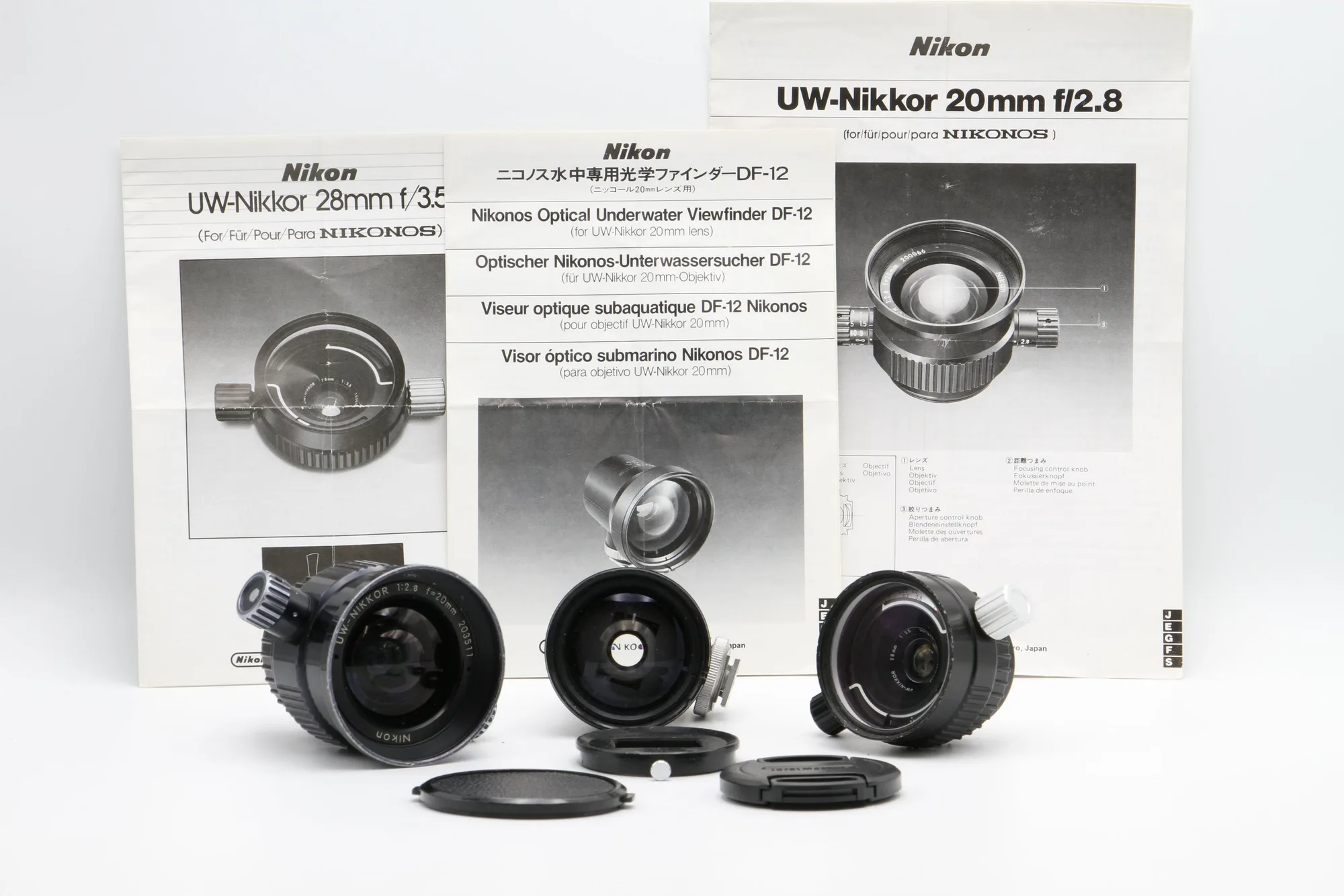
- Viewfinder: The set includes a Nikonos 20mm Finder plus a 28mm mask for that finder, so you can frame both angles without swapping the whole viewfinder. That is a practical bonus if you plan to carry both lenses.
What the used set actually includes
Before you compare specs, know what is in the box. The CameraMall listing for this used set is specific about what you get.
-
USED Nikon Nikonos UW 20mm F2.8 and UW 28mm F3.5 Lenses with Finder: The set includes a Nikonos UW-Nikkor 28mm F3.5 Lens, a Nikonos UW-Nikkor 20mm F2.8 Lens, a Nikonos 20mm Finder, a Nikonos 28mm Mask for the 20mm Finder, and manuals. You are not choosing between two separate purchases; this listing gives you both lenses and the finder hardware in one kit, which is a practical way to cover two angles on a dive.
USED Nikon Nikonos UW 20mm F2.8 and UW 28mm F3.5 Lenses with Finder
-
USED Nikon Nikonos UW 20mm F2.8 and UW 28mm F3.5 Lenses with Finder: The lenses are in working condition, tested and functional, with smooth focus and only minor wear from normal use. Smooth focus is critical for underwater work, where adjustments are harder with gloves and limited visibility. The tested condition gives you a baseline before you commit.
-
USED Nikon Nikonos UW 20mm F2.8 and UW 28mm F3.5 Lenses with Finder: Minor fungus is present on the 20mm lens and the 20mm viewfinder, which may affect the image. Fungus can reduce contrast and sharpness, especially on a wide-angle lens. This is a real trade-off to weigh against the price, and you should inspect sample images if possible.
-
USED Nikon Nikonos UW 20mm F2.8 and UW 28mm F3.5 Lenses with Finder: The integrity of the seals on these lenses cannot be guaranteed. Seals are what keep water out of a Nikonos lens. If they fail, the lens and camera can flood. This is the single most important limitation to verify before you take either lens underwater.
Which lens should you use first?
If you are new to Nikonos, start with the 28mm. Its narrower angle is more forgiving for framing, and it is easier to keep the camera steady. The 20mm is the better choice when you want to get close to a subject and still show the surrounding reef or wreck. Both lenses reward getting physically close, which is the standard technique for underwater wide-angle work.
The faster f/2.8 of the 20mm helps if you shoot in darker water or at depth, but you will still want a strobe or natural light for most shots. Do not treat the extra stop as a substitute for proper lighting.
What to check before you take a used Nikonos lens underwater
A used Nikonos lens is only as good as its seals. Run through these checks before you trust it with a camera body.
- Inspect the seals: The listing states that seal integrity cannot be guaranteed. Examine the O-rings and mating surfaces for cracks, dirt, or deformation. Replace any questionable seals before diving.
- Look for fungus: The 20mm has minor fungus that may affect the image. Shine a light through the lens to see how much it impacts contrast and sharpness, and decide if that is acceptable for your work.
- Test the focus: The listing confirms smooth focus, but you should still cycle the focus ring with the camera in a dry housing or on land to feel for any stiffness or play.
- Check the viewfinder: The 20mm finder also has minor fungus. Make sure the framelines are clear enough for accurate composition, especially since you will be wearing a mask.
The honest trade-off
The main draw of this set is having both focal lengths and the finder hardware in one purchase. The main risk is the seal uncertainty and the fungus on the 20mm. If you are comfortable servicing the seals and can accept the fungus's effect on image quality, this is a cost-effective way to build a two-lens Nikonos kit. If you need pristine optics and guaranteed waterproofing, you would be better off with new or recently serviced lenses.
Either way, treat the condition notes as part of the decision, not a footnote. Underwater gear fails hard when it fails, so a few minutes of inspection can save you a flooded camera.