The LPL decision starts with sensor coverage
If you are shopping for an LPL mount cinema lens, the first question is not bokeh or price. It is whether the lens covers the format you actually shoot. The NiSi T1 PRIME 50mm T1.0 is built for full-frame, VistaVision and large-format cinema cameras, and NiSi states it fully covers Open Gate on the FUJIFILM GFX ETERNA 55 and Blackmagic URSA Cine 17K 65, plus 5.1K mode on the ARRI ALEXA 65 and ALEXA 265.
That coverage matters because LPL is often chosen precisely to put a larger sensor behind the lens. If your camera is not on that supplied list, treat coverage as unconfirmed rather than assuming it will work. The lens also performs on widely used full-frame and VistaVision bodies, so it can travel between owner-operator full-frame jobs and high-end large-format shoots without changing the kit.
Coverage and mount evidence for the 50mm T1.0
-
NiSi T1 Series 50mm T1 Full Frame Cinema Lens (LPL Mount): Fully covers Open Gate on the FUJIFILM GFX ETERNA 55 and Blackmagic URSA Cine 17K 65, and supports 5.1K mode on the ARRI ALEXA 65 and ALEXA 265. These are the large-format modes where an LPL lens is most likely to be tested first; if your camera is not listed, confirm coverage before you commit.
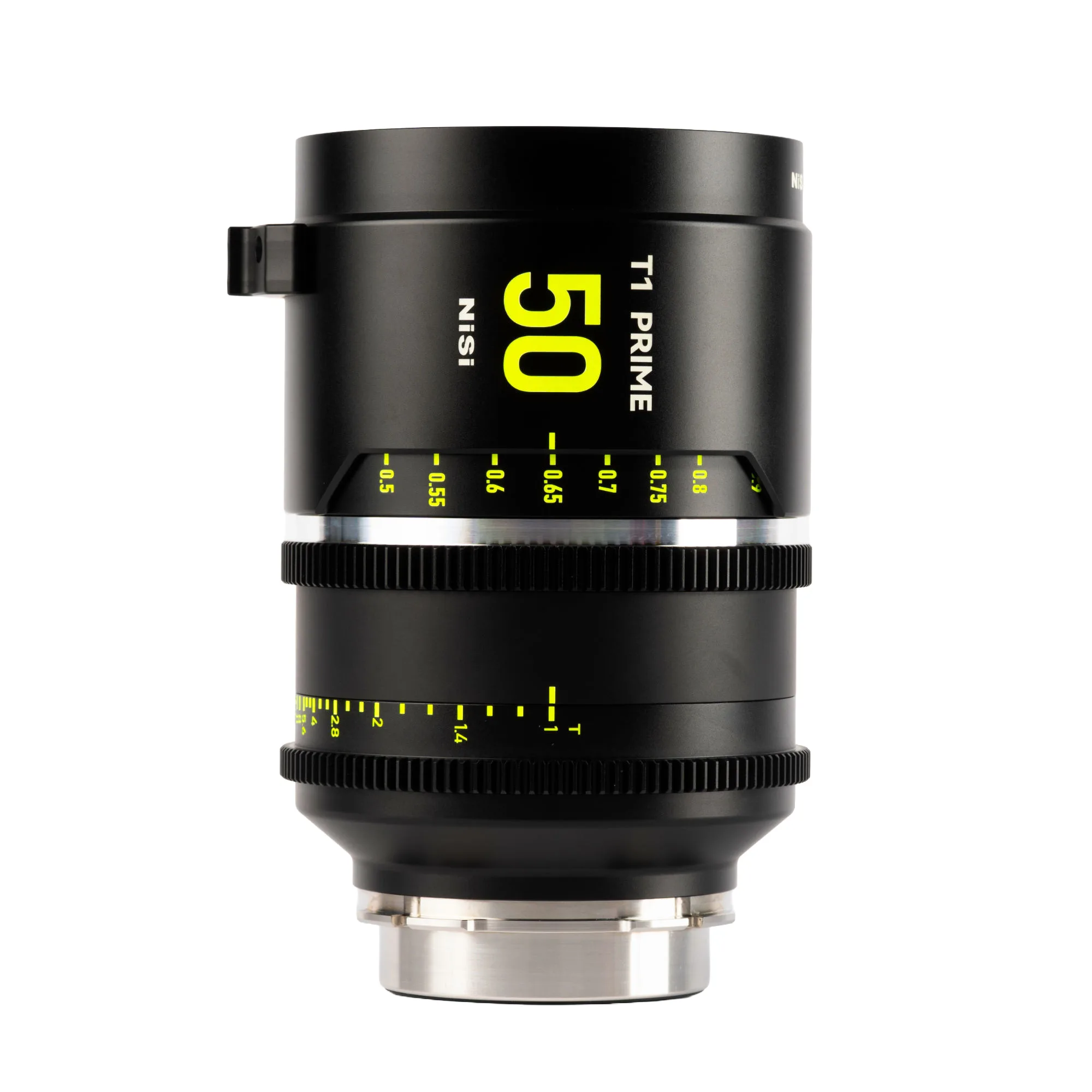
NiSi T1 Series 50mm T1 Full Frame Cinema Lens (LPL Mount)
-
NiSi T1 Series 50mm T1 Full Frame Cinema Lens (LPL Mount): LPL (ARRI) mount, manual focus, T1–T16 aperture range. The mount and iris range define the basic compatibility and exposure envelope you can plan around on set.
What T1.0 actually buys you here
Many fast cine primes ask you to stop down to T2 or T2.8 before the image feels usable. NiSi's claim for this lens is different: at T1.0 it stays clean, sharp and high in contrast, with chromatic aberration controlled across the frame. The company says edge softness and longitudinal colour fringing on high-contrast highlights have been engineered out, so T1.0 becomes a creative choice rather than a technical compromise.
That is the central trade-off to evaluate. A 50mm T1 lens for video gives you ultra-shallow depth of field and dramatic subject separation, but it also makes focus critical. The supplied information does not include measured sharpness charts or test results, so treat the wide-open performance as a manufacturer design goal and test it on your own camera before a paid shoot.
Focus pullers get a real working throw
The focus mechanism was redesigned around focus pullers: a precision cam delivers approximately 180° of throw between 1m and infinity within a generous 300° total rotation. Scale markings are evenly spaced and behave linearly, so repeatable pulls are achievable on follow-focus systems and motorised wireless rigs alike.
The aperture ring is click-less and damped, which supports smooth iris pulls during a take. Close focus is 0.5m (1’8″) with 0.14x maximum magnification, so tight, intimate framings are possible without a diopter. For a 50mm T1.0, that combination is the practical difference between a lens that lives on the camera and one that stays in the case.
Handling and close-focus specifications
- NiSi T1 Series 50mm T1 Full Frame Cinema Lens (LPL Mount): Approximately 180° of focus throw between 1m and infinity within a 300° total rotation; evenly spaced, linear scale markings. This is the focus-puller ergonomics that determine whether consistent pulls are realistic at T1.0.
- NiSi T1 Series 50mm T1 Full Frame Cinema Lens (LPL Mount): Close focus 0.5m (1’8″), maximum magnification 0.14x, 18-blade iris, click-less damped aperture ring. Close focus and a click-less iris expand the shot list you can cover with one prime, especially for emotional close-ups and iris pulls.
The bokeh is a deliberate choice, not a defect
NiSi studied the rendering of legendary vintage cinema primes and deliberately reintroduced a softer, more natural blur into a modern optical formula. Out-of-focus highlights bloom gently rather than snapping into hard discs, and the transition from sharp focus to defocus is described as smooth and three-dimensional. The lens uses a non-aspherical optical philosophy inspired by vintage primes.
If you want the hardest-edged, most clinical bokeh available, this is not that lens. If you want a contemporary lens with a poetic, characterful rendering on large sensors, the supplied material positions it for narrative work, music videos and projects where atmosphere matters as much as resolution. The 16-element design and 18-blade iris are part of that look.
What the 50mm field of view becomes on large format
On modern large-format sensors, NiSi says the 50mm focal length yields a field of view roughly equivalent to a 40mm lens on full-frame, with a depth-of-field character that feels closer to T0.8. That combination evokes classic 65mm and 70mm film: an immersive, slightly wide angle of view paired with shallow, romantic separation.
For 36 x 24 format, the supplied angle of view is 47.6° diagonal, 40.4° horizontal and 27.4° vertical. Those numbers help you compare it with a familiar full-frame 50mm, but the large-format equivalence is the more useful planning figure if you are shooting Open Gate or a 65-style format.
Where the NiSi T1 PRIME 50mm fits against a typical fast prime
- Wide-open usability: NiSi positions T1.0 as usable without stopping down; many fast primes are described as softening and showing chromatic aberration at maximum aperture. Test on your own camera to confirm.
- Bokeh character: A softer, vintage-inspired blur rather than hard-edged, onion-ring textures. Choose it for atmosphere; avoid it if you want clinical separation.
- Focus ergonomics: 300° total rotation with about 180° between 1m and infinity, plus linear markings. This is a focus-puller-friendly design, not a stills-style short-throw lens.
- Format flexibility: Covers specified Open Gate and 5.1K large-format modes and works on full-frame and VistaVision. Coverage outside the supplied list is not confirmed.
- Close focus: 0.5m (1’8″) and 0.14x magnification let you get tighter than many traditional cine primes, which matters for emotional close-ups.
Practical checks before you buy
First, confirm your camera's mount and recording mode against the supplied coverage list. LPL is the only mount listed for this lens, so an adapter is not described in the supplied information; do not assume one will preserve coverage or functionality. Second, budget for the support gear a 50mm T1.0 demands: follow-focus and a solid rig are implied by the focus design, but the supplied material does not list a support requirement.
Third, handle the weight and size question on your own rig. The supplied dimensions are ø95 x 144.8mm with a ø95mm filter size, and weight is listed as excluding front and rear caps but the value is not included in the supplied excerpt. If weight is critical, ask before ordering rather than guessing. Finally, decide whether the vintage-inspired bokeh matches your project. The lens is priced at USD 3,255.26 in the catalog, compared with a catalog comparison price of USD 4,399.00, so the value case rests on the T1.0 performance and large-format coverage rather than on a complete accessory kit.