What Makes a VND/PL Different from a Variable ND?
A standard variable ND (VND) lets you adjust light reduction by rotating the filter. It cuts exposure but does nothing to manage reflections or glare. A combined VND and polarizer (VND/PL) adds the ability to reduce non-metallic reflections from water, glass, and foliage while also controlling exposure.
The key difference is independent control: with a VND/PL like the NiSi True Color VND/PL Pro Nano, you can adjust density and polarization separately. Changing one does not affect the other, which is not the case with some stacked or hybrid designs.
Independent Control: The Core Advantage
-
NiSi 82mm True Color VND/PL Pro Nano 1-5 Stops (0.3-1.5) Variable ND and Polarizer: Independent VND & PL Control – Adjust density and polarization separately for full creative flexibility, so changing one never disturbs the other. This means you can dial in exactly the amount of glare control a scene needs without resetting your exposure. It saves time and avoids guesswork, especially when light is changing.
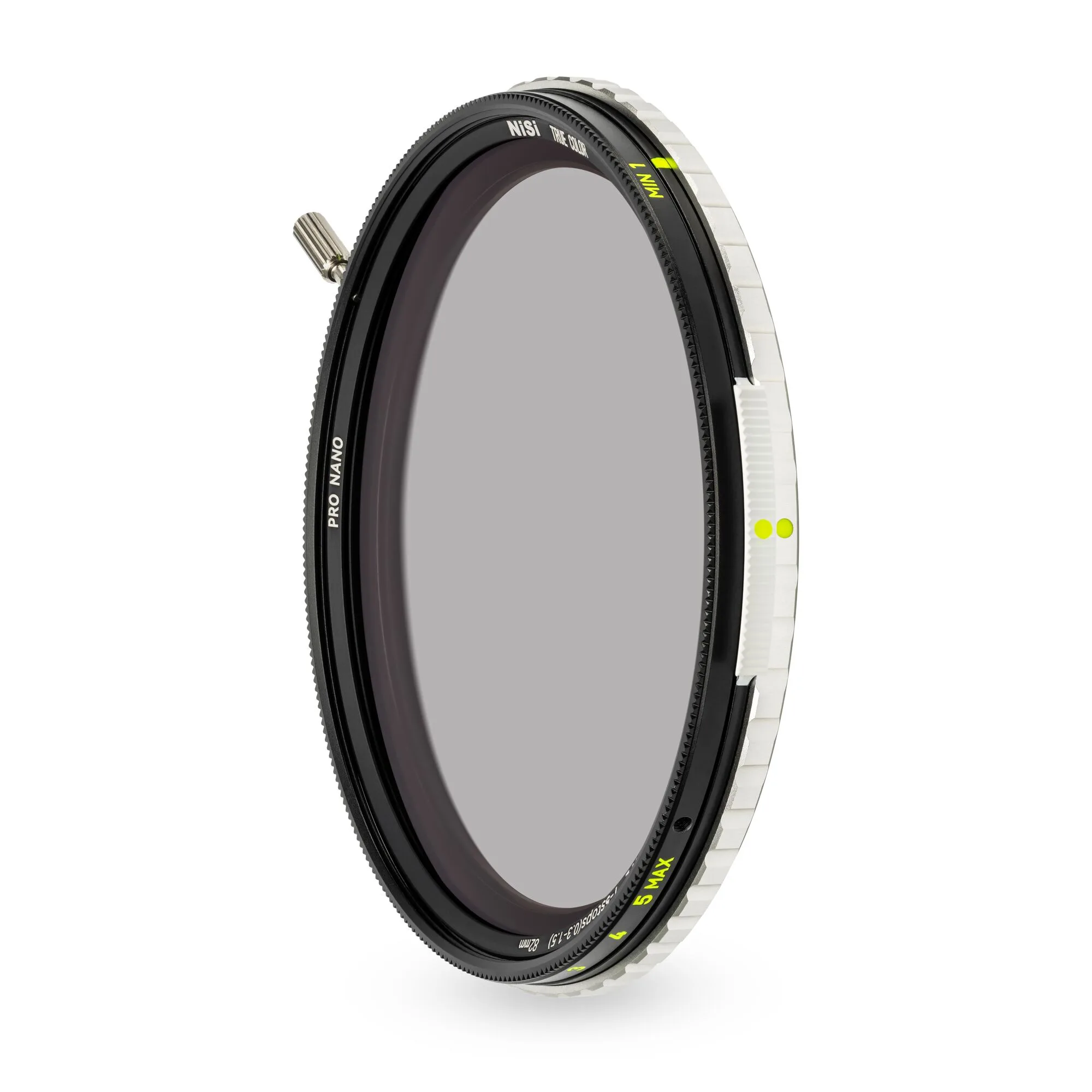
NiSi 82mm True Color VND/PL Pro Nano 1-5 Stops (0.3-1.5) Variable ND and Polarizer
-
NiSi 82mm True Color VND/PL Pro Nano 1-5 Stops (0.3-1.5) Variable ND and Polarizer: Unlike many other PL filters, it produces no magenta tint or warm color cast, preserving consistent tones whether you are shooting RAW stills or LOG video. Color accuracy is a priority for many photographers and videographers. A VND/PL that avoids color casts means less correction in post and more confidence in the look you capture on set.
Practical Trade-offs of a Combined Filter
A combined VND/PL replaces two filters with one, reducing the gear you carry and the time you spend stacking and unstacking. The NiSi True Color VND/PL uses an ultra-slim metal frame that minimizes vignetting even on ultra-wide lenses like a 15mm full-frame.
However, there is a limitation: at high density settings (4–5 stops), adjusting the polarizer can lead to overly saturated colors. The manufacturer advises avoiding polarization adjustments at those settings. This is a trade-off for the convenience of a single filter.
Also, the filter is recommended for focal lengths of 35mm and longer. On wider lenses, polarization cannot be even across the entire frame, so the combined filter may not suit every shot.
Key Specifications at a Glance
- NiSi 82mm True Color VND/PL Pro Nano 1-5 Stops (0.3-1.5) Variable ND and Polarizer: Cut 1 to 5 stops of light (0.3–1.5) and dial in exactly the amount of glare control a scene needs, without one adjustment undoing the other. The range covers most daylight scenarios, from slightly overcast to bright sun. The independent control is what sets it apart from a standard VND.
- NiSi 82mm True Color VND/PL Pro Nano 1-5 Stops (0.3-1.5) Variable ND and Polarizer: True Color Technology – Delivers natural, true-to-life colors without unwanted color casts. Combined filters often introduce a warm or magenta tint. True Color Technology aims to preserve neutral tones, which is especially valuable for video work where color grading is critical.
- NiSi 82mm True Color VND/PL Pro Nano 1-5 Stops (0.3-1.5) Variable ND and Polarizer: Built from durable aluminum alloy with a corrosion-resistant finish, and slim enough to prevent vignetting even on ultra-wide lenses like a 15mm full-frame. Durability and slimness matter for field use. A thin profile avoids mechanical vignetting, which can be a problem with stacked filters.
When to Choose a VND/PL Over a Standard Variable ND
If your work frequently involves reflective surfaces—water, glass, wet leaves, car windows—a VND/PL can be a time-saver. You get exposure control and reflection reduction in one movement, without needing to swap filters.
If you rarely need a polarizer, or you shoot with very wide lenses where even polarization is impossible, a standard VND might be a simpler, lighter option. The NiSi True Color VND/PL is not a universal replacement; it is a specialized tool for specific shooting conditions.