The Nomad 13 makes power only while the sun is out
The Nomad 13 is a 13-watt foldable solar panel, not a battery. It does not hold a charge, so it only produces power when exposed to sunlight. That single fact shapes every practical tip below: you either charge a device directly while the panel is in the sun, or you send that power into a power bank and use it later.
The panel measures 10.5 x 24 x 0.25 in unfolded and 10.5 x 9 x 1 in folded, and weighs 1.6 lbs. It is rated 13 watts with an open circuit voltage of 18-22V. Those numbers tell you what kind of jobs it suits: phones, cameras, tablets, headlamps, and other smaller USB devices, plus Goal Zero power packs.
Nomad 13 ports and what each one is for
-
Nomad 13 Solar Panel: USB port: 5V, up to 1A (5W max), regulated This is the port you use to plug a phone or other small USB device directly into the panel.
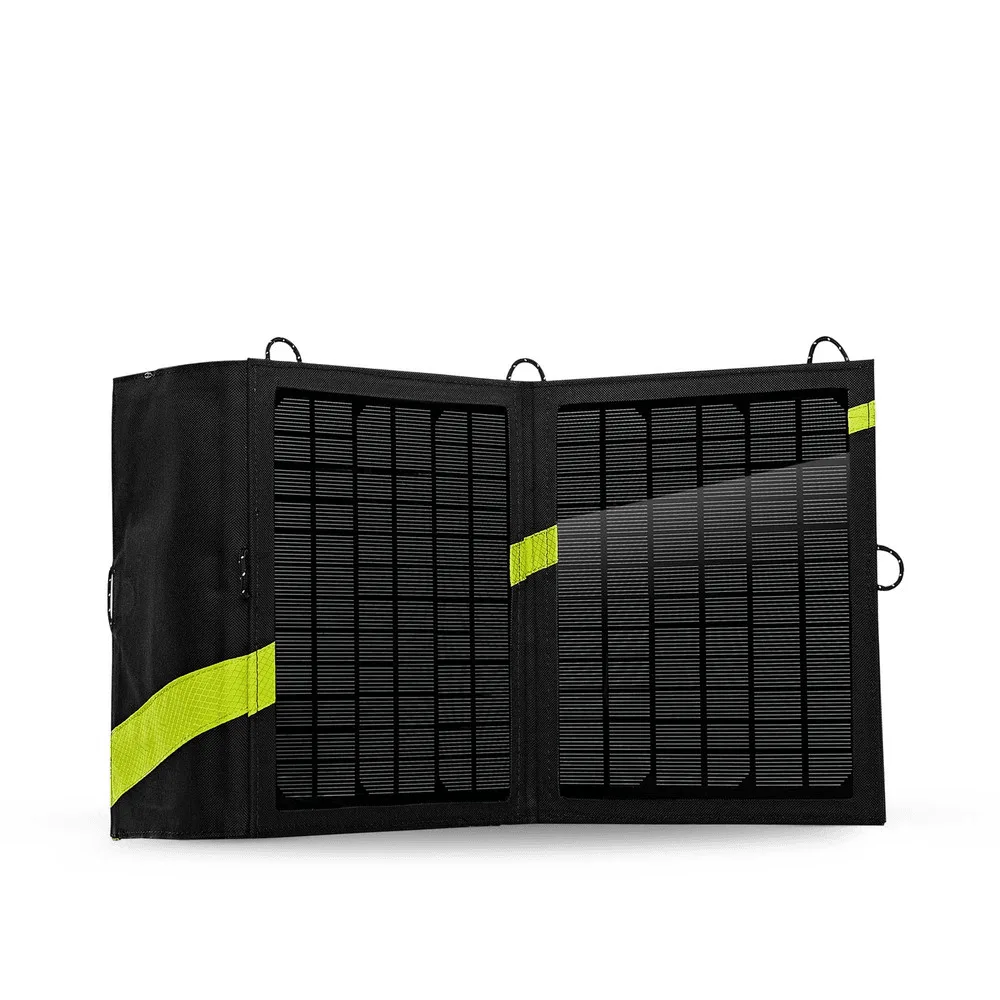
Nomad 13 Solar Panel
-
Nomad 13 Solar Panel: Solar Port (blue, 8mm): 14-22V, up to 0.9A (13W max) This is the higher-power connection for compatible Goal Zero power packs and rechargers.
-
Nomad 13 Solar Panel: Mini Solar Port (2.5mm): 6.5V, up to 1.1A (7W max) A second solar input option for compatible small Goal Zero gear; check your device's own input before assuming it fits.
How to use the Nomad 13: a simple setup routine
The supplied instructions describe two supported paths: plug your phone directly into the panel, or use the panel to recharge a portable recharger for later use. Follow the steps that match your goal.
- Unfold the panel and face it toward the sun: The panel produces power only when exposed to sunlight. Unfold it fully (10.5 x 24 in open) and position it so the face catches direct sun rather than shade.
- Choose your charging path: For immediate charging, connect a phone, camera, tablet, headlamp, or other small USB device to the built-in USB port. For charging later, connect a compatible Goal Zero power bank or power pack to the solar port instead.
- Keep the run time in mind: The panel has no internal battery, so unplugging it stops the charge. If you need power after sunset, the power-bank path is the one that carries the charge forward.
Charging a phone with the Nomad 13
The USB port is regulated at 5V and capped at 1A, or 5W maximum. That is a modest output by wall-charger standards, so treat direct phone charging as a top-up rather than a fast fill. The panel is listed as suitable for phones, cameras, tablets, headlamps, and other smaller USB devices.
Because the panel only works in sunlight, direct phone charging is best planned around a stretch of time outdoors rather than a quick five-minute plug-in. If your phone needs a full charge by evening, the more reliable route in the supplied information is to charge a power bank during the day and charge the phone from that bank later.
How long the Nomad 13 takes to recharge Goal Zero power banks
The supplied charge times give you a realistic planning window. They vary widely because the power bank capacities differ. Use them to choose the right bank for your trip length rather than expecting the panel to fill any bank quickly.
- Flip 10 Power Bank: About 2.5 hours
- Guide 10 Plus Power Bank: About 2.5-5 hours
- Switch 10 Core: About 4 hours
- Flip 20 Power Bank: About 5 hours
- Flip 30 Power Bank: About 6-12 hours
- Yeti 150 Power Station: About 26-52 hours
What the Nomad 13 does not tell you about angle and daisy-chaining
Two topics come up often with folding panels: the best tilt angle and whether you can chain panels together. The supplied information for the Nomad 13 describes it as a foldable and weatherproof panel that is chainable with a built-in USB port, but it does not include a recommended angle, mounting method, or daisy-chain procedure. Rather than guess at a specific tilt or cable sequence, treat those as setup details to confirm against the panel's own documentation before relying on them.
What the supplied record does confirm is the physical footprint: 10.5 x 24 x 0.25 in unfolded and 10.5 x 9 x 1 in folded, at 1.6 lbs. That folded size is small enough to tuck into a pack, and the low weight makes it easy to reposition as the sun moves. Repositioning to follow the sun is general practice, not a manufacturer instruction.
Nomad 13 at a glance
- Nomad 13 Solar Panel: 13-Watt (18-22V) foldable and weatherproof solar panel with monocrystalline cells Sets expectations: a compact panel suited to small devices and power banks, not large appliances.
- Nomad 13 Solar Panel: Weight: 1.6 lbs (726 g); folded dimensions 10.5 x 9 x 1 in (27 x 23 x 2.5 cm) Confirms it is practical to carry and store between charges.
- Nomad 13 Solar Panel: Warranty: 12 months; certifications CE, FCC, ROHS Useful context if you are comparing this panel against other small solar options.